
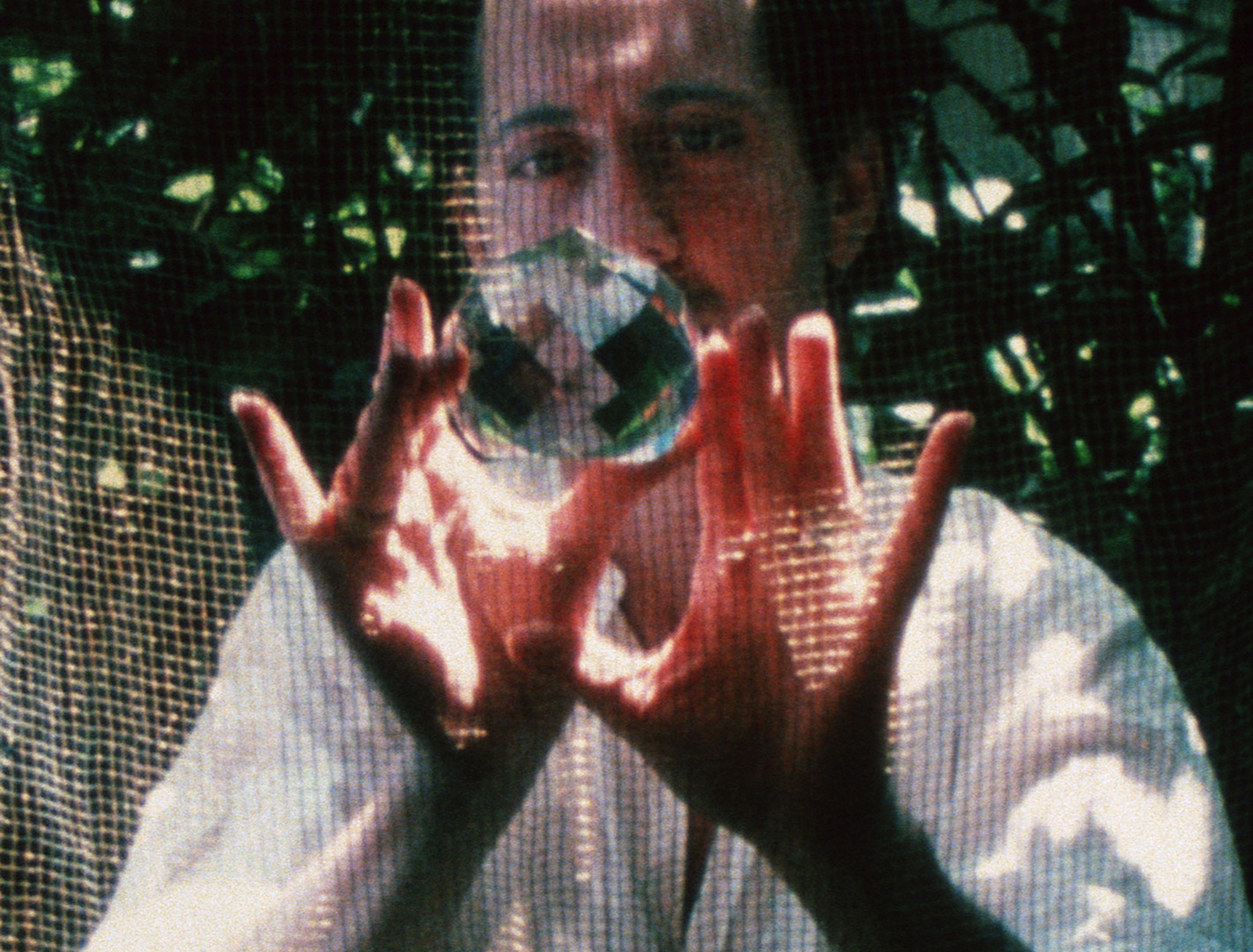
header image: Cristaux. 1979. France. Directed by Teo Hernández. Courtesy Light Cone
by Maximilien Luc Proctor
With their upcoming mammoth 12-program screening series, “Teo Hernández: A Pomegranate Orchard and the Bitter Well”, guest curators Carlos Saldaña and Francisco Algarín Navarro have accomplished nothing short of a miracle: presenting the majority of the filmmaker’s available works from May 14–26 at MoMA, the first U.S. retrospective of its kind.
One of greatest moving image artists of the 20th century, Teo Hernández built a towering oeuvre in miniature. Super 8—a format made more user-friendly than its ‘regular’ 8mm predecessor and aimed squarely at the home-movie market upon its introduction in 1965—was his weapon of choice for its flexibility and portability. Hernández weaved several primary filmmaking pillars into the foundation of his life’s work: the diaristic impulse, a spiritual openness, layering of veils and tableaus throughout the visual field, and a deep connection to the physical human form. Teo seemed to adore the human form for both its durability and malleability, characteristics it held in common with celluloid, and especially so with the robust yet light cameras of his chosen format. Beyond aesthetic choice, Hernández retained a certain fidelity to Super 8 for his entire working life, shooting primarily on Bauer cameras. He shot only one film on 16mm, Feuilles d’été (1983).

From Hernández’s journals: June 29th, 1983—“In Super 8 the form immediately becomes the subject.”
This form-as-subject had everything to do with the body behind the camera, and one’s frenetic collaboration with the device.
October 21st, 1983—“Watching the film of Corinne Cantrill in her company, along with that of her husband Arthur, Jakobois and of Michel Nedjar. She (Corinne) tells us that the S8 camera is very light, which is a problem for her. I comment that the S8 camera is light like a feather, and that in order to employ it well, the filmmaker should be light as a feather.”
From the series’ opening screening of Salomé (1976-82), there is a temporal play in the curation akin to the filmmaker’s own plasticity of form, via the inclusion of the 1987 four-minute work Vloof l’aigrette – Pain de singe, a portrait which begins in a calm black-and-white Warholian mode and moves into hyper-kinetic frenzy as the film stock changes to color and its subject comes alive in a drag performance for an audience of one. It is a sibling-film of Pas de Ciel, from the same year and also featuring dancer-choreographer Bernardo Montet.
Saldaña & Algarín Navarro’s lovingly curated program then steps into Hernández’s grandiose biblical four-feature-film cycle, The Body of the Passion, in chronological order, beginning with Cristo (1977), paired with Tables d’hiver (1978-79), a brilliant time-lapse study set entirely within the confines of a single apartment, summoning all the mundane and ecstasy of daily meals, dancing, reading, dreaming. After completing The Body of the Passion cycle, there is a screening of Maya (1978-79), followed by three programs of short and medium-length works made by Hernández between 1981-1990. The series offers incredibly astute program notes, from curators who have so clearly been digesting the filmmaker’s life’s work over the course of their own lives, borrowing from Hernández’s texts and offering crucial guidance through various cinematic phases.
With his hypnotic whip pans and circular rotations, Hernández liquifies the physical world with ease, melding it to his vision and creating a new plane of existence, parallel to the one we inhabit in our daily lives. It’s Teo’s world, we’re all just living in it. Hernández’s film language is completely singular, yet not one that was developed in isolation. In making films together and projecting their work for one another, Hernández and his collaborators developed a common visual grammar spoken between them, as a family unit, as a micro community of Parisian artists. As a crucial inclusion of this context, the three final screenings in the program present work by these lovers, companions, and collaborators: Michel Nedjar, Jakobois, and Gaël Badaud. Together the four also created two films collaboratively credited to MétroBarbèsRochechou Art. It’s a language of total freedom, movement unconstricted by filmmaking rules. To present the world this way is a feat of imagination but also of bodily presence—a cinema of physics pursuing the physical.
At times the physical is blown apart through flickering stutters which push from one plane to another, allowing the films to encroach on various meta territories. There is, for example, the inclusion of re-filming projected images from Cristo in Cristaux (1978), or even the sudden breaks with the fictional diegesis at the end of either film which give way to a brief ending segment of filming everyday surroundings, or one’s shadow on the grass—a meeting of the filmed image and the lived reality, the physical essence of the filmmaker never taken for granted in the process of filming. An approach which scholar Andrea Ancira García calls a “tactile cinema, a kind of expanded interdisciplinary and self-taught cinema, characterized by an organic and permanent flow between the staging of the psyche and the intimacy of the filmmaker through aesthetic languages such as cinema, photography, poetry and body expression.”1

October 31st 1983, 1:31pm—“Cinema is made with blood.”
An assertion which brings to mind the dripping red end title cards of Lacrima Cristi, printed onto transparent plastic and held in front of the sky. In fact, Teo had a real knack for making in-camera credits, writing his name on the sidewalk in chalk, or with gold paint on fabric. Hernández constantly sought to meld vying worlds, to position what we witness in a bustling marketplace as essential rather than counter to imagination run wild, a leveling of work and play. More specifically, one might look to Mesures de miel et de lait sauvage (1981–84) wherein the filmmaker catalogs trash and various inanimate objects for half an hour, with the occasional interjection of a human face, and eventually, famous gravesites and works of art—all filmed without hierarchy.
October 30th, 1983, 8:40pm, at a restaurant—“I think I should also give a total liberty of composition to the film, not to limit it to a project. Filming when I can and when I am in the mood to film ‘anything’, trying to connect everything, days and nights, personal experience and the reality of everyday life.”
To make experimental films, even when they fit into a broader context of similar works in overlapping eras, is in essence to resist accepted norms of image-making, against what is typically trafficked through the commercial movie houses. To make a film like Lacrima Cristi on the other hand, is outright defiance—of what a film can be limited to, of how one should spend their free time or ‘disposable’ income, of how one should get along in life. With its incessant flickers, swivels, swirls & agitations, it is two full hours of constant motion.
September 8th, 1983—“A film should be easy to watch and difficult to describe.”
There’s great truth in this affirmation, which points to Hernández’s use of the specificity of moving images as medium; no individual still image taken from any of the filmmaker’s works manages to suggest quite the intensity of movement which occurs, nor is it possible to ascertain how often or how enthusiastically they occur without sitting through the durational aspect of film. It brings to mind Nathaniel Dorsky’s concepts of metabolism & alchemy in filmmaking, as elucidated in Devotional Cinema:
“For alchemy to take place in a film, the form must include the expression of its own materiality, and this materiality must be in union with its subject matter.”2
From his writing and films, one feels that Hernández was nothing if not in complete union with his own creations and their subject matter, that there was no barrier whatsoever between his life and his art. Nearly a decade prior to his death, Hernández looked with steely resolve to the key event which would connect all of his work:
December 12th, 1983, 6:17pm—“My only goal is death. The only thing, the sole goal that a filmmaker, an artist, can have. Between the present moment and the moment of my death there is a space, where everything that happens is my completed oeuvre. This “line,” which grows shorter day by day, finds its reflection, its development, its illustration in the film. The film becomes the illustrated line connecting this moment to the last.”

All journal entries translated by the author from the French-language publication ‘Anatomie de L’Image, Notes de Teo Hernández’, edited by Andrea Ancira García and Neil Mauricio Andrade
Maximilien Luc Proctor (MLP) is a French-American filmmaker, critic, and curator. He records music in the band Two Nice Catholic Boys, is the founder and a co-editor of Ultra Dogme, and the avant-garde instructor for Berlin’s Art-on-the-Run film school.
If you enjoyed this article, please consider supporting Ultra Dogme on Patreon, Ko-fi, or Substack, so that we may continue publishing writing about film + music with love + care.