
by Alex Fields
Four films by Peter Bundy are currently streaming through May 29th in the Ultra Dogme Movie Club
I first encountered Peter Bundy’s work in the New York Public Library. A friend had watched their print of Alabama Departure (1978) almost at random and recommended it. The ten minute film was a revelation, obviously fitting into the pattern of Seventies structuralist landscape film but combining it with a documentarian spontaneity and a lived-in regional feel. A few months later, when the programmer of our local film festival asked if I knew any regionally-themed experimental works I’d recommend, it was the first thing I thought of. We learned that Walker Art Center had Bundy’s entire catalogue and had recently digitized all of these films, and ultimately screened nine of them at Film Fest Knox 2025, the first ever digital screening of any of Bundy’s works. Ultra Dogme’s May 2026 Film Club program is the second, and includes the first digital screenings of Polar (1975) and Gloucester Skipper (1976).
Bundy’s completed filmography, rich as it is, was entirely produced in the short period between 1975 (when he earned a Master of Arts in Film Production from the University of Iowa) and 1983, the year after his first marriage ended and he left his job as Assistant Professor of Film Studies at Carleton College to pursue a new life and career in forestry. He continued working in media for years after, writing several dramatic screenplays and even becoming a Sundance Institute finalist for one of them, Arabella, in 1985, but none of these projects were realized.

The films are thus all products of a period in the American avant-garde when the formal rigor of early “structural film” was opening toward broader concerns with landscape and the natural and constructed history of the nation. They are exactly contemporary with the major works of Al Wong, for example, with Peter Hutton’s New York Portraits I and II (1979 and 1981) and Boston Fire (1979), and with the early masterpieces of James Benning like The United States of America (1975, in collaboration with Bette Gordon), One Way Boogie Woogie (1977), and 11 x 14 (also 1977). The family resemblance is clear, both in the structural concern with the cinematic apparatus–the materiality of the film, the fixed position and self-aware presence of the camera, the obvious manipulation of sound–and in the playful, sometimes comic view of the landscape in its regional particularities. Like Benning, Bundy studied and began his career in the Midwest; like Benning, he was drawn to the wilderness and built his own cabin in the woods (but unlike Benning, he actually lived in his).
But Bundy’s sensibility is distinct. In Michael Snow’s foundational works, the camera and filmmaker, abstractly conceived, have a metaphysical character. On first encounter, formal conception overpowers all other content; you could easily not realize until the near the end of Wavelength, or even until a second or third viewing, that the film is very funny, that the people who appear in it are Snow’s friends, that his personality is always there and usually laughing. Benning may likewise strike new viewers as an objectivist, offering distant views of the landscape, composed for careful reflection.
That this is an illusion, that it’s all constructed or sometimes even faked, is of course part of the point for both artists, and something the works are meant to reveal through their own devices. But Peter Bundy’s work, while containing most of the same ingredients, inverts the relationship. Most of his films, especially the longer and more ambitious ones, are personal and observational in the first instance, revealing their rigor and artifice more gradually. He has far more of a documentary impulse than his closest contemporaries, which manifests among other ways in the regular appearance of individual interview subjects as one structuring element in the films.

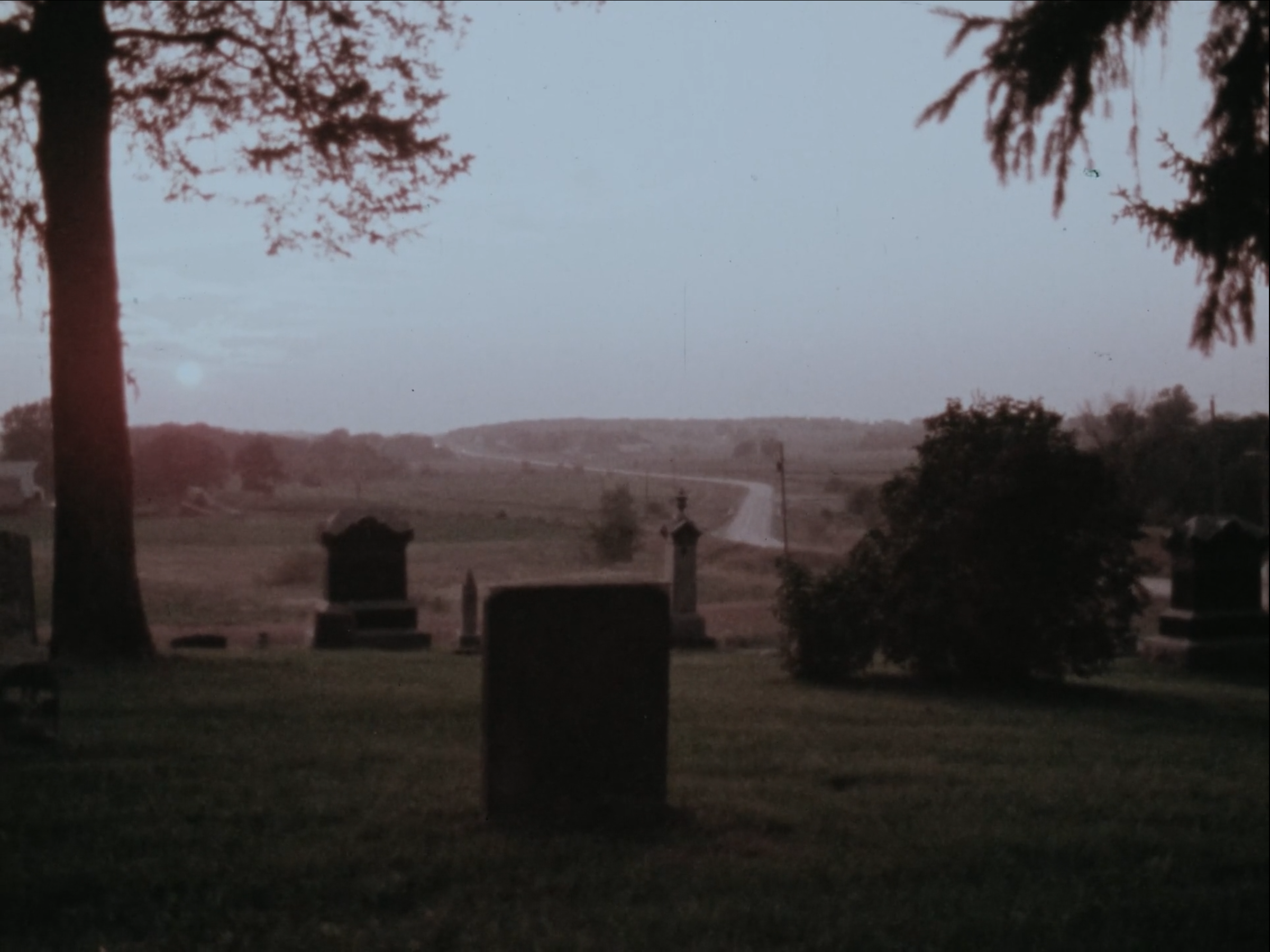
Alabama Departure might be Bundy’s best and most representative work. It consists of six segments, each introduced by an intertitle naming the Alabama location where it was shot. Three of these are wordless environmental studies, the most memorable of which sums up the artist’s formal playfulness in a most amusing way: flying fish jump from the water near some fishing boats, and with each jump a guitar strikes a non-melodic note. The fish serve as a visual score, a found soundtrack performed in post-production. The other three segments have the same subject, an old man who sits in front of a Pepsi sign in what might be an old corner store or gas station or might be his house and tells stories about the stuck up and judgmental folks at the church down the street and the rich ladies who have a cemetery for their dogs. The film concludes with this fellow playing the credits out with an organ and vocal rendition of the old nineteenth-century hymn “I’m Going Home,” the soundtrack now diegetic and traditional.
Bundy had a great ear for such musical possibilities, as well for such accents and organic storytellers. Perhaps the most remarkable of these is his own grandmother in To and From Childhood… A Portrait (1983), which also features Bundy himself on camera in his most biographical and personal film. Like Alabama Departure, the film alternates between takes from the interview and wider shots of the environment, with the latter doing the formal heavy lifting and the former delivering verbal commentary. The grandmother talks about how the younger generations wanting to “find themselves” and how she doesn’t know what that means. Such apperception was never part of her vocabulary. She’s not judgmental, just reflective about these new notions of interiority. What does it mean to “find yourself” other than just living your life?
In a sense, her words offer a core insight into her grandson’s work. Bundy is never satisfied merely to show, as though words or images fully speak for themselves free of context. His works record the places he goes and the people he meets, but their formal structure demands an account of the triadic relationship of artist, the technical means of production, and who or what the former sees or hears by means of the latter. In a conventional documentary form we usually call this last the ‘subject’, and the filmmaker might aspire to make themself invisible and let the subject speak. Arguably, in Bundy’s work, the artist is equally a subject, in the philosophical sense of the consciousness which has experience of the world of objects. Or rather, the artist and his audience and the people and places he films all emerge as subjects and objects alike, in a field mediated by technical equipment and by time itself.

In a letter written in 1979 when Bundy won a Bush Foundation Fellowship, Carleton colleague John Schott summed up this formal strategy:
Bundy’s films, however, become especially interesting upon discovering that the strategy of overall construction draws on a tradition of rigorous formalism–one which is most often distinct from the evocative, expressive concerns apparent in the local imagery…it is on the level of film form, where Bundy’s syntax is so apparent as to make it virtually the second “subject” of the film, that we sense a disciplined, architectural intelligence…the rigor of the construction insulates the images from any flirtation with sentimentalism. Viewpoint and structure function as a particularizing screen to the ostensible subject.
In some films this obstruction is as literal as a second physical barrier or “lens” placed in front of the camera and shaping its view. Polar (1975) begins with a shot of a frozen pond seen through some sort of round window or peephole. The camera moves away in a blur, but when it settles into place again we’re looking at a similar structure, this time larger and closer to the edge of frame. Did the camera move, or have we been looking through a microscope or slide project or some other literal lens, which itself moved? Another movement or adjustment and the barrier is gone entirely, the full camera frame allowed to view the ice. This “natural” viewpoint comes only after we’ve seen the obstructed ones and learned not to trust or understand what we’re seeing. Conversely, a soundtrack that begins with a solo Shakuhachi or similar wind instrument is then joined by two human voices humming and saying “aah” or other semi-verbal enunciations. This film and Night Awakening (also 1975, and structurally similar) are Bundy’s earliest extant films and, while more purely formal than his works in the coming years would be, clearly announce his intention to complicate his and our view of landscape.

Underbridge (1978) is a more mature application of a similar strategy. Here we see detail shots of moving ships through some sort of narrow opening, while hearing both industrial (metallic) and natural (birdsong) sounds in an apparently diegetic sound recording. The nature of the obstruction isn’t initially clear, but reframings reveal metal bolts and eventually the actual structure of a bridge. (The title also gives it away, of course, but in the film itself the title isn’t stated until the end credits, which name the work as an “edited document.”)
Between those first films and Underbridge, Bundy made a few other formalist miniatures like Composition 321 (1977) and Pendulum (1978), but also his most conventional documentary, Gloucester Skipper (1976). His only film from the 1970s to break 10 minutes in length, it was shot on a fishing boat off the Northeastern coast, where Bundy grew up. An interview with the ship’s Captain, and the Captain’s radio communications with customers, make up the film’s soundtrack, but the Captain is never actually shown. The camera merely observes the crew working and eating, and they never acknowledge its presence. Bundy’s technical skill is well-used here and it’s an effective study, but his least formally inventive work. In the years to come, he would make his most original films when he learned to combine these interests in regional documentation and formal experimentation.
In addition to Alabama Departure, these various elements are all on display in Wyoming Passage (1980). Like its Southern counterpart, it alternates more “objective” studies of the Western landscape—its hills, oil rigs, and geysers—with an extended “subjective” interview. The subject here is again an old man with some great stories, for example about the fights he used to get in at bars and how he became friends with the guy he whipped in one of them. This two-level approach allows Bundy a thematic and reflective complexity that reaches beyond the content as such and brings the recording process itself into view.
These films are not just about the particular moments in time and space that are recorded, but what it means to record a moment in time and space. They don’t aspire to be objective records of regional culture or landscape, but records of an artist’s encounter with them, which are structured to interrogate the meaning of that encounter and, later, to ask an audience to interrogate their own experience of it. There is, indeed, no such thing as a view of America, of its landscape or its people, that isn’t a view from somewhere and produced by some particular means. The richness of Peter Bundy’s films is that, for all their beauty and charm and humor, they obstruct that view just enough to keep alive the activity of making and experiencing it.
Alex Fields is a film writer and postal worker in Knoxville, TN. They write regularly on formalist, experimental, and genre film for Tone Glow and their blog, Not Reconciled.
If you enjoyed this article, please consider tipping the author (PayPal: ac_fields@hotmail.com) and/or supporting Ultra Dogme on Patreon, Ko-fi, or Substack, so that we may continue publishing writing about film + music with love + care.