
by Dean Kavanagh
This essay is an accompaniment to Six Films by Joseph Bernard, a streaming programme available through our Movie Club on Patreon from the 17th to the 31st of August.
Every revival is a two-way mirror. The continued fascination with super-8mm film draws the era of its production into dialogue with the present. In an age of information saturation and pristine digital images, its renewed appeal lies not simply in nostalgia but in absence: the space to imagine. Joseph Bernard’s films also reveal an unexpected continuity with contemporary image culture, sharing its restless desire to arrest the elusive present moment before it slips away.
Between 1975 and 1985, Joseph Bernard made one hundred silent, super-8 films. Before his death in 2025, he restored and released more than half of them, reviving a body of work that had remained largely unseen. The reappearance of his films writes a missing chapter in Detroit’s underground cinema history, revealing Bernard as perhaps its defining experimental filmmaker of the period.1
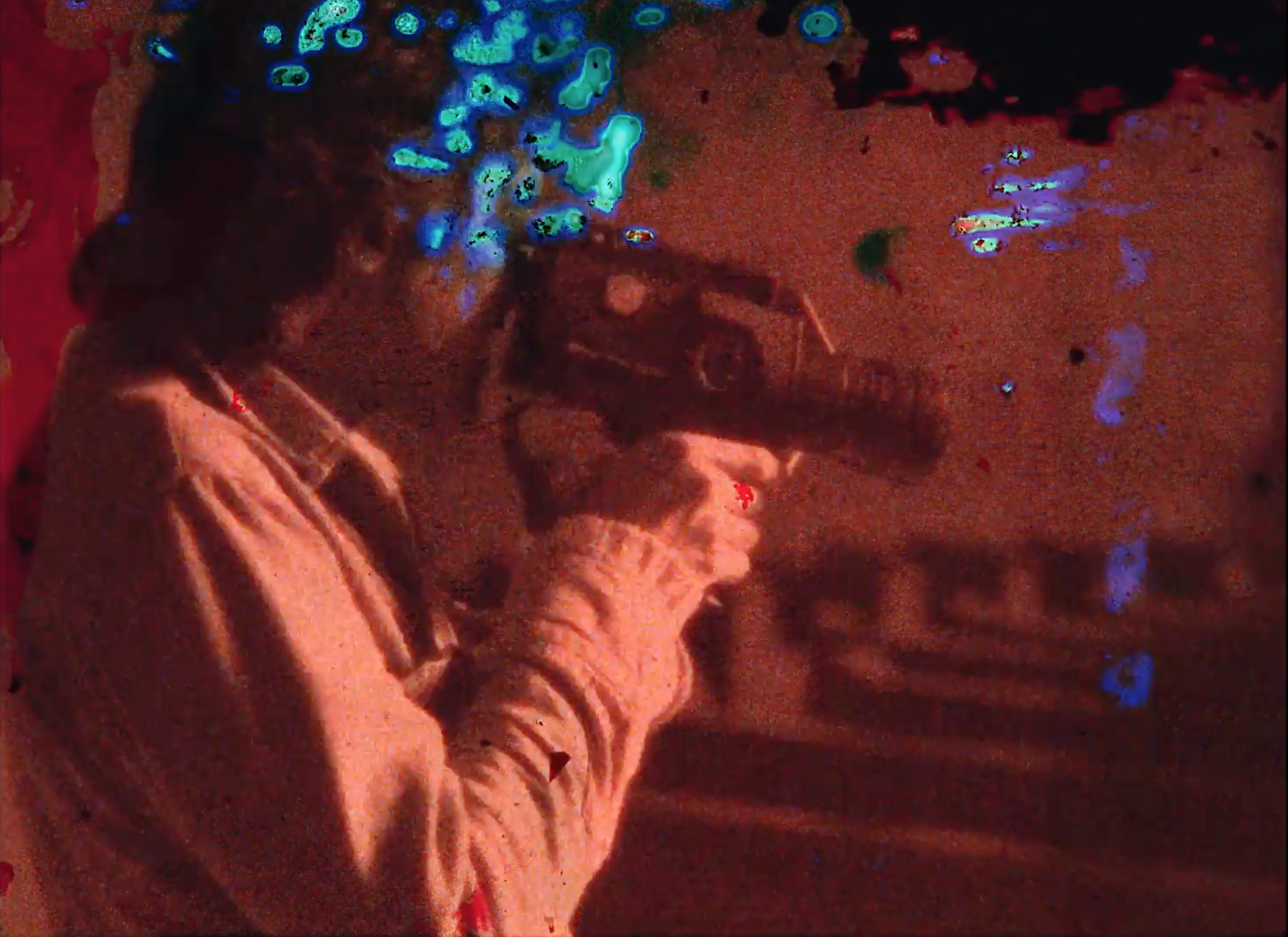
Bernard’s work is primarily concerned with perception, movement, light, and the rhythms of ordinary life. His cinema is lyrical, and often diaristic, using abstraction and collage-like techniques, drawing the eye to the surface of the image and accepting rather than disguising the screen’s two-dimensionality. His images seem less to recede than to, one might say, infold, carrying the memory of depth within the surface itself: two dimensions marked by the memory of a third. It is this trace that destabilises the image: a visual field pulled backwards through the corruption of remembrance. The specimen under his microscope is suspended between concealment and revelation, like light surrendering its brilliance to successive layers of glass. Kierkegaard suggested that life can only be understood backwards; but it must be lived forwards.2 Bernard exemplified this paradox. A lifetime of looking is compressed into a decade of fleeting moments, resurrected forty years later, and restored not by the filmmaker who made them but by the person he became in the absence of filmmaking. Bernard found these films, just as we find them now, bearing the traces of their own making: an eye trying to hold on to moments as they disappear.

Filmmakers and film critics Fergus Daly and Katherine Waugh describe Tarkovsky’s cinema as a “search for lost time,” granting access not to ordinary recollection but to what Proust called “a little time in a pure state”: an involuntary encounter with the past as a living present.3 As Deleuze writes, “the present is the actual image, and its contemporaneous past is the virtual image, the image in a mirror.”4 Bernard’s films extend this coexistence of past and present by revealing that the preserved past is never pristine. It is materially unstable—scratched, bleached, and painted over. In Bernard’s cinema, preservation and disfigurement occur simultaneously.
Bernard reminds us that super-8 continues to excite the digital imagination. Perhaps it speaks to a hunger not for the past itself, but for the appearance of authenticity. Like a forger in reverse, we modify our literal flesh to resemble our digital reflection. We no longer see ourselves through our own eyes, but through a gaze conditioned by algorithms that learn our desires only to return them, amplified and distorted, until aspiration, conformity, and identity become increasingly difficult to distinguish. We distress our digital ‘selfie’ with faux-analogue imperfections, endowing it with pastness 5 as if to further shunt ourselves from the present moment.
Film critic Adrian Martin notes that much writing on photography and cinema has emphasised the image’s ubiquitous pastness, invoking Barthes’ ça a été (“that-has-been”)i: the photograph bears witness to a moment that unquestionably existed before the camera, even as it reminds us that this moment has been irretrievably lost to time. Every filmed image arrives already marked by temporal distance, carrying with it the certainty that whatever we witness has, by definition, already occurred. In 2026, super-8 intensifies this condition, not simply by conjuring a past aesthetic but by bearing the visible traces of its own ageing; as if time has already acted upon the image itself.
We first perfect a digital image, then simulate its decay. Flann O’Brien’s satirical “book-handling” service, proposed in his 1941 Cruiskeen Lawn column for The Irish Times, has finally become reality. We can now pay a specialist to maul and relic the hot new bestseller.6 As though reading it were not enough, you can also buy the dog-eared pages, underlined passages, a mottled cover, a cracked spine, and, for a premium, they’ll dab it with wine and go at it with a drill. As for the marginalia, “the moron who owns the book will be asked to write [it] (and shown how if necessary).”7 The illusion of wear—of a life lived—has become a commodity.

Ernie Gehr once remarked that the film image is comparable to a painting, insofar as you are looking at the image, not through it.8 Our digital world increasingly resembles a Leibnizian monad: each feed presents a complete world while remaining sealed within its own logic. Each is a closed perceptual universe. The distance between looking and seeing has never been wider.
Drawing, in part, on interviews with filmmaker and cinematographer Fred Kelemen, Waugh and Daly’s gallery exhibition I See a Darkness (2022) characterises analogue and digital images as differing not merely in their method of production, but in their relationship to reality itself. Whereas analogue film bears the direct chemical trace of its encounter with light, digital imaging samples incoming light and encodes those measurements as numerical information. Kelemen argues “we also lose black in digital processing because digital requires information, and black, or nothing, means an absence of information. Darkness on a digital copy will never really be black, because it’s a technology that does not understand nothingness.”9
Bernard’s rediscovered films arrive as super-8 itself undergoes a resurgence. At the same time, our culture is saturated with information at an increasingly granular level. From the perspective of media archaeology, this resurgence is not simply nostalgic but symptomatic: obsolete media return because they offer perceptual and aesthetic possibilities eclipsed by newer technologies. As one of the leading scholars in the field, Jussi Parikka, suggests that such past technologies are continually discovered anew.10 The resurgence of retrograde image-forms speak to a desire for absence—for images that leave something unknowable, a veil drawn across the eye. In a culture that increasingly equates visibility with truth, concealment becomes a radical aesthetic. By allowing detail to recede, these imperfect images occupy the interval between what is present and what is known. The Ganzfeld effect reminds us that ambiguity is rarely empty; where detail recedes, imagination fills the breach. We might find revelation in what the small gauge medium withholds.

The six films selected for this programme represent Bernard at his most reflective. By this point, his filmmaking had become a focused investigation of the medium itself, exposing the apparatus and laying bare his engagement with it. That trajectory culminates in 1985, after which Bernard stopped making films, lending this work an unintended sense of closure. Bernard’s decision to step away from filmmaking was almost certainly shaped by circumstance as much as inclination. By the mid-1980s, the pioneers of American experimental cinema had rejected one establishment only to become another. The avant-garde had acquired its own institutions, histories, and gatekeepers. Meanwhile, the small-gauge ecosystem was rapidly collapsing, and many accessible laboratories disappeared. Video had captured the imagination, and Kodak, rather than defending the home-movie culture it had created, increasingly redirected its investment towards electronic imaging and partnerships with companies like Sony.11 By 1988, Kodak had entered the pharmaceutical industry for the first time, buying out an aspirin business.12 ii The company whose cellulose acetate had carried generations of flickering films concluded there was money to be made on either side of the headache.
Format remains less a choice and more an economic condition. Today, film is an increasingly expensive material practice. It is little wonder that key properties such as grain, soft focus, halation, and light leaksiii—sites of inquiry for the analogue filmmaker—have become simple drag-and-drop effects: passive decoration for the digital creator. The point is not that photochemistry is inherently superior, but that, in a film artist’s hands, every scratch, flare, splice, and fluctuation performs dramatic work. Imperfection can be both phenomenological and dramaturgical.
I have no claim to objectivity here. Much of my own practice has been devoted to the romance of imperfection: the lived texture of light, the visible trace of time, the material presence of the image. Hence the persistent “we.” You’ll find me in the stalls with the other fetishists, sniffing at any stock with a base ISO above fifty.
Bernard did not fetishise the exhibition experience. In my chats with him, he simply referred to cinema as “light in the dark.” Digital endowed his films with a clarity and silence that was impossible before. Whether you watch these films on a projection screen or a laptop screen, all that matters is sufficient darkness. Time contracts and expands across these six films. Allegro, adagio, scherzo—a rhythmic montage solicits a playful fury of light, shadow, and silence. It is a silence that presses against the ear, summoned through the musicality of the cut, and the pulse of our own blood. These films form an expression of personal cinema that is intimate, poetic, and at times uncomfortable. Bernard remains at the threshold of this encounter, a spectral presence conducting from the penumbra. His images emerged through the commingled containers of life and art, developing organically, and carrying the residue of a lived experience filmed, and a filmed experience lived.
Thanks:
Thanks to Ruairí McCann and Ultra Dogme for providing me with the opportunity to exorcise my demons. As ever, my thanks to Anja Mahler, Fergus Daly, Katherine Waugh, and Shane Vernon. This programme would not have been possible without the generosity of MariaLuisa Belmonte, and the late great J.B.
Notes:
(i) Adrian Martin also discusses presentness, citing Roger Munier as a counterpoint to Barthes’ emphasis on photographic pastness. For Munier, the image feels so immediate that its temporal distance almost disappears. See Martin, “Incursions,” 55–56.
(ii) Funny coincidence: Kodak briefly owned the U.S. rights to Bayer Aspirin through its acquisition of Sterling Drug, entirely unrelated to the Bayer colour filter array invented at Kodak in 1976 by Bryce Bayer and the subsequent de-Bayering (demosaicing) process by which full- colour images are reconstructed from sensor data. Conversely, Bayer AG, the German chemical and pharmaceutical conglomerate, also operated a photographic business through its subsidiary Agfa, a major manufacturer of photographic and motion picture film.
(iii) One of the finest examples is Saul Levine’s Light Licks (1999–2014), a series of super-8 films exploring light leaks and the material nature of film itself.
References:
1) O’Toole, Owen. “Joe Bernard.” In Prismatic Music: The Super-8 Films of Joseph Bernard. Cinelicious Pics Blu-ray booklet, 2022.
2) Kierkegaard, Søren. Journals and Papers. Edited and translated by Howard V. Hong and Edna H. Hong. Bloomington: Indiana University Press, 1967–1978. JP I 1030 (Pap. IV A 164 [1843]).
3) Daly, Fergus, and Katherine Waugh. “Ivan’s Childhood.” Senses of Cinema, no. 15 (July 2001). https://www.sensesofcinema.com/2001/cteq/ivans-childhood/
4) Deleuze, Gilles. Cinema 2: The Time-Image. Translated by Hugh Tomlinson and Robert Galeta. London: Bloomsbury Academic, 2013, p. 79.
5) Martin, Adrian. “Incursions.” In The Language and Style of Film Criticism, edited by Alex Clayton and Andrew Klevan, 55–56. London: Routledge, 2011.
6) Scally, Derek. “‘Coffee must be dropped at different height than wine’: The Berlin team making books look well-read.” The Irish Times, July 15, 2026. Accessed July 20, 2026.
https://www.irishtimes.com/business/2026/07/15/we-all-have-unread-books-berlin-based-ageing- treatment-includes-spine-breaking-and-dog-ears/
7) Myles na gCopaleen [Brian O’Nolan]. “Cruiskeen Lawn.” The Irish Times, November 10, 1941. Accessed July 22, 2026.
https://www.irishtimes.com/news/cruiskeen-lawn-november-10th-1941-1.631082
8) Gehr, Ernie. “Thoughts on Cinema with Ernie Gehr.” Interview by Mark Webber. In Adventures in Virtuality: Proceedings of the 2008 Virtuality Conference, edited by Pablo Garcia and Spike Wolff, 66–67. Buffalo: University at Buffalo, 2010. Accessed July 20, 2026.
https://doczz.net/doc/3918638/thoughts-on-cinema-with-ernie-gehr
9) Waugh, Katherine, and Fergus Daly. I See a Darkness. Exhibition, Photo Museum Ireland, Dublin. 11–20 November 2022. Accessed 23 July 2026.
https://photomuseumireland.ie/exhibition/katherine-waugh-fergus-daly-i-see-a-darkness/
10) Parikka, Jussi. What Is Media Archaeology? Cambridge: Polity Press, 2012, p. 2. 11)
11) Eastman Kodak Company. “Milestones.” Accessed July 20, 2026.
https://www.kodak.com/en/company/page/milestones
12) Vinokurova, Natalya, and Rahul Kapoor. “The Problem of Sustaining a Successful Enterprise: Kodak’s Multiple Takes at Strategic Renewal that Culminated in Failure.” Business History Review 99, no. 1 (2025): 3–38. Accessed July 20, 2026 https://doi.org/10.1017/S0007680525000236
Dean Kavanagh is a filmmaker and film archivist based in Dublin, Ireland. [Website]
If you enjoyed this article, please consider supporting Ultra Dogme on Patreon, so that we may continue publishing writing about film + music with love + care.