
by Mako Fukata
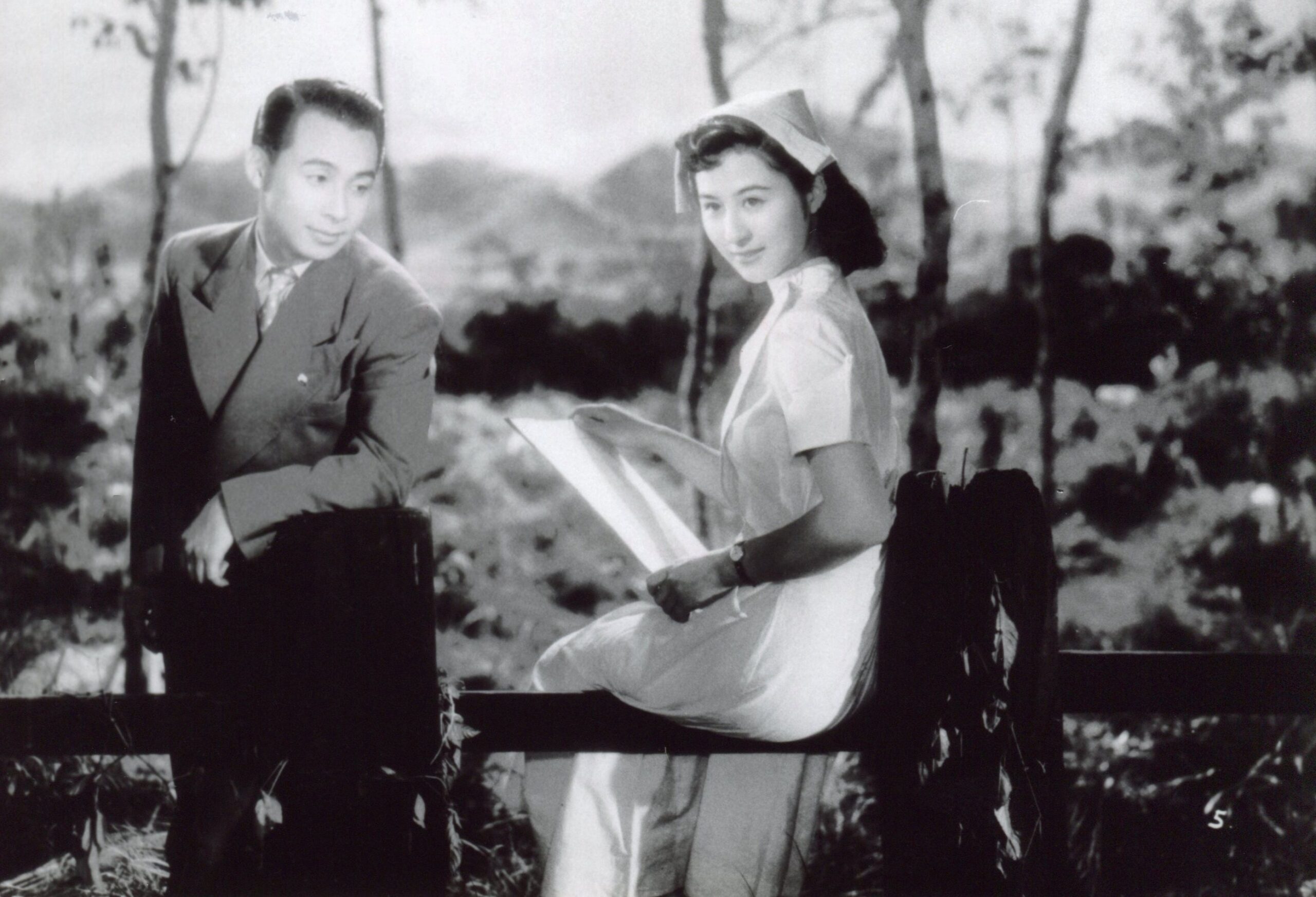
Kyoko Kagawa Rarities, running August 13-16 at Asia Society and Anthology Film Archives in New York, presents five films centered on a beloved Japanese actress whose career is often framed around her “supporting performances,” but whose versatility and screen presence extend far beyond the suggested limitations of that designation. Composed entirely of celluloid imports, the series will offer a rare opportunity to see Nobuo Nakagawa’s Farewell to the Highland Station (1951), a deeply romantic film of the kayō eiga (“song film”) genre that features a leading performance by Kagawa and has never before been shown in the United States. At a time when international cinema feels more accessible than ever—with streaming platforms, restorations, and the growing prominence of repertory programming—many historically significant films still remain out of circulation simply because they have never been translated or subtitled.
A spotlight on the creation of new English subtitles for the film by Monika Uchiyama, Tokyo- and New York-based interpreter and translator, draws attention to the often-overlooked labor of translation and localization, offering a reminder that the circulation of world cinema depends not only on archives and exhibitors, but also on translators whose work fundamentally shapes how films travel across cultures. Writer Mako Fukata, who will manually advance the subtitles during the screening, spoke with Uchiyama about her navigation of linguistic and cultural nuances in translating the film, and about the often invisible labor involved in bringing a film like this to a new audience.
Mako Fukata: You created brand-new subtitles for Nobuo Nakagawa’s film Farewell to the Highland Station (1951), which has never been translated into English. You’ve become known for doing so much amazing live interpreting work for a number of renowned Japanese filmmakers, but how was your experience subtitling a film like this?
Monika Uchiyama: I would say that my process of subtitling is closer to my interpreting work because, instead of working from an existing transcript and then translating that word-by-word, what becomes more important is the tone and how a line is delivered. I think what was interesting for me with Farewell to the Highland Station was considering the dated language delivery, and how much of that sensibility to preserve. Then there’s also the question of how to try to make it as concise as possible. I tend to veer toward prioritizing readability rather than very precise accuracy.
Would you say this process of translation didn’t feel all that different from your live interpreting work?
When it comes to translating text, it’s quite different to interpreting. I would describe my live interpreting as being very impressionistic, meaning that I’m not processing language by converting every sentence or every word into English as I listen. I’m understanding language through the kind of impression that I get from it. That might look like images in my mind, or picturing the speaker’s experience. I then try to convey that while preserving key words that I feel are important to that person’s speech.
With translation of text, you have an obligation to be very precise with language and how it’s converted on a vocabulary level. To me, subtitling is kind of in between. I’m taking some of my skills as an interpreter in the way that I’m listening to dialogue and how it’s delivered, because when we’re watching cinema, we’re not just processing text. If you’re a hearing person and you can experience the speech as it’s delivered through sound, then we are not really processing language on a vocabulary level. Then there is the context provided through images and an actor’s body language, too.

Once, when I was interpreting for Ryusuke Hamaguchi, he was asked a question about the subtitling process and if he makes interventions in the making of them—whether he provides guidance to the translator to preserve his artistic intention. His answer was no, that the subtitler does their own work. They’re kind of creating a new layer of the piece through the act of translation.
Part of what he said was that since the image, the voice, the sound, and the expression of the actor still exist for us to experience, it’s not like the subtitles are doing all of the heavy lifting of conveying meaning or narrative. It’s a combination of everything. So that became my guiding principle and helped me take the pressure off of being super fixated on the textual accuracy of the translation.
Something you have to consider when subtitling a film, especially a film from a different time period, is how much to account for the historical specificity of its language. This film was made in 1951—how did you navigate its being from an earlier time?
I think the one thing that I battled with while working on a film from this period was how much to localize the language to resemble that of a film from a similar era, but in an American or Western context. When you think of a Hollywood film from the ’50s that’s in black and white and formally similar, you might imagine a Transatlantic accent and a specific kind of delivery. One of the things I questioned was whether a translation felt too contemporary, or whether I was making assumptions about what I imagined a person from that period speaking English would sound like without doing the appropriate research.
So you’re negotiating not only between two languages, but between two different cultural and historical contexts. At the same time, was there anything about the subject matter and theme of the film that affected the way you approached the language?
I think the film itself is somewhat progressive in its themes. For the most part, it’s just about two people falling in love, but there are interesting dynamics that make it veer away from what might be considered a very conservative love story.
Particularly toward the end, with the dynamics between Keiko, who is arranged to be married to the leading man Toshio, the female doctor Mikami, and the heroine Nurse Izumi (who’s played by Kyoko Kagawa)—the way that they relate to each other as women feels quite contemporary. So I thought it should be simple language because it’s so relatable and relevant: the way that they’re moving around each other and trying to relate to each other while there’s this power dynamic.
Did you watch the film? Isn’t it kind of feminist?
I think it is too, yeah.

Yeah and also there’s a kind of frank discussion of gendered experience. The film really paints a picture of a conservative, patriarchal workplace, especially around Dr. Mikami, where there’s this very strict hierarchy, and certainly there are probably a lot of moments where the women are incredibly disadvantaged, even though they’re working just as hard as their male counterparts.
But then the film also has this part where people talk about the incompetency of the male characters so aggressively and blatantly, like, “Oh, she’s smarter,” or, “He only gets that job because he has seniority.” There’s so much open discussion of the power imbalance, or joking about ability and merit and how people ascend to certain positions.
The fact that Toshio is marrying into the family as the son-in-law of the chief director at his hospital feels like it places him under the power of his wife, Keiko, from the outset.
When it comes to her potential marriage to Toshio, Keiko seems to see things quite pragmatically, which makes me wonder if it was radical for a female character in a melodrama in the ’50s. There’s a frankness about Keiko that seems unaffected by the expectations being projected onto her by other people and society—the expectation of romance.
So I feel there’s some kind of layer of performance throughout the film, where they’re going back and forth between performing a feminine role and being true to themselves. And if anything, Nurse Izumi represents the most feminine performance. She, quite frankly, barely has any lines. I think about the moment when Toshio is literally like, “And now Nurse Izumi will sing us a song!” and she has to perform.
I feel like that’s kind of her role—that she’s this performance of femininity, while Keiko and Dr. Mikami are closer to reality.
Those interplays of gender roles are tricky because, in Japanese culture, they’re often implied through language and mannerisms in ways that might require more than just a literal translation.
Yeah, that’s something I think about when watching Japanese subtitles on English-language films. One kind of norm that I notice in subtitling is the gendering of language.
Women characters will use female-coded language markers in the subtitles. Even if they’re on screen and speaking in English in very flat, frank language, the subtitle might add a wa or wayo (which are the sentence-ending particles that are used to imply a feminine style of speech) at the end of their line. So there’s a kind of established and forced gendered language in subtitles.
When we’re reading the subtitles, there are also all these other markers of gender already playing out on screen. So we shouldn’t need that in the text itself because we’re hearing the tone, vocal inflection, etc.
I don’t think of the subtitles that I made as being overly simple, but maybe they’re missing a little bit of flourish or are a bit restrained. In a sense, it’s my experiment in trusting how a viewer experiences film—image, audio, and text—as a total thing, instead of focusing on trying to make the audiovisual and textual components completely the same.
But then, on the other hand, there’s also the possibility that subtitles could kind of over-explain things, right? I think the ones you made for this movie are very concise, but just informative enough to bridge the gap between the cultural specificity of the language and a non-Japanese-speaking audience.
For most of the film, these characters are really chatty and very literal, and didn’t require much cultural translation. But, for example, when Keiko arrives from Tokyo and calls Toshio by his first name, it surprises people from the village because using someone’s first name indicates a certain degree of closeness or intimacy in Japanese culture. That’s something you kind of have to put into the subtitles because it’s specific to the culture.
My plan is to make things even more concise before the screening because the subtitles are going to be advanced manually, right? Are you going to do it?
Yes, I am!
Okay, so in this case, I don’t have to worry about timing because you’re doing the difficult work of timing it! [Laughs] But for that reason, too, there’s a need to keep everything very concise. When subtitles have to be timed manually, there’s always the risk that they’ll go by too quickly and people won’t be able to read them.
I really appreciate your attention to line length. Because when you advance the subtitles manually, you have to quickly determine how long each subtitle should stay on screen depending on that. The longer a line is, the more time it should stay for better readability. But if the timing is too inconsistent between lines of different lengths, then that can both be more difficult to manage and also distracting to read.
I’m glad you gave me that perspective. With this film, which is a kayō eiga—a “song film”—the narrative also plays out almost like a song. There’s a strong sense that you don’t want the subtitles to become a distraction by keeping them on screen too long. They become part of the graphic composition of the image, too.
It’s so interesting how you can tell whether subtitles were made with their method of projection in mind—whether they’re being projected on a big screen and advanced by a human or viewed on a computer screen. I compared your subtitles with the subtitles for Five Sisters (1954), which I’m advancing the night after Highland Station at Asia Society and which were probably made by a fan, and I could really see the difference.
Yeah, it’s so interesting how the fan-sub community has become its own culturally distinct thing, because there’s a kind of immediacy and passion behind them. A lot of the time, there’s a real commitment to accuracy because of this sense that you want the person watching to get the whole experience of the dialogue. Then there’s the balancing act of whether to prioritize meaning or prioritize length and readability. If every line were 100% accurate, that would be great, but oftentimes they don’t need to be.
For example, with Farewell to the Highland Station, there are many parts where the audio on the file I had was very poor quality. So I went online to see if there was a DVD of the film that I could buy, and reviews for the Japanese DVD were people saying, “I can’t understand the audio. I wish this had Japanese subtitles.” So there are parts where I had to guess a bit from context. If you can make out the reason for a scene existing, then one line not being completely by the book or 100% accurate doesn’t necessarily impact the film overall.
That’s where I had to let myself off the hook, because there isn’t a better-quality source. But that’s also part of the experimental nature of what we’re doing. We’re working with a pretty freshly struck print from the last 15 years, and it needed to be imported into the U.S. so it could be screened at the Asia Society. I didn’t have access to it during the subtitling process, so there’s a little bit of experimentation involved.

I can imagine those poor-quality audio sections would have been especially challenging when it came to the singing. How was translating the dialogue different from translating the songs?
Translating songs is harder because there’s poetry involved, and it’s very impressionistic. Talking about the wind, the stars, or the sky in a love song is very different from straightforward dialogue. With song lyrics, the poetry matters, but so does the rhythm. You also have to think about culturally specific ideas that might come through in the lyrics. But if you stick too closely to the original—if it feels deliberately literal and stilted, and, let’s say, it doesn’t make any sense in English, but you keep it that way as an exact translation—then that can reinforce the sense of the strangeness of the Japanese language from an English speaker’s perspective. Then that becomes a consideration: “Do I want to preserve a particular lyricism, or is what’s trying to be said something that I could approximate in English without taking away from the fact that this is supposed to be a pop song?”
Right. And I appreciate that idea of keeping something as it is, staying truthful to the original language as well. When I watch foreign-language films, if I watch an Italian film or a French film and the English translation feels strange to me, I can kind of clock it as, “Oh, it was probably meant to be strange,” or that something was lost in translation.
I think some translators do argue against coddling the reader, or the speaker, of the target language—that we should include a kind of awkwardness, or embrace certain things that might get lost in translation, as a way to challenge the language itself. I think that for this film, I didn’t feel like taking that approach. Not that there were many parts that felt challenging like that—I’m not even sure there were any at all. But it’s a pop song and a pop movie, and it’s about the beauty of a person. And, like we said, there’s this kind of performed femininity, specifically with the lead character, Nurse Izumi. So I’m not trying to challenge that too aggressively, in this context.
I also wanted to talk a little bit about the kayō eiga genre, which seems to have been very popular in Japanese cinema during this period. The genre has similarities to the musical genre, but, like with this film, it seems like the song would typically come first and then the film would be built around it, so it’s kind of a reverse of the traditional musical in which songs are written specifically for the purpose of the film. Is that right?
Yeah, I mean, I didn’t know a ton about the genre. As far as music singles and their relation to certain films, this was something I recently learned about through my interpreting work with the actress and singer Meiko Kaji. Recording an accompanying single for many of the films she was in was a requirement in her contract.
I don’t know the backstory to this film very well, except for the fact that there was a hit song and they decided to pair a film with it. It’s obviously about capitalizing on the popularity of something to create a product with wide appeal. I think the catchiness of the music is undeniable. The fact that the story actually tries to do something interesting with it says something about the writer and director of the film. They were given a constraint: “Make a film using this music.” And then they found a way to make it interesting for themselves.
I was surprised that this film had never been shown in the U.S. Its themes feel surprisingly progressive, and I wonder if it’s been overshadowed by the director’s better-known films, like Jigoku (1960) and The Ghost of Yotsuya (1959). I’m glad that Joseph (Eusebio) and Akinaru (Rokkaku) discovered it and gave it an opportunity to be shown in the U.S., but I feel like a lot of Japanese films—and international cinema in general—still fly under the radar. Especially in New York, where independent theaters are doing more retrospectives and engaging with global cinema, there are still so many films that haven’t been seen here.
What do you think about the process of discovering and bringing films like this to audiences in the U.S.?
It’s all just such a labor of love, and it’s incredible that Joseph and Akinaru put together this series. I want people to appreciate how difficult and labor-intensive it is not only to source these prints, but then to commission new subtitles and actually project those subtitles, making sure they’re accurately shown alongside the film. It’s such a precious experience. I’m sure it’s not commonplace in most cities to have the resources and ability to project subtitles alongside a print of a film.
When I hear about people experiencing it for the first time, they’re like, “Wow, I didn’t even think about how that would be a thing.” You think that if there’s no print with burned-in subtitles, then we’re screwed. But actually, we have this other way. It’s exciting that you live in a city where that’s something you get to do, and that’s something people get to access. I hope people recognize the theatrical experience as something that is extremely rare and special, and as the culmination of so much effort from many different people.
I think that’s the value of going to see a film like this.

Farewell to the Highland Station plays August 14th at 7pm at Asia Society in New York as a part of ‘Kyoko Kagawa Rarities’, with original subtitles by Monika Uchiyama advanced live by Mako Fukata.
Mako Fukata is an independent writer and localization coordinator with a special interest in Japanese cinema. By day, she works as a floor manager at an independent movie theater; outside of work, she channels her creative passion and curiosity into writing, subtitling, curating film programs, and conducting interviews.
If you enjoyed this article, please consider tipping the author and/or supporting Ultra Dogme on Patreon, Ko-fi, or Substack, so that we may continue publishing writing about film + music with love + care.
One thought on “Translating ‘Farewell to the Highland Station’: An interview with Monika Uchiyama”