
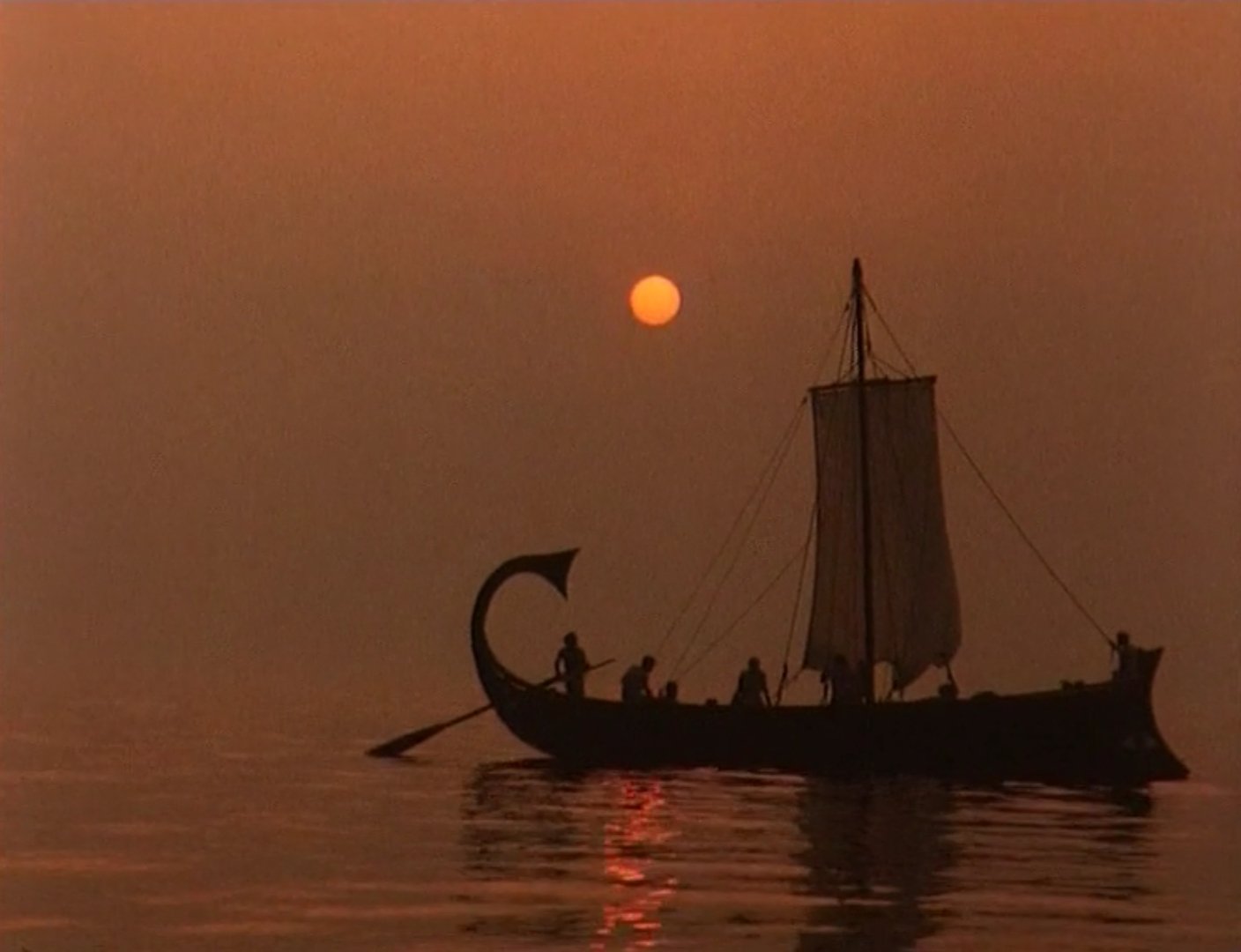
by Samuel Alexander
Keep Ithaka always in your mind.
Arriving there is what you’re destined for.
-—Ithaka, C. P. Cavafy
Homer’s epic poems, The Iliad and The Odyssey, stand as pillars of Western cultural cannon, their influence likely comparable only to the Bible. The story has been told and retold, adapted and reinterpreted dozens of times. The story and its structure are so ubiquitous that everything from Apocalypse Now to Spongebob owes something to the blind poet’s work. Yet one of the most unique and atmospheric takes on the story remains Franco Piavoli’s cult 1989 film Nostos: Il Ritorno.
Born in 1933, Piavoli is something of a renaissance man, an artist with a passion and skill for poetry, painting, music and photography, all of which he tried before settling on cinema at the age of 21, while studying law. Hailing from the Lombardy region of Italy, this cult figure of post-war Italian cinema has a signature style built on compassion and tenderness for the natural world, which earned him the title of a pragmatic dreamer and praise from filmmakers like Tarkovsky and Brakhage, amongst others.
His films play out like city symphonies of the 1920s, only set in rural locales. He’s Dziga Vertov, divorced from the city, working with his camera to present a different view of the world we think we know so well. His early films, like Domenica Sera (1962) which captures a Sunday evening dance, show his knack for combining beauty and melancholy, showing people as ingrained in the natural world, not just a part of it. His work treats atmosphere and narrative as deeply intertwined; the films are not really about anything as much as they want to create a feeling from the event captured.

Most of Piavoli’s films feature none, or very little, dialogue. He treats language as a sound, more interested in its phonic qualities and ability to suggest emotions than conveying a particular meaning. Language is only a tool, not the key to understanding. His unique treatment of sound and visuals lets the viewer create their own stories and meanings, letting each viewing become a subjective experience. This idea was brought to its apex in Nostos: Il Ritorno, an adaptation of The Odyssey which decenters the human protagonist, stripping him of language and placing him in the grand, unpredictable nature.
Released in 1989, Nostos: Il Ritorno was Franco Piavoli’s second feature, filmed largely without sets over a period of two years, using the existing landscapes of Sardinia, Lake Garda, Campania and Calabria. The film presents Odysseus’ journey as both a physical and a metaphorical endeavour with an emphasis on the subjective. As the film begins, we see a boat on the open sea, its crew asleep. One of the men, our hero, dreams of a child playing with a hoop, the first of many times we will see this image. Almost immediately after, we are taken back to the burning of Troy, but there is no heroism, only the screams of women and a city in flames that plagues the soldiers’ memories. The beginning sets up how valuable dreams and memories are in Piavoli’s world, putting them on equal footing with the real.
The rest of Nostos flows in a similarly loose, episodic structure, where scenes follow one another like dreams, drifting in and out between the real and the imagined. It is the dream of the child with the hoop that propels Odysseus in his journey. He goes back to that image at key points of the story, the hazy world of dreams drawing him back to Ithaca. Odysseus travels through the Mediterranean and his consciousness, turning away from the spectacle and heroism, something Piavoli also did quite literally in his 1964 short Evasi, which captures a sporting event just by looking at the fans’ reactions. Nostos, on the other hand, plays like a meditation. There is very little dialogue in the film, and when it does appear, it is a fictional mix of Sanskrit, Latin, and Armenian. This ambiguity creates a truly mythical portrayal of the ancient times, transporting us to a unique interpretation of the pre-Homeric world. The film does not need a legible language, because what it seeks to convey is that the feeling of wanting to return home is universal, and it needs no translation.

The longing is conveyed solely through Odysseus’ eyes and in the awe-inspiring nature around him. His silence, and the fictional tongue, lets the viewer reach their own conclusions. Franco Piavoli looks at Odysseus almost like an anthropologist, posing questions about man’s place in the world. With no one around, in landscapes devoid of human presence, what can a hero, or any man, do? By stripping language and dialogues to the bare minimum, the film makes it easier for us to identify with the man beyond the myth. Even Odysseus gets homesick.
Piavoli’s omission of language in Nostos also does away with the nature/culture divide, framing the world as pre-Enlightenment thinkers might have seen it, not separating between man and nature, science and art. It is all one and the same, harmonious. The film’s lush camera work enforces an affinity for the grand nature which recalls the Romantics and their idea of sublime. Piavoli finds it in the everyday aspects of this foundational Western text. He is less interested in cyclops and sirens than he is in the trees Odysseus might have hugged. When Odysseus loses his crew, we don’t see their bodies, but only their helmets, sinking under the water. Moments later, the hero is in a fetal position on an empty beach, surrounded by nothing but sand. When he does meet another, like the nymph Calypso, their lovemaking is intercut with a river running through the landscape, the human, the natural, and the mystical combining. Piavoli’s treatment of nature with a magical realism that makes one almost believe the Greeks’ pantheism, that every part of the world is ruled by a presence mightier than man.

The film ends in a synthesis, Odysseus finding home in a man-made structure, blending dreams and reality into one as he sees a sunny, serene landscape and children playing, along with his wife, Penelope, in the background. The long journey is done and in that moment we understand Odysseus completely, without a need for spoken language. What Nostos does sounds impossible. The film is a free reconstruction of a foundational Western text, something like reinventing the wheel. It’s hard to suppress the feeling of awe that a work like this actually exists. One of fiction’s most famous characters is transformed into a tabula rasa, inviting the viewers to project themselves on it while showing that the core elements of The Odyssey are so universal that even with an invented language it is possible to understand and relate to the story. Piavoli does not even try to subscribe to the collective illusions of what an epic should look or sound like. To him, the epic is in the everyday, which is why the story will continue to be interpreted and reinterpreted for centuries, if not millennia, to come, transcending time and language.
Samuel Alexander is a culture writer and photographer from Slovakia. His writing has appeared in Ringtone Magazine, HMOTA or SudetyRaport, and he runs the music blog not4climbing.
If you enjoyed this article, please consider tipping the author and/or supporting Ultra Dogme on Patreon, Ko-fi, or Substack, so that we may continue publishing writing about film + music with love + care.