
by Alex Fields
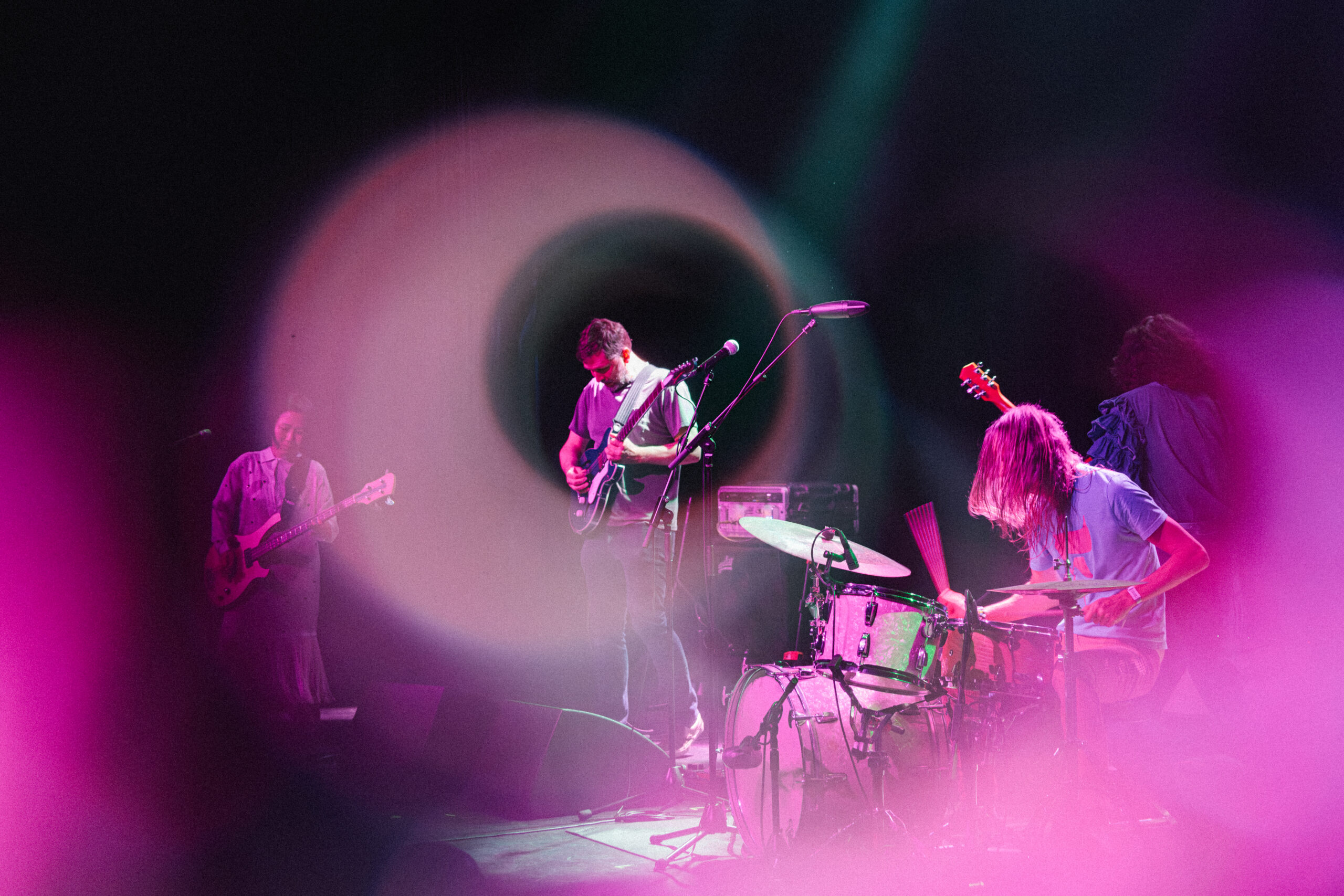
Featured Image: Deerhoof. Photo by Andy Feliu.
Every Spring, Big Ears maps the creative landscape of contemporary music onto the physical one of downtown Knoxville, TN. Jazz improvisations, through-composed classical works, singer-songwriters, multimedia installations, drones, rock bands, and traditional musics from around the world all compete for your scheduling choices. The settings vary almost as widely, with stages in churches, an abandoned bus station, a gin distillery, hotel lobbies, historical theaters, cinemas, pubs, a civic center, and standing room venues of all sizes.
While live music always differs from a recording, a festival like Big Ears offers the unique experience of contrasting widely varied forms of music and audiovisual art in quick succession. It’s impossible to be here without reflecting on the varieties of these experiences and the interactions of musical forms with physical spaces and modes of attention.

Anna Tivel and S.G. Goodman made two of the better songwriter albums of last year, and one might be inclined to judge them as inhabiting a fairly similar space in Americana based on those releases. Yet seeing them minutes apart—the former with a few dozen people crowded intimately in a tiny pub and the latter in a huge, booming club packed with over 500—suggests instead a divergence. Mary Halvorson’s Canis Major and SML are both “jazz” bands with guitar, bass, drums, and horn, but seeing the former from a balcony in a concert hall and the latter in a dancing crowd surrounding the band, the similarities nearly vanish. The white hot big band music of the Patricia Brennan Septet, or Roscoe Mitchell’s saxophone abstractions, or the orchestral chaos of Simon Hanes’s GARGANTUA all further push the meaning of “live jazz” into distant corners, and jazz is but one aspect of this festival.
With so many options—always at least three or four at a time across at least seventeen locations in downtown Knoxville—it’s impossible to talk of the festival as a whole. A friend and I compared notes afterward and realized we’d each spent four days here and caught two dozen or more performances, yet never once been at the same show! In addition to those already named, my weekend included wonderful performances by some of my favorite living songwriters (Jimmie Dale Gilmore, Butch Hancock, Richard Dawson) and bands (Moin, the Tara Clerkin Trio). Meanwhile I saw none of the dozen plus John Zorn events, none of the film program, and none of the live podcasts or discussion panels. I could not be comprehensive if I wanted to be, and rather than exhaustively describe every show I did or didn’t catch, the heart of my report will discuss the festival through the two centerpieces of my chosen experience: the weekend long residency of LA electric jazz group SML, and the traditions of fingerpicking guitar and experimental Anglo-American folk music.

SML (XXL)
SML, from Los Angeles by way of Chicago, is Jeremiah Chiu (synthesizer), Booker Stardrum (drums), Anna Butterss (bass), Gregory Uhlmann (guitar), and Josh Johnson (saxophone). The band played six shows at Big Ears, three with their core lineup and three with special guests (e.g. Rob Mazurek, John Dieterich, Jeff Parker, Mikel Patrick Avery), all at a pop up venue called The Greyhound for the logical reason that it used to be a Greyhound bus station (I can personally verify this, as I took a bus from there to NYC once). They specifically requested to perform facing each other in a circle, so the stage (barely elevated) was placed in the center of the tall empty room, the crowd surrounding the band.
In my draft schedule for the weekend, I planned to see SML’s first set only. I ended up at five of the six sets, and I imagine I wasn’t the only one drawn back repeatedly. The venue hit its 500 person capacity at every show, and the majority seemed to stay through the break between sets each night.
These shows were the strongest possible lesson of the important difference between live and recorded music. I like SML’s albums very much, but those albums consist of two to four minute tracks, apparently edited from live performances but expressing a very different relation to the compositions (improvisational or otherwise). Because of their condensed form, and presumably also because of the excerpts chosen, these tracks exhibit a concise snapshot of their ideas, and lean toward a relatively more melodic form of groovy electronic jazz.
The actual live sets, by contrast, consist of 10, 20, even 60 minute unbroken jams which develop their material extensively and induce their audience into dance-driven trance. The glory of the performances is, first, in the accumulated power of lengthy collective experience, but also in how the music evolves seamlessly from one groove or texture to another, rarely involving any sudden and dramatic change yet becoming unrecognizably different within five or ten minutes’ time. This variety held within each set and across the different sets, such that the five hours of music I saw from this band never seemed to repeat ideas. Depending on when you walked in, you might have called this jazz fusion, or a DJ set, or Düsseldorf-school krautrock, or Fourth World music.

The enormous range of genres the members have worked in all come into play in their collective work, and the whole is clearly greater than the (already great) sum of its parts. The band’s contributions are so well matched that it’s often difficult to tell which sounds are coming from which instrument (an effect amplified by their circular seating and the impossibility of a frontal view of all five at once). Chiu’s electronics mesh seamlessly with Stardrum’s physical percussion and the clicks and pops of Uhlmann’s guitar.
Program notes describe Chiu as the band’s “central nervous system,” which is right insofar as he and his synthesizer seem to play a bandleader role, but the impeccable rhythm section of Butterss and Stardrum are the foundation these grooves are built upon. Their choices of when to alter this foundation are less conspicuous than the melodic instruments, but perhaps do more to structure the outcome. Meanwhile, guitar and saxophone don’t exactly solo so much as come in and out the groove organically, such that the whole seems to be operated by one mind which absorbs the individuals who compose it.
All of which is to say: this band is very fun live.

John Fahey’s Grandkids
When I interviewed Gwenifer Raymond recently, she described getting into Blues pickers as a teenager through the folk and rock artists she and her parents listened to, and then being introduced to John Fahey when a friend said the music she had begun writing sounded like his. Her path is in a sense representative. Most popular music can in some sense be traced back to the Blues, and Fahey’s style (not just his fingerpicking but his conceptual experimentation with American folk traditions) is arguably more influential today than it has ever been, but this influence has taken winding paths. Fahey was out of favor for much of his career, and his rediscovery in the ’90s had as much to do with artists like Sonic Youth and Jim O’Rourke as with folk or Blues music as such. The sensibilities of the artists continuing his legacy today range from drone and ambient to post-rock and grunge.
Raymond herself represents one extreme of this spectrum. She started playing music in grunge bands, and her inclination toward speed and aggression are apparent even on her comparatively modulated studio recordings. Her last album, Last Night I Heard the Dog Star Bark, was my favorite album of 2025. In live performances, she plays much faster and harder still. The guitar strings seem to be her mortal enemies, and it’s a constant wonder that she doesn’t break them. Generating prodigious sound and energy from an acoustic guitar, her performance feels more like a noise rock show than the prettified strumming of Hayden Pedigo or William Tyler. That rock star impression is not damaged by seeing her kill a tall boy of PBR in the middle of a song while continuing to play with just her right hand.
Another extreme—connected to Raymond’s approach only if you follow the chain of artists and influences between them—is SUSS, who premiered a longform multimedia piece called Americana Apocalypse on the first night of the festival. The title of the piece conjures a barren landscape with the detritus of American culture, and indeed the music is something like that, but not in a good or formally expressive way. There is nothing here to critically inquire into the state of either Americana or ambient music, much less the American condition, nor even to create musical interest or sustain merely pretty textures. Just some aimless strums and synthesized pedal steel riffs, generic markers with no structuring vision.
Asked at a 2025 Big Ears panel what made his music different from previous ambient music, guitarist Bob Holmes said something to the effect of “my heart is an instrument.” Unfortunately, feeling it in your heart is not enough to make compelling music of this sort. The multimedia aspect of the piece was, if anything, even worse. Four projectors showed two video feeds on the walls of the venue, consisting of sprawling Western landscapes and run down buildings seen aerially by a spinning ‘camera,’ except there’s no actual photography and it all appears to have been made digitally through some kind of video game graphics engine. It feels like a bad parody of the films Phil Solomon made in Grand Theft Auto, and echoes of the shallow signification of the music.

If Raymond and SUSS were respectively the best and worst of the festival, as well as opposite extremes of experimental folk styles, several other fingerpickers and banjo players fell somewhere in between. Hayden Pedigo’s solo work is more on the minimal and pretty side of this spectrum, which is somewhat ironic since his last release was a collaboration with Chat Pile, but that contrast between the two albums he released last year speaks to the range this music has, or rather to the way apparent differences of influence can disappear in its actual practice. I enjoy Pedigo’s albums and I enjoyed the few songs I was able to see of his Big Ears show, but I find his compositions too lacking in tension to be really exciting.
Brandon Seabrook also played a solo show, but while last year he brought a twelve string guitar to Big Ears, this year he played on a four string tenor banjo. His set included everything from clawhammer to fingerpicking and flatpicking to effects pedals, and was something of a showman’s exercise in demonstrating every technical possibility offered by an instrument not associated with its wide range. Some of this approached gimmick, and favored bouncing rapidly between extremes of style and virtuosity over developing compositional ideas, but it was the kind of show meant to entertain without taking itself too seriously, and it certainly accomplished that.
The band Setting also use a banjo, played by Nathan Bowles, formerly of Pelt. Bowles is joined in the group by drummer Joe Westerlund and synthesist Jaime Fennelly, their droning style, while recognizably descended from Pelt, is even closer to post-rock or krautrock and further from folk. The banjo seems visually out of place here, but its sound dissolves into the band’s minimalist grooves.
Nineteen year old Irish fingerpicker Muireann Bradley played at the same Scottish pub as Setting, and her music was much closer to what you’d usually hear on that stage outside of Big Ears. Bradley is clearly enamored with the Blues and related folk traditions, and mostly performs faithful covers of classics and traditional songs like “Vestapol,” “Shake Sugaree,” and “Stag O Lee.” She’s a very good picker with a powerful voice, but so far doesn’t offer much of an original perspective on the tradition she’s working in, and is perhaps too clean and precise in both vocals and guitar. But that’s hardly unusual for a teenager experiencing very early success in folk music, and she has plenty of time and talent to explore.

William Tyler and Yasmin Williams debuted their collaboration at the Knoxville Museum of Art. I like Williams and her band, but I mostly wondered what Tyler was doing there. The collaboration did not seem to be fully formed or have a clear idea what to do with two fingerpickers on stage together. Tyler is a perfectly competent guitarist, and his collaborators seem to love working with him, but his many projects and guest appearances often feel driven more by a desire to work together than a vision of how to do it.
I appreciate that Big Ears offers this condensed snapshot of musical traditions which span continents and generations. Variety in and of itself may not be wanting when we all have the history of music at our fingertips, ready to skip continents or decades at a swipe. But the very ease and interchangeability of the digital track can flatten the vision and the countless hours of work an artist committed to their music into something you skip if it doesn’t grab your attention. When you enter a room with those artists and witness the physical reality of their work, you see in three dimensions again.
Alex Fields is a film writer and postal worker in Knoxville, TN. They write regularly on formalist, experimental, and genre film for Tone Glow and their blog, Not Reconciled.
If you enjoyed this article, please consider tipping the author (PayPal: ac_fields@hotmail.com) and/or supporting Ultra Dogme on Patreon, Ko-fi, or Substack, so that we may continue publishing writing about film + music with love + care.