
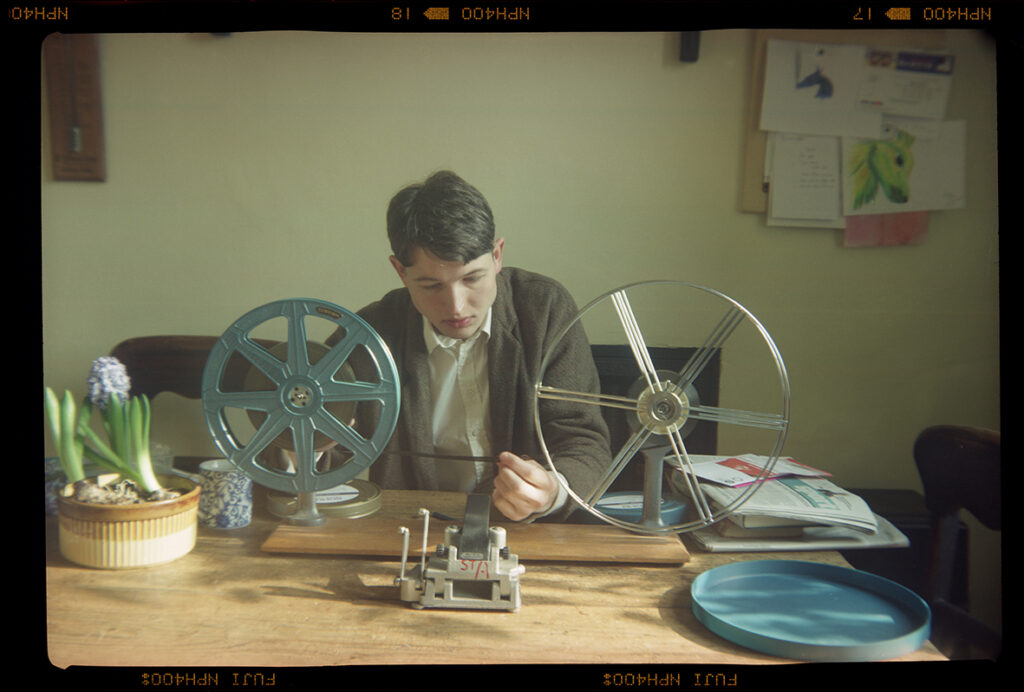
by Miguel Armas & Mariya Nikiforova
This interview was first published in French by Débordements as LUKE FOWLER: GARDER L’ÉNERGIE DU MOMENT on 19 March, 2026. Ultra Dogme is proud to present the interview in English, edited directly from the original English transcript. We would like to thank the authors, Luke Fowler and Débordements for their kind permission to publish. The above featured photograph of Fowler is by Alan Dimick.
Mariya Nikiforova: We wanted to start with a very basic question about how you got into filmmaking. Where did you study film?
Luke Fowler: I went to Dundee Art School. There was a video art department there run by Stephen Partridge. He had been at the forefront of experimental video when the Portapak came out in the ’70s. There were two camps: video art and experimental film, and they didn’t really get on.
I would borrow equipment from them to make films and videos, but I studied printmaking. I was also interested in sound and making music from an early age because my brother was something like a computer genius. He started programming around the age of ten. I was always playing around with tapes, tape recorders and microphones. Since we were already using the computer to play games, he said, “Oh, you can make music on the computer.” And I thought, really? He got me this software that was called a tracker. It was almost like a jackpot machine, with numbers that would go round in a loop. Then, next to the numbers you’d place events wherever you wanted something to happen. It was a very basic sequencer. After that, he built me a computer for making music. When I was at art school, I was the only person with a computer for music, so everyone would come around to my apartment to make music with me — including one of my tutors.
Mariya Nikiforova: Did he base this computer on some sort of model?
It was just a PC, but he configured the sound card and the graphics card. It was before laptops. I remember doing concerts where I’d bring the whole PC and a monitor. It was not very portable. At art school, I was always making music on one side, and on the other, doing more socially engaged artworks involving the public. For example, I would set up a stall outside, print a banner that would say “coffee for knowledge,” and I would give away free coffee and have conversations with people.
Mariya Nikiforova: Sociological inquiries.
Yeah, just stopping people. I was interested in speech and language, something that has run through a lot of my work since then, this interest in the vernacular and the oral tradition…At one point I did make some early videos, but I was never so interested in just filming with a video camera. I did an exhibition where we were using a video camera that was set up on a tripod with a 180-degree aerial view. It was called The Social Engineer. Again, it was about creating encounters between people. But this time, it wasn’t me that was doing the conversation. I set up a kind of blind date between two strangers who had never met. I filmed their conversation, took the speech, and used it to make music. Then I gave that material to electronic music composers to use as source material.
Around the time of my degree show, my father had a breakdown and was briefly hospitalized. Due to that experience I became interested in alternative forms of therapy and the pharmaceutical industry as a whole. I started reading the psychiatrist R.D. Laing amongst others. Then I thought that maybe I could make a film out of this research. So, I went down to London and did some filming at this place called Kingsley Hall, which was a social experiment started by R.D. Laing, David Cooper, Francis Huxley and several other therapists that began in 1965 and ran until 1969. Then it turned into something else called The Philadelphia Association. It was radical and very much in the spirit of the 60s. No one was forced to take drugs or do anything against their will. It was anti-hierarchical and anti-authoritarian. You couldn’t tell who was a patient and who was a doctor. There was no distinction made, because it was felt that everyone, at times, goes astray or has a breakdown. People shouldn’t be stigmatized for that because it’s just a natural part of what Laing felt was a product of capitalism, i.e. alienation.
So I made this film which was a kind of collage of found footage: I used archive material and also an interview that I made with one of the members of the experiment. I was very much influenced by things like Johan Grimonprez’s Dial H-I-S-T-O-R-Y and Rock My Religion by Dan Graham. I had grown up watching a lot of television, but I was interested in documentary, and these were forms of documentary that were much looser and more queering the form, in a way. I realized that what I was interested in doing was making some kind of epistemological anarchy in film-form, where the film follows the form of the subject. The film itself becomes unhinged from reality, or from the usual safety net of being guided by the filmmaker. At a certain point you lose your grip on what’s happening and it all starts to disintegrate. That became my first film in 2000, when I graduated, titled What You See Is Where You’re At.
The other important factor was that my partner at the time was very interested in experimental film—particularly flicker films like Tony Conrad or Paul Sharits. That was the first time I was exposed to those films, which became the starting point of my influences: Structural film, American experimental film, and then, this strange hybrid form of documentary that some artists like Sarah Tripp, Duncan Campbell or Oliver Payne and Nick Relph were making.

Miguel Armas: Is Margaret Tait one of them also? Did you already know her work at that time?
I remember seeing Margaret’s work after she died and being very struck by it. She was also Scottish and an independent filmmaker, and she didn’t conform to any groups or scenes. She wasn’t a Structural/Materialist filmmaker, and she wasn’t a documentary filmmaker. She was a singular figure who really pioneered her own form and was fiercely independent. She was there, but I didn’t become seriously interested in her until recently.
Mariya Nikiforova: The kind of montage you’re describing also makes me think of a film like Handsworth Songs.
Yeah, that was definitely an influence—the Black Audio Film Collective, for sure. You have to remember the prevailing context in contemporary art at the time was people like Douglas Gordon and Bill Viola and the whole YBA [Young British Artists] scene. The defining features of which were often a locked-off video camera on a tripod or performance to camera type thing. This very immediate way of using video cameras to create a feedback loop or the video camera as confessional booth wasn’t for me. I was more interested in using the devices to explore histories of ideas. So I would go and read Peter Gidal and watch folks like Markopoulos, Frampton, Beavers and Marie Menken, things that would nourish the kind of cinema I was searching for.
Mariya Nikiforova: When you talk about listening to speech patterns, it also makes me think of some films by Lis Rhodes. Is she an influence at all?
Yeah, for sure. I did something called the Lux Associate Artists programme, and Lis was my first mentor there. After her, I started working with the Welsh sculptor and former Super 8 filmmaker Cerith Wyn Evans. I love his work too. But yes, Lis’s Light Reading and Pictures on Pink Paper were very important films for me because they were so personal, but political as well. I was totally obsessed with Structural film and I was interested in how it became more poetic and personal as identity politics hit in the ’80s. Filmmakers like Guy Sherwin, for instance, whose films changed from a pure interest in film material to something that was much wider. Those films with his child, like Messages, or another one—Mile End Purgatorio—which is a Super 8 film which has great timelapse sequences, seem much more poetic and personal. And interestingly, Guy visited Margaret up in Orkney, in the ’80s.
Miguel Armas: You talk a lot about experimental language and not being happy with video. How did it change for you to start using the Bolex? When I watched your films for the first time, I was thinking of the Bolex as your instrument, there’s some kind of a very rhythmic use of this instrument.
The Bolex was a revelation. Before that I’d been using Super 8, and I liked the results, but it was always a bit random. You could set some cameras to manual, but often they had auto exposure, and the film speeds were limited, basically Kodachrome, so you couldn’t get faster stocks. Shooting interiors was difficult. When I got the Bolex, I treated it like a Super 8. But you’re also aware of all of the people that have used Bolexes before, so you feel like you’re continuing a tradition: Marie Menken, Hollis Frampton, Warren Sonbert, people like that. So, immediately you think, there’s so many things that you can do with it. You can fade, change the speed, put things in the filter holder, change the turret. It felt to me like it was quite an open system, not like video, where it’s locked off, and you’re just recording reality. Actually, for a long time, my Bolex was broken. When the camera was set to 24 frames per second, it was probably shooting closer to 40. So when I got the footage back everything was slightly slowed down. I loved that it was slower than reality, it really helped with handheld footage and gave the images a kind of distance and weight. For the first few years I also used a Bolex light meter. What I didn’t realize at the time was I was always measuring the brightest highlight of whatever I was filming. The result was that the streak of light would be perfectly exposed, but everything else would fall into darkness. That became part of the look of a lot of my early films.

Miguel Armas: And also about the Bolex, I’m thinking about the Tenement Films, but maybe it applies to all your films, how it’s important for you to edit in-camera. I know those four films are edited in-camera. Do you usually do this?
It came from Super 8, because in Super 8 you didn’t want to go anywhere near editing, because it was so small and fiddly. So you had to edit in-camera, that’s how I learned. I’m still very lazy about editing, and I don’t like to sit down to edit. I’d much rather have this energy of the work, the decisions made at the time, in the space. It’s very hard to approximate the energy of the editing in-camera on the editing block. I don’t have access to a Steenbeck, so I’ve always edited either with transfers or with rewinds. Those two systems are very different and produce very different results. When you edit with the rewinds, there’s an economy in editing, and it’s very labor-intensive. The film gets more and more beat up while you’re editing, it’s a kind of destructive editing. And you can’t easily go back to rectify decisions that you’ve made. So you have to be much more clear-headed about what the film is and its form rather than the digital system of just making an edit, deleting that version, making another version. And that’s what I do with digital. One of the films screening tonight, For Christian, was edited on a Steenbeck because I was at Harvard and I had access to one.
Mariya Nikiforova: For Christian was filmed while you were on a fellowship?
I was at Dartmouth College in New England when I met Christian [Wolff]. He was on the faculty there—not teaching music, but comparative literature. I didn’t want to make a film about him, but I knew that I would be kicking myself if I went home and I hadn’t made some kind of document of his influence. So I said to him, “Can I come out to your farm and do some filming?” I brought the Cornelius Cardew film that I’d made [Pilgrimage from Scattered Points] because Christian was in the Scratch Orchestra at one point when he moved to London in the ’70s. Whilst he watched the film, I went around and filmed in his house. And then I came back another time, that’s when we did the interview. He laughed because when I turned up for the interview, I didn’t bring my camera with me, but he’d got a shirt on. But when I was filming him in the farm, he didn’t expect me to bring a camera, so he was dressed in an old hoodie, which was his farm clothes.
Mariya Nikiforova: You film people, but without imposing the camera on them. And sometimes they’re not present at all: sometimes it’s just what is left of the person or what traces they have left in other people. We were wondering about your choice to film people in this way.
Not to film people? [laughs]
Mariya Nikiforva: Exactly, or to represent them in this way that is very respectful, very delicate.
I think it probably comes from Structural film and from distrust of dominant ways of representing people. Peter Gidal’s Room Film and also things like Georges Perec and Walter Benjamin! [laughs] So, I’ve never really been interested in faces—you know the Andy Warhol Screen Test thing. I just wanted to distance myself from ethnographic ways of looking or from exoticizing the other. A lot of it comes from where I grew up. Glasgow was quite a violent and volatile place. There was a very violent machismo culture, and a popular phrase that other young men would say to me was, “What the fuck are you looking at? Are you looking at me?” So, naturally you avoided looking at people. To look at somebody was confrontational because it also implied a class-based system of judgment. Quite often, a lot of people in Glasgow had scars. But I learned, just because you had a scar didn’t necessarily mean that you were a fighter. It just meant that you were a victim. So, a lot of it comes down to not wanting to point the camera, to transgress a boundary. And again circling back to Georges Perec’s essay My Table, and this interest in the objects on his table and feeling that this said more about him than a portrait could. So, the two sort of went hand-in-hand for me: the gaze and modernist literature.
Mariya Nikiforova: Or a strategy to still do it somehow, without betraying the ethical, compassionate position. It comes from a place of compassion also, empathy for others.
It also comes out of feeling that if one has too many images of that person, then it’s somehow a definitive portrait rather than a fragmentary, aloof and subjective thing. So with the film about Margaret Tait [Being in a Place], it was a very conscious decision not to have too many images of Margaret, because I knew that she was wary of being filmed. She was dissatisfied with portraits of her. She was like, “Why don’t you show my films, not me?”

Mariya Nikiforova: When we watched Mum’s Cards, we thought: Ah! The fact that your mother is a sociologist explains a lot! Would you say she’s a big influence for you, and maybe your dad?
My father was definitely an influence early on. And my mum also, because I had a sociological mode of inquiry drummed into me, and I was interested in people and places maybe also comparatively…It certainly wasn’t field work, and it wasn’t academic, but I think I did it by way of osmosis. You can’t escape the influence of your parents or where you grew up, your “habitus”. My dad, who died in 2000, was what in Glasgow you would call a “culture vulture.” He had a voracious appetite for culture, film, theatre, opera, books, television. Maybe less [so for] music, though he liked classical music.
In a way he was a frustrated artist; his life was spent as a spectator. He would go and see things and then he would come back and tell you about them, and his interpretations were often better than the actual things that you’d seen. He was always forcing us to go to art museums when we were younger and would always give these amazing interpretations of paintings. That was my introduction to art and film very early on. With my mum, when I was in primary school, she compelled me to ask my friends’ parents if she could interview them. She would give me pieces of paper to hand out to them. I realised late that I was helping her with her field work. I remember once being bullied by a boy in school, and her solution was to invite him around to the house to play. “Why on earth would I invite this bully into my home?” Her response was, “why don’t you invite him around to the house and just see what happens.” Eventually, he came and he was really nice to me whilst he was here, so it sort of worked! I always say that my childhood was a bit of a sociological experiment. And still, my mum is one of my harshest critics. You should interview her! My films are too ambiguous, too vague for her. Sometimes she likes them.
Mariya Nikiforova: She criticizes your method.
Not rigorous enough, not scientific enough. And the Margaret Tait one—not enough pictures of Margaret Tait in it.
Mariya Nikiforova: It’s funny how in the film about your mother, when you ask her how she got into sociology, she describes it as a sociologist would: “I think it’s the downward social mobility of my family.”
Who says that? [laughs] I showed that to my sister, and she was quite skeptical: “Bullshit, total bullshit!”
Miguel Armas: I have a more general question about sound and music in your work. You collaborate with musicians for your films and installations. Starting with the Tenement Films, each one involves a different collaborator. How do sound and image interact in your practice?
I did a collaboration with Lee Patterson called Draw a Straight Line and Follow It, for Courtisane Festival in Ghent. It was influenced by a La Monte Young score with the same title. We drew a ten-mile line on a map. Lee Patterson would make sound recordings, and I would make footage with ten rolls of film. It was all edited in-camera and not edited, just put together on a reel, and instructions were given to the lab: Don’t grade the film, so the underexposures and overexposures remain. When we showed it, Aki Onda, the Japanese composer, said to me: “You shoot film like a musician, and Lee composes like a filmmaker.” And now, I think and make films like a musician and make music like a filmmaker myself.
I kind of wanted to push that even further. That’s why I’m interested in making this film about Brunhild and Luc Ferrari. Luc pioneered this idea of anecdotal music and “sons mémorisés”. The music itself produces images and ideas in the viewer’s mind. The qualities of speech or qualities of sound that have symbolic meaning are very important to him, in contrast to musique concrète and Pierre Schaeffer, who made music that was purely abstract, that was about completely removing the association with what was making the sound, the source. He did not want people to know that it was, like, a metal can or a very banal object. He wanted free associations, but Luc was the opposite. He wanted people to be situated.
For me, at the start it was always a bit like the two things were quite separate. I would make music and then I would make films that were about musicians or about sound, but I wouldn’t really overlap the two. And now, 23 years later, I’m starting to do soundtracks for people and make my own sound works that are like “cinéma pour l’oreille”, Walter Ruttmann-inspired. I see it as more and more porous, more and more overlapping. In the past, music felt like this sacred thing. Film was different. Now I’m more interested in the overlap. I’m making sound sculptures or making ruptures in the film soundtrack.

Mariya Nikiforova: You made a series of films where people inhabit the same kind of space, which, as I understand it, was worker housing back in the day, which is maybe not the case anymore today. Do you have a particular interest in those kinds of spaces or habitations?
I suppose, again, I see it as a continuation of this idea of Perec, the species of spaces, as when he made the book Life: A User’s Manual, where he looked at everybody that lived in this block of flats. I was interested, with the Tenement Films, in this alterity, if that’s the right word, where we all inhabit the same physical space, but what we do with it is completely personal. At the time, the people upstairs from us were always complaining to me about my sound because I had my studio at home, so they would come down and complain—”I’m trying to sleep. I work the night shift. What’s going on? It sounds like a plane going off.”
There was a chemist on the top floor, and a mathematician on the middle, and on the bottom floor there was a jeweler. There were all these different classes of people and professions all thrown together. It’s very Glasgow in that way. So I suppose, I’m not interested in architecture as a figure, I’m not an architectural fanatic, but I’m interested in how people occupy architecture and space, especially acoustic space. And I suppose, in a lot of ways, with the Tenement Films, I was thinking about film time and film space and how it could be represented in architecture. There’s no divide between the inside and the outside, and there’s constant movement in the films of the camera, moving in angles that you wouldn’t ordinarily see space in. And also using the camera to reveal patterns of light or behavior that wouldn’t ordinarily be observable by the naked eye. So, I think architecture interests me in the way that it’s a mute witness to patterns of behavior and reflects the politics and society of the time.
This interview was conducted on February 14, 2023, in Paris, where we invited Luke Fowler to present the screening Film Portraits by Luke Fowler.
Miguel Armas is a film critic and researcher, born in Tenerife and based in Paris since 2011. He studied at Pompeu Fabra University (Barcelona) and the Sorbonne Nouvelle University (Paris), and has worked in the fields of film publishing, curating, and distribution, with a special interest in experimental practices and the relationship between film criticism and filmmaking. He has been a member of the editorial board of Lumière, and since 2020 he works at Light Cone, a Paris-based association dedicated to the preservation, promotion, and distribution of experimental film. He has recently published the essay On the threshold of the visible (Breus CCCB, 2026).
Mariya Nikiforova is a Paris-based curator who works with experimental and photochemical film in various capacities. She has been the collection manager at Light Cone since 2019. She has made several short films at artist-run film laboratories L’Etna and L’Abominable; she also occasionally curates film programs, writes, and teaches. Her creative and research interests include conceptual performance and video art in Eastern Europe in the 1970s-1980s, representations of post-socialist urban landscapes in cinema, questions of peripheries and edgelands, and hybrid photochemical/digital practices.
If you enjoyed this article, please consider supporting Ultra Dogme on Patreon, Ko-fi, or Substack, so that we may continue publishing writing about film + music with love + care.