
by Nguyễn Bình
The novella Distant Star by Roberto Bolaño opens with an eerie celestial omen. One late afternoon, while being held by Augusto Pinochet’s military dictatorship, the narrator looks up at the vast sky and sees a warplane’s squiggling smoke trail spell out a poem. The pilot, as it turns out, is Carlos Wieder, an elusive peer from his former poetry group. While other members have disappeared since the 1973 coup d’état, Wieder has fit himself right into the regime and found a place to pursue his wild, sickening artistic ambitions. The dictatorship has effectively split their old group in two: those who wither away in confinement, and those who integrate themselves into brutality for their own goals and over time become indistinguishable from it.
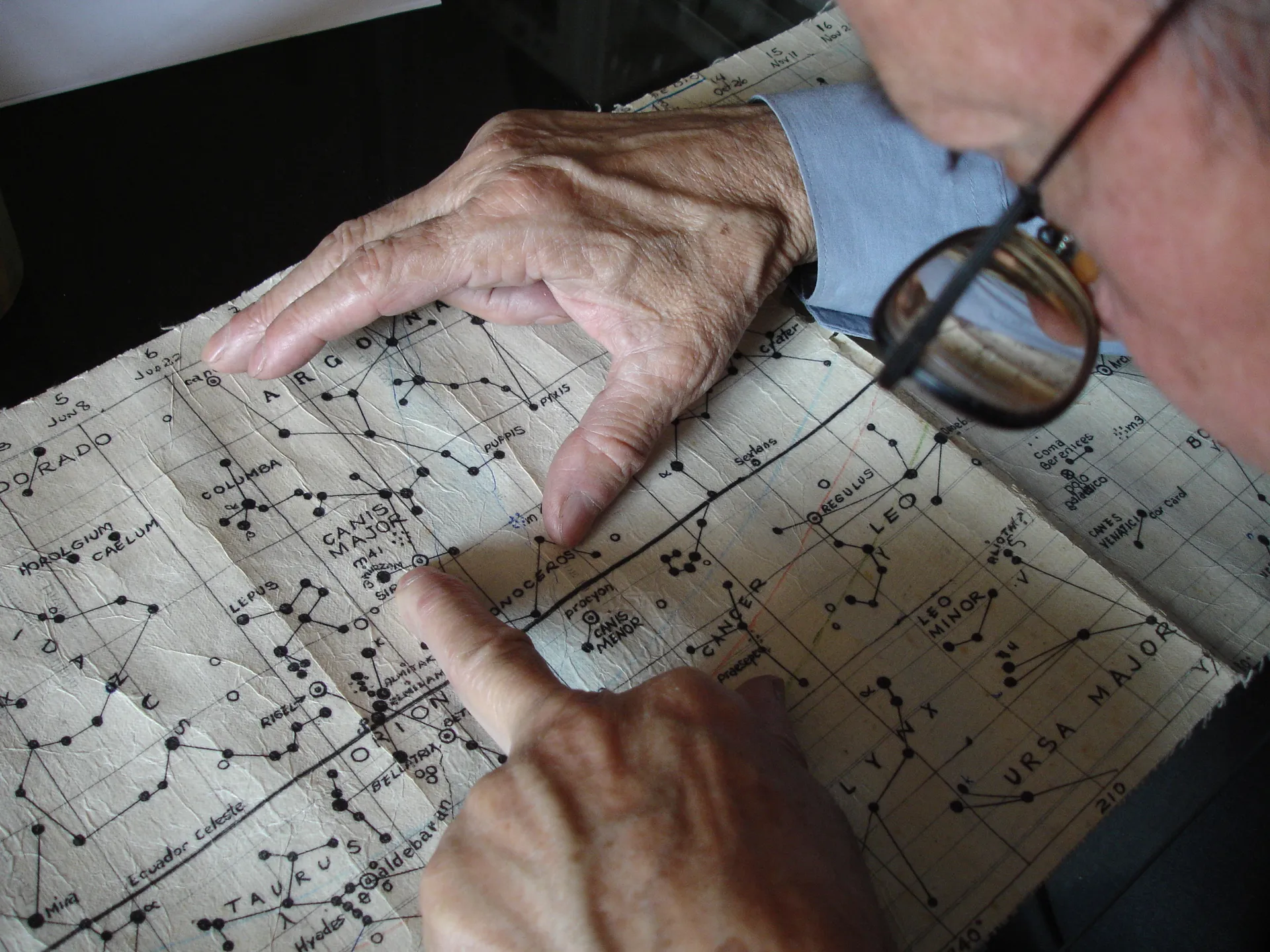
This divide is palpable in Patricio Guzmán’s Nostalgia de la luz (Nostalgia for the Light, 2010), which also grapples with the Pinochet regime through its own host of sky-watchers. Half an hour into the documentary, we meet Luís Henríquez, who pulled through his imprisonment at the Chacabuco camp in the Atacama Desert by stargazing. Led by a Dr. Alvarez, he and other political prisoners tracked the constellations’ movements, marveled at their pure light in the clear desert sky, and felt their souls liberated from carceral suffering. But the military, notes Guzmán, was quick to ban these observations, fearing that the stars would guide the inmates to escape. The film regularly shifts between stories like Luís’s, where survivors of Pinochet found motivation in the stars, and frames of the giant telescopes that now bestrew the Atacama, their domes rotating like dragon eyes to capture starlight. Luís was doing astronomy with his naked eye, while these facilities are feats of machinery, whose colossal scale requires productions, international treaties, and reallocations of resources that simply could not have happened without the regime’s involvement. Throughout the film, the telescopes soar above the prison camp in a manner similar to Carlos Wieder, and given the history behind them, that impression is strikingly apt.

Patricio Guzmán’s work has long been defined by rigorous, multi-layered depictions of socio-politics. His first major film, El primer año (The First Year, 1972), captures the fervors of Salvador Allende’s first year as president, where coal mine workers, Mapuche farmers, and other disadvantaged corners of society expressed hope at the new socialist reforms, while the pearl-clutching middle class fumed at the scarcity of ham and yogurt in supermarkets and comically took to the street. After Pinochet’s 1973 coup, Guzmán was detained for fifteen days. He spent the following years in exile and eventually put together his trilogy La batalla de Chile (The Battle of Chile, 1975-79). Despite its turbulent production—filming was halted by the coup, and the reels had to be smuggled to Europe—The Battle of Chile went on to become Guzmán’s masterpiece, where Chile’s turmoil plays out in excruciating detail, similar to his previous work. After the dictatorship ended in 1990, Guzmán worked tirelessly to make the case against Pinochet and compel Chilean society to confront the brutality. Nostalgia for the Light was born in the late 2000s, after decades have passed, and Guzmán, nearing seventy years of age, must have exhausted himself retreading the specifics of history. Now, the number of interviewees is reduced, and the grief trimmed into slow dialogues, then shots of elderly families pacing about at home, leafing through files, or scouting in the vast Atacama for the bones of their disappeared relatives. Stitched in-between are conversations with scientists at observatories nearby, who nod their heads and ponder the underlying themes. There is no such thing as the present, says astronomer Gaspar Galaz, since light always takes time to travel, whether milliseconds or years. Hence, we cannot escape the past, and must instead confront and reckon with it, especially when it involves a dictatorship that has claimed the lives of thousands.
However, the inclusion of astronomy only as a parallel theme to examine the post-traumatic effects of the Pinochet regime means that Guzmán fails to confront it head-on. The film opens with an old, manual telescope in Santiago, where Guzmán in his childhood fell in love with the cosmos for the first time. Drawing from this juvenile passion, Guzmán takes us to the Atacama, where former inmates share his childlike wonder for the stars, and real astronomers sit regally in their offices, overseeing large humming machines and spouting out romantic musings on existence. But not once does the film stop to ask: how did these newer telescopes, reportedly some of the biggest in the world, get built here? Guzmán’s voiceover notes that global astronomers started flocking under Chilean skies around the same time a ‘revolutionary tide’ disrupted his tranquil youth; yet any possible interplay between the two is never suggested. This omission stands out, for he painstakingly pursues every other historical thread. When the film mentions Chacabuco’s beginnings as a mining camp, we find pictures and anecdotes of the miners’ harrowing living conditions; we are also reminded by archaeologist Lautaro Núñez of the settler-colonial violence inflicted on the Atacama’s indigenous communities—another past that Chile seeks to forget. Astronomy, all the while, is framed as a pure, inspiring, knowledge-seeking passion. Is passion all that it takes to prop up such high-tech domes; to pay for their water and electricity; and to cut roads through the desert in order to reach them?

Observatories began mushrooming on mountains across the Atacama in the 1960s, first on Cerro Tololo (1962), then La Silla (1964). They were the result of a decade of site surveying, much of which was done by Chileans; however, the benefits that Chilean scientists received varied by observatory. AURA, which runs Cerro Tololo, worked with the Universidad de Chile and recruited its scientists. Meanwhile, the European Southern Observatory (ESO), which runs La Silla, signed a convention with the Chilean government in 1963 that gave them diplomatic immunity, as well as tax and labor law exemptions. These institutional decisions would lead to different orbits around Pinochet. After the 1973 coup, Cerro Tololo’s director, the Puerto Rican astrophysicist Victor Blanco, asked Pinochet to affirm support for their scientific operations. Pinochet’s adjutant instead requested a list of their staff members and political affiliations, which Blanco refused to provide. Soon after, Pinochet himself visited Cerro Tololo; Blanco wrote in his memoir that he ‘kept those Chilean staff members we knew to have been pro-Allende well away.’
Meanwhile, ESO, with its facility on La Silla, was unscathed. In 1977, the military dictatorship even expropriated 725 square kilometers of land around Cerro Paranal from a family, and in 1988 granted these to ESO. After Pinochet fell, the original landowners sued ESO and the Chilean government. Although the case was dismissed, it sparked enough controversy; under pressure from local lawmakers, ESO agreed to grant 10% of their telescopes’ observing time to Chilean institutions and apply some local labor laws to their operations staff. Yet it must be noted that this 10% pales in comparison to the 15% and 20% that observatories on Hawai’i and the Canary Islands respectively offer to local institutions. Moreover, ESO continues to exhibit patterns of neglect towards local communities, many of whom indigenous, while receiving special privileges from consecutive Chilean central governments since Pinochet—redolent of a neocolonial, multinational enterprise. For decades, ESO’s Paranal facility was preferentially provided water by the government, while the nearby village of Paposo continued to lack any regular supply of water and, as of 2015, received neither assistance nor coordination from the observatory. And up until the 2000s, ESO was able to not only flatten the top of Cerro Paranal and carve roads through the desert for their observatory, but also build accommodation, even a swimming pool, for its guests—all without submitting any environmental impact report. Such blatant disregard would have been denounced in Guzmán’s previous documentaries, which often take note of foreign interests and subsequent encroachments into Chilean socio-politics. It is unfortunate that Nostalgia for the Light instead approaches astronomy through a rather sentimental, if not rose-tinted lens.
Still, the film’s non-recognition does not mean that the viewer leaves it with no inkling of critique towards astronomy. From my perspective, Guzmán allows his themes to color the film so pervasively that against any gap of information, an informed viewer can still apply such themes and make their own interpretive critique too. Lautaro Núñez, the archaeologist who studies Chile’s indigenous cultures, compares his work to astronomers, who are also reconstructing a kind of distant past; however, he adds, there is a paradox in how everyone views history. According to Núñez, much has been said about Chile’s distant past, with all the petroglyphs he shows the viewer in the desert; yet, people still dance around the more recent history, which includes massacres of the indigenous and striking miners at the hands of Chilean authorities. The film carries on with this thread, suggesting that the military dictatorship has become another touchy subject of recent history. Given the astronomers’ track record, we can apply Núñez’s analysis to them too. Their Atacama telescopes can look back to billions of years ago, when the Universe and its galaxies were still in a primordial phase; all the while, these same telescopes are situated by Global North superpowers in a Southern settler colony, benefiting from brutal military dictatorships and at the expense of locals.

This tendency among astronomers to cozy up with power is most evident in Chile, where more than 50% of the world’s telescopes are located; however, it is not exclusive here. In the 1990s, facing fierce protests from Apache activists and environmentalists against their new observatory on Mount Graham, the University of Arizona recruited policemen to infiltrate the opposition and incite violence. And for more than a decade now, despite protests from Native Hawaiians, astronomers still insist on putting the Thirty-Meter Telescope on Mauna Kea, sometimes even portraying the Hawaiians as ‘backward’ and ‘uncivilized’ to justify their intrusion. Facing these common, often unquestioned collusions between stargazers and oppressors, Nostalgia for the Light, with its warnings against forgetting the recent past, offers us a helpful line of critique. Where’s the ethics in studying ancient galaxies, if it means trampling on our own world and reopening the wounds from recent injustices that have yet to heal? And where’s the ethics in looking for life on exoplanets when all around your telescope, families still search tirelessly for the bones of their dead relatives, who were disappeared by the same regime which allowed your telescope to be built there?
Nostalgia for the Light is not a documentary about astronomy; it merely uses the coincidental location and goals of astronomical research to grapple with Chile’s collective memories of murder. For Valentina Rodríguez, an ESO staff member who lost her parents to the dictatorship and is also the film’s final speaker, astronomy helps her ‘give another dimension to the pain’ and alleviates her grief. She poignantly compares growing up in her parents’ absence to a new star being born from the nebular remains of stars that have died. It can be inferred then that the film is reminding us through astronomy to both remember the brutal past and accept it as part of our life, our composition. For history permeates widely and immeasurably into everyone’s lives, from a future scientist losing her parents at one year old, to a young filmmaker detained for the political pronouncements of his works. As observers gazing back from the present day, we must not shy away from that history nor its complications. We must remember that for every astronomer shaking hands with the dictator, there is another telling their dissident colleagues to hide. And further down below, in a saltpeter mine turned concentration camp, there is also a prisoner with the same adoration for the night sky, who will look up and wonder: what did you do, Carlos Wieder?
Bibliography
Barandiaran, J. (2015). Reaching for the Stars? Astronomy and Growth in Chile. Minerva, 53(2), 141-164.
Blanco, V. M. (2001). Telescopes, Red Stars, and Chilean Skies. Annual Review of Astronomy and Astrophysics, 39(1), 1-18.Swanner, L. A. (2013).
Swanner, L. A. (2013). Mountains of Controversy: Narrative and the Making of Contested Landscapes in Postwar American Astronomy. Ph.D. Thesis, Harvard University.
Nguyễn Bình is a writer from Hanoi. Bình published the Vietnamese sci-fi novel series Battle with the Fantom Planet at the age of eleven, and having moved on to more literary pursuits, they are the translator of The Tale of Kiều: A New Cry of Heart-Rending Pain (Major Books, 2025). Bình’s poetry and essays have been featured in The London Magazine, Literary Hub, The Common, among others. Bình is seeking publication for their debut English novel about a missing bronze drum from the British Museum. Beyond the arts, Bình is a PhD student in Astronomy at the University of Washington, specialized in massive, dead galaxies from 11.5 billion years ago. Their papers can be retrieved by the ORCID iD: 0009-0009-9700-1811.
If you enjoyed this article, please consider tipping the author and/or supporting Ultra Dogme on Patreon, Ko-fi, or Substack, so that we may continue publishing writing about film + music with love + care.