
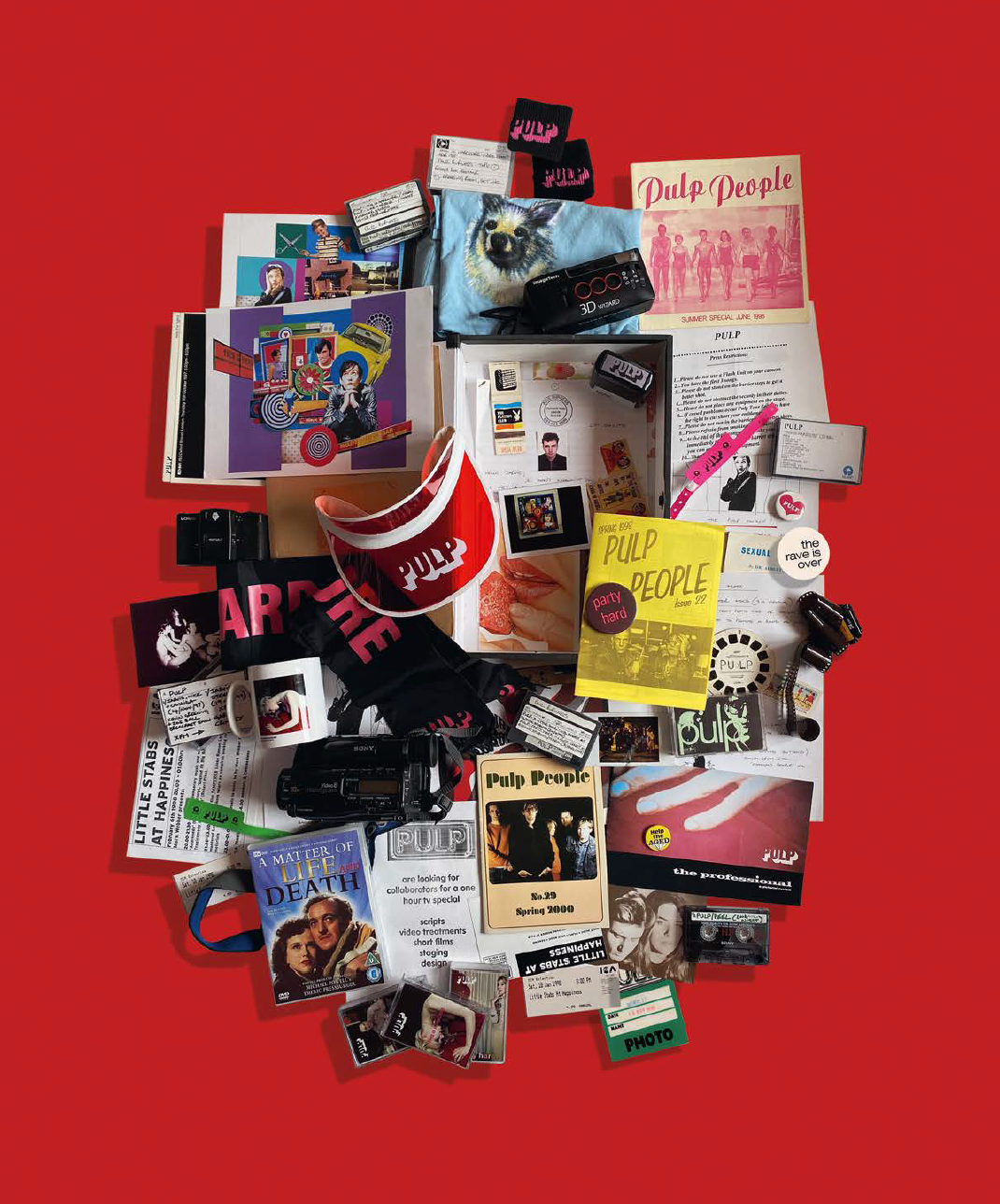
by Nel Dahl
PART 1: MARK WEBBER ON FILM, PULP, BOOKS & MORE

Photographer credit: Paul Burgess
Pulp’s work has resonated beyond its 1990s British setting to a global audience including younger generations at recent concerts. Mark Webber’s I’m With Pulp, Are You? depicts the extensive archives of photos and ephemera he kept from his time working with the band. The book documents his unusual rise from young fan to official member of the group: his relationship with Pulp started when he was a teenager, as a fan interviewing the band for his music zine. He later became their tour manager, and eventually joined the band as a guitarist.
Webber’s investment in experimental film showed through his presence in the band and is regularly referred to in the book. Jarvis Cocker remarks that Webber “made us better” in the book’s foreword, and mentions that he introduced the band to Michael Snow’s Wavelength (1967) on their tour bus. Webber reveals how Jonas Mekas was in the audience at a Pulp performance in NYC but was stopped by security from filming and how Pulp recorded music not just for Todd Haynes’ Velvet Goldmine (1998) but also incidental music for the director’s cut of Donald Cammell’s Wild Side (1995). Pulp’s hastily recorded music wasn’t used after Ryuichi Sakamoto was selected to score the film, except for “My Chopper”, a track near the film’s finale “when the main protagonist skulks away in his helicopter”. In the late 1990s, Webber began a film and music club at the ICA London with friends. From “midnight movies” (like Jose Ramon Larraz’s Vampyres (1974), Jeff Lieberman’s Blue Sunshine (1977), and Walerian Borowczyk’s The Beast (1975)), to avant-garde shorts like Ken Jacobs’ Little Stabs at Happiness (1960) that Webber named the series after, the scope of the films programmed is outstanding. After three years and various frustrations including the lack of 16mm prints available, they concluded the series: “The sound of the film projector ticking along at the back of the room, something magical that many of the audience had never experienced, was a big part of what made the evening special.”
By the mid 2000s, as Pulp stopped releasing music, Webber moved more into programming for international venues. He began publishing rare writings by filmmakers through The Visible Press, the independent imprint he co-founded with curator and wife María Palacios Cruz. Webber’s book discusses some of the highlights and complexities of these several roles. I spoke with Webber about how he first discovered underground cinema in a small town, what caused him to make it a “mission” to advocate for bigger platforms for avant-garde filmmakers, how these things coincided with his joining the band, and more.
Nel Dahl: What were the films that were your gateway into the avant-garde and how did you see them?
Mark Webber: Having discovered Andy Warhol and reading about the Factory when I was maybe 15, 16 years old, that’s how I became aware of avant-garde cinema, whatever that might be. I was interested in all of the different things that were going on around The Factory. My way in was through The Velvet Underground, but then I quickly became interested in all matters Warholian and so I read a lot of books. That was the first thing, because there was no way for me to see these films. It was like the mid-eighties, I was living in a small town in the north of England. And then there were two different things that meant that I could finally see some things.
There was a TV series on Channel 4, called Midnight Underground (1993-97). The first season showed a compilation of short avant-garde films with a host introducing them. Channel 4 had a sort of public service cultural remit in the beginning. I guess licensing some experimental films from the Film-Makers’ Coop or wherever was relatively cheap as far as TV production goes. They had this series of maybe 12 half-hour programs and that was how I saw things like Meshes of the Afternoon (1943) [and] Pull My Daisy (1959). I think Kustom Kar Kommandos (1965), probably Little Stabs at Happiness, stuff like that–classics of the avant-garde. We had a VCR at home, so I would record and watch them.
Then when I started to come down to London, mainly to go to concerts, there was a fantastic cinema at Kings Cross called The Scala, which is now being celebrated. This was a fantastic place and I would go and see all kinds of things there and sometimes go to the all-night screenings and that was where I first saw an avant-garde film program. I don’t remember now if it was Kenneth Anger’s Magick Lantern Cycle, or if it was a double bill of Blonde Cobra (1963) by Ken Jacobs and Flaming Creatures (1963) by Jack Smith, but that was very intriguing and I was completely sold into trying to find out more about this whole world of avant-garde cinema.
In your book, you discuss the film series you curated for the ICA in the nineties, ‘Little Stabs at Happiness’, and it seems a bit ahead of its time. You describe how hard it was to see some of those films at that time, before rare movies were more widely available on DVD. What have been your methods of discovery for learning about rare films?
Maybe 8 or 9 years passed between the two experiences I’ve just described and me starting to actually program. There was a free magazine in London at the time called Time Out that had really good film listings, so whenever there was anything in that area I would try to go and see it. That was how I first went to the London Film-Makers’ Co-op, which still existed at the time and had a cinema in Camden, the ICA, occasionally the BFI–and The Scala. That was about it. At the time those were the places where you could see these kinds of films and I would just always find it so depressing that I would go to screenings and there’d be so few people there.
There was one screening [in particular] at the ICA which was like my main prompt: they were showing a mixed program. [They screened] Carolee Schneemann’s Fuses (1967), a Bruce Conner film, maybe a Brakhage film, something else… And there were six people there: one of whom was the organizer, one of them was me, and then there four other people. And I just thought this work just deserved so much better. So I made it a bit of a mission of mine to try and get it more attention, get it seen by more people. But on its own terms: projected on film in cinemas. And to try to get it in places like the Tate Modern that had completely ignored film.
So being in the band opened some doors in the beginning. Barbican were having an exhibition that was touring called The Warhol Look, which was like Andy Warhol in fashion. And I don’t remember what happened, either I knew the exhibition was coming and I contacted them or maybe they asked me to DJ at the opening and I said, well yeah, sure, but I’d like to show some Warhol films ’cause no one gets to see them. So I did two programs of Warhol films for that. After that, I talked to the cinema programmer there and they commissioned a big survey of American avant-garde films and I ended up doing 16 programs, with films from the fifties to the seventies. And half of it was at the Barbican, half of it was at the LUX Centre. That was like my first sort of semi-serious piece of programming. I say semi-serious because I was still having to show a lot of films that I’d never actually seen, but I’d read avidly about and was quite sure they were interesting and appropriate. But that was my first attempt at putting film programs together. And the knowledge for doing that just came from reading books. Obviously things like [P. Adams Sitney’s] Visionary Film, David Curtis’ Experimental Cinema, Scott MacDonald’s A Critical Cinema books. But I also bought the New York Film-Makers’ Cooperative Catalogue No. 7, which was hundreds of pages, and I read it from beginning to end. I would make lists of films that seemed interesting so that was where I was getting my knowledge from.
When I first went to New York, which was actually a bit earlier, 1989, I went to New York for an extended holiday, like six weeks. The first places I went to in New York were the locations of The Factory, the location of The Dom on St. Mark’s place where the Exploding Plastic Inevitable was, and Anthology Film Archives. They were the places I wanted to see. And then whenever I would return to New York, I would go to Anthology and in those days, if you went to Anthology and rang the buzzer in the morning, Jonas Mekas was the only person there, so he would answer the door and invite you in. And I had to try and explain and he was always very open and welcoming to people like me that were curious about film. And so he was very helpful. And then slowly I got to know the filmmakers.

Photo: Burgess
Your book, I’m With Pulp, Are You?, is not the first book that you’ve worked on. You’ve edited and published books of writing for The Visible Press. How did that begin and what is the work like for you?
After those first attempts at programming that I described, I did it off and on for maybe 15 years… curating programs all over the world, as you can see from the website. And then when I had a child, without having grandparents nearby or any babysitters to turn to, that was kind of an end to going out at night, an end to film programming. Being a parent puts things into perspective quite a lot and things that used to be very serious and meaningful are maybe not that significant anymore. So then I thought, while I’m staying at home, I could work on some books because I’d already done some books. Like I did a book on Owen Land, formerly known as George Landow, as part of a touring program that I did with LUX in 2005. We’d been working on another book about the London Film-Makers’ Co-op, Shoot Shoot Shoot, which eventually came out much later, 2016. Through working with all these filmmakers on programs, I knew there was a lot of writing out there that hadn’t been published. And it was a bit like with the programming, like if no one else was doing it, then I may as well do it. The first book was Gregory Markopoulous’ writing [Film as Film: The Collected Writing of Gregory J. Markopoulous]. I’d done a lot of work showing his films and reintroducing his films and the films of his partner, Robert Beavers, who I got to know very well.
I just thought, I’ve got time on my hands, I can afford to publish a book and see what happens, and hopefully I can at least recover the printing costs. And so that was how it started. Me and my wife Maria established the press like that. Then the next book was Thom Andersen, Slow Writing, and then Peter Gidal, Flare Out. We published a Lis Rhodes book [Telling Invents Told]. Then the most recent one is the Afterimage book [‘The Afterimage Reader’, though the title of most recent is now ceded to ‘I Walked Into My Shortcomings’ a collection of texts by Ken Jacobs].
I thought the Visible Press was finished, but it seems like it might come back. I love putting the books together, but we did it all without distribution, without funding and that basically means that most of the books are sold mail order and I’m the one who’s packing them up and taking them to the post office, filling in the customs form, which has become a huge drag the last few years. I’m a little bit exhausted by it, but we have a couple of books we kind of have to put out.
Is there a parallel between you being an archivist for Pulp during that long period of precarity for the band (where it was questioned if the band would ever find its audience), and to your being a curator and publisher of rare film-related materials? Is your interest towards preservation of those varying media from the same place in your brain, or are they distinct to you?
I can see how someone could draw a parallel. Having saved all of that ephemera related to the band does demonstrate a particular inclination of mine [laughter]. Similarly, I’ve got filing cabinets full of flyers and photocopies related to avant-garde cinema. So yeah, there’s that hoarding instinct. I guess the band archiving I don’t take as seriously as when you’re doing actual research and going to film collections or libraries, special collections, and like researching a book or whatever. It’s sort of a different thing.
To go back to your ICA series, some of the films and filmmakers you featured at that point had not had the resurgence of interest that they later would. It’s a surprise, for example, to see a flyer for Borowczyk’s The Beast in a Pulp book. How did the screenings of weirder, even controversial films like that go?
Well [with] that particular film, there was a Pulp connection. Because we did a screening when “Do you Remember the First Time?” was released. Jarvis and Martin Wallace made a short film called, Do you Remember the First Time? (1994). And I think it was shown in the Leeds Film Festival cinema. I think we chose some other films to be shown with it, and Jarvis and I went up to introduce it or something like that. And they were also showing The Beast that same evening I think. And so we went to see it and that was the first time I’d seen The Beast. And that was exactly the kind of film, that kind of midnight movie, that I was interested in showing at ‘Little Stabs at Happiness’, because they had become quite invisible by that point. It was before DVDs and streaming obviously. And there was still a bit of repertory cinema programming going on in London, but that would be more for film nerds than the kind of general audience that I was hoping to reach. So the idea of the club was to expose people to films that I thought were interesting and then reward them with a disco at the end of the night because it was at the ICA, which people thought was a sort of hip place to go. That was the only thing I’ve done as a programmer where I’ve done it as like, Mark from Pulp. Usually when I was doing film programming, I just didn’t want Pulp to be acknowledged. But with the ICA thing, obviously there were a lot of Pulp fans and people came because of that association and the fact that I was DJing, or sometimes Jarvis would DJ. But that was just a draw to expose all these vulnerable young people to interesting films [laughs].
Another thing I forgot to mention: when I was programming in the early years, in order to try and build an audience for films, I started an email list, which was called Secret Cinema. And there actually was another thing called Secret Cinema, which I think still goes on, of staged events around films. Nothing to do with me. But mine was just an email list and people would sign up at screenings and then I would send them announcements, not only of screenings that I was doing, but of other screenings by people that I knew or that I was aware of, that I thought people should see.
That was really effective. Within a couple of years, what would’ve been six to ten people going to screenings like that, [had changed to us] regularly getting [between] 80 to 120 people.
Wow. So gradually more and more successful?
Yeah. And getting the work shown at serious places like Tate Modern that had historically neglected film.

Photo credit: Mark Webber
There’s a lot of ways to learn about film now, like over the internet, so we can see that there are passionate audiences for the type of films that you were showing back in the nineties. But back then, it was harder for people to learn about and see these films…
Yeah. It seems that now, even though things are accessible online, it doesn’t seem to stop people going to see them when they’re shown in cinema, which is what everybody was worried about when the internet was developing.
Do you archive the materials from your work in film, like the flyers and the programs and anything else that you’ve come across? Is there a possibility of a similar book of your movie-related archives?
I dunno about that… Of course I saved all of that stuff. A lot of it we used when I had some help to put the website together and all of the texts from all of my programs are there online. We scanned a lot of the documents and stuff like that. All of my research is just sitting in filing cabinets over there beyond the computer. I have hundreds of VHS tapes because that was the sort of dominant format at the time, for previewing. They’re all in storage. Dunno what to do with those. I’ve got thousands of DVDs here in the house, dunno what to do with those now. And photocopies of stuff that I’ve discovered in other archives that I’ve used for the work or that I’m using for other projects that I’m still theoretically working on.
There is a book, aside from the Visible Press books, that is hopefully going to come out [in 2026], I did a lot of work more than 14 years ago, towards a book of an oral history of avant-garde cinema. I interviewed many of the people that were involved. Mainly in America, in the avant-garde film movement from the fifties to the seventies. The whole Jonas Mekas world, basically. I did 80 interviews. Most of the people have since died. But when I originally started to edit the book, I got very overwhelmed by the quantity of material that I had and just put it aside ’cause I didn’t have a deadline for it. Then you just get busy with other things and in the meantime I’ve published five or six other books. And so that’s something that I need to get back to if I can get some time.
That would be very interesting to see, like which filmmakers you talked to.
Well, everyone that was willing to talk to me, which was, most of them except some of the very difficult ones like Bruce Conner and Jordan Belson who generally didn’t talk to anyone. In that period between 2000 and 2012, some had died, like Brakhage, before I could interview them, but a lot of them were still around. And I also talked to not just filmmakers, but programmers, writers, someone who worked in the film labs, all kinds of people around that sort of milieu.
How do you choose what books to publish with The Visible Press? Is it just from seeking out and reading a lot of film writing out of your own personal interest?
Well it’s basically personal interest because otherwise why would someone go to all that trouble for like absolutely no return and just endless trips to the post office and accounting and for like, pennies [smiles]. So it’s things that I’m interested in, or things that my wife and I are interested in, that no one else is doing.
You’ve said that the success of Pulp allowed you to pursue curating and publishing books.
Yeah. Being an avant-garde film curator is not a great source of income [laughs]. You know, although I earned bits of money along the way, if I hadn’t been in a successful band and been able to save money and buy a house, then I certainly wouldn’t have been able to do all of that, and I wouldn’t have been able to afford to publish books and travel to go and see films. None of that.
Of all the series that you’ve curated, has there been one in particular that stands out as one of the biggest highlights to you?
Yeah, there was a series I did on Expanded Cinema in Dortmund in 2004 where we showed a lot of multi-screen works and a lot of performance works where we had filmmakers like Malcolm Le Grice, Anthony McCall, Carolee Schneemann, Valie Export, Katerina Thomadaki, Wilhelm Hein, William Raban, [and] Tony Conrad. We brought all these people to Dortmund and on three separate weekends, so it was like a sort of seminar, but it was a public program and that was kind of amazing for the range of work that we were able to show, and the different technical requirements that they all had, and that was all documented. That was good for people to refer to in the future.
I did an evening at the Rio Cinema in London called Flux Party. I did this in association with the South London Gallery, and we showed the Fluxus films, the Fluxfilm Anthology, but we also had Fluxus performances and Jonas was in town, so he did an introduction and showed a film with George Maciunas. Ben Vautier was there, he did a couple of his Fluxus performances. We also did things like… we enacted Nam June Paik,Solo for Violin, which is someone very slowly over the course of five minutes bringing a violin down onto a podium and then quickly smashing it. So that was how the evening started. We did things like a Fluxus performance where you pass a block of ice to someone in the audience and they pass it around the audience. We gave everyone paper airplanes, and at a certain point in the night, they threw the paper airplanes at the screen. At the end of the night there was a Fluxus piece, which we performed by taking groups of people down into the basement of the cinema through a passage and then up and then out of a sort of secret fire exit, and then we just left them down the street at the end of the night [laughs]. That was the best single event I’ve ever done.
With your extensive knowledge of film and music, it begs the question, what for you are some of the best film scores?
Well, this is a bit of a blank spot in my knowledge actually, because I never understood people that buy soundtrack albums. I think the music is part of the film. And that it shouldn’t be separated out and taken on its own terms. It’s like a blind spot that I have, but I just don’t really understand it. That’s not to say there aren’t many amazing avant-garde films with incredible soundtracks. I like the soundtrack of Flaming Creatures that Tony Conrad put together with Jack Smith… the soundtrack to Scorpio Rising (1963), of course. Tony Conrad’s Ten Years Alive on the Infinite Plane (1972). We showed it at that event in Dortmund, which is for four film loops and live performance. I’m not really answering your question, sorry.
That’s okay. But there’s a lot of great film composers who worked on the more avant-garde or like with Borowyczk –
[Bernard] Parmegiani?
Yes! Him!
Yeah. There is The Strange Case of Dr. Jekyll and Miss Osbourne (1981)… That soundtrack is pretty amazing.
It is. So, the plot of the music video for “This is Hardcore” is built around the struggle of film archivists in constructing something out of the leftovers of a lost film. It was kind of unusual to see that in a major music video from that time. And it was interesting because this was approximately where you were starting to work in film, with the histories of films that were almost lost, things like that.
Mm-hmm.
What was it like for you working at Pinewood Studios?
Well, the parallel you’re drawing there I think is actually more of a coincidence [laughs]. This thing with the screen tests and stuff at the beginning of the video… that’s what you’re talking about, isn’t it? I didn’t really get involved in any of the music videos because I always said that music videos are the lowest form of moving images [laughs].

Photo: Burgess
Yes, you said that in your book.
I’ve said that for a long time. And it would be excruciating for me to see ideas from avant-garde cinema being adapted in pop videos and especially in Pulp videos. You know, Jarvis went to film school, Steve went to film school, so they had some exposure and knowledge and interest as well, so it wasn’t coming from me. I mean, the original ideas behind the “This is Hardcore” video were to do with that Diane Keaton book, Still Life. And bringing those images to life. And then the Busby Berkeley-influenced sequence at the end. I don’t know where the idea came from about this being footage from an unfinished film.
I think it was the director. He wrote a “treatment” that was in Paul Burgess’s book.
Paul’s book, yeah. It probably did come from him. I mean, it was amazing to be at Pinewood and work on that scale. By far the most expensive and complicated video we did.
I wanted to ask you about your belief in how music videos are the lowest form of the moving image, because there’s a lot of short films that predate the official era of like MTV style music videos, like Bruce Conner’s Breakaway (1966), where people say, oh see, this predates the music video. Are there exceptions that are good music videos for you?
There are some good music videos but it just seems very arbitrary to take some music and put some images to it. Arbitrary or even mercenary [laughs]. The other thing is like a book versus a movie, it plants an image in the mind of the listener. They could listen to music and imagine anything, but once they’ve seen a music video for that song, then you can’t really ever erase that. I used to be very annoyed at the kind of co-opting of styles developed by all these penniless forgotten filmmakers. People were exploiting their inventiveness to promote their rubbish pop songs. If you were to ask me “Okay, so what music videos do you like?” I’d have to think about that. I think there are some David Bowie ones that I love, Talking Heads…
You did an interview where you talked about a film of The Velvet Underground concert that you like.
Oh, The South Bank Show. A TV documentary.
Yes. So there are some music-related films that you like.
Documentaries are a different thing and there’s good ones and bad ones. I watch music documentaries all the time. That was an especially good one. And that was another place where I had very early exposure to avant-garde film ’cause it has a lot of Jonas’ footage in it. Some of the others, like the Todd Haynes’ The Velvet Underground (2021) documentary where he spent a lot of time arguing that The Velvet Underground developed out of the avant-garde film world and included a lot of footage from filmmakers’ films, which they [licensed]. So, yeah, I don’t mind documentaries.

Photo: Burgess
Since you have seen lots of different forms of film programming because you were doing it in the nineties and at several different venues all over the world, you have seen how some things have changed and how it continues to be kind of a precarious field to work in. Do you have any comments or advice for people who want to do that kind of work?
I guess you’ve just gotta try, you know. One of the big changes that happened in those years when I was doing a lot of programming was the development of video and digital projection. In the beginning, the video was inferior and the 16 millimeter film looked far better. Then the technology changed, and now video actually looks better. Which is weird ’cause I was always very medium-specific. I used to be like fanatical about film having to be shown on film, in its original format and all that kind of stuff. But that has definitely blurred in I suppose the last decade, but definitely the last five years. I’ve mellowed and I’m not sure because newer generations are not really that bothered, I don’t think. It’s a better experience to see a really good cinema screening, but people are not that fussed, whether it’s on film or digital, or if they’re watching it on their laptop or their phone. I used to think before we talk about contemporary work, you’ve got to know what’s come before, what order things happen in. You need to understand the medium. But I don’t think that is important anymore. And maybe that’s okay.
In some of the big film scenes, like here in America, there’s a big appetite for the history of cinema and ideally seeing the movies play on film. There’s a lot of people that would love to work on film screenings, but the money is not there, as you have discussed.
I think it was Ken Jacobs who first talked about this. It will just become like a boutique, sort of… he used to call it like chamber screenings. It would just become like a specialized thing for small groups. And maybe that’s okay.
In America we’re worried about cinema being overtaken by things like Marvel movies, so…
Superhero films, isn’t that already over?
Last I knew, they’re still making them and it’s torture for us in film who know about film history…
You just have to work harder [laughs].

Photo: Burgess
PART 2: PAUL BURGESS ON PHOTOGRAPHING THE BAND, WORKING WITH DAVID LYNCH & MORE

Photo credit: Jeannette Lee, courtesy of Paul Burgess
Pulp’s Russell Senior, Jarvis Cocker, and Nick Banks had published books regarding their experiences in the band by the time Mark Webber’s was published, but the Pulp books didn’t stop there. Webber was joined by photographer Paul Burgess for a recent book festival talk at Lincoln Arts Centre in which they both discussed their books on the band. It was titled “‘More’ Pulp: Unseen Reels”, the latter referring to what Burgess had filmed of the band years ago. Burgess and Louise Colbourne’s book, Hardcore: The Cinematic World of Pulp, has several photos Burgess took of Pulp starting in the 1990s. As he explains in his book’s introduction and further in the interview below, he reached out to Pulp after becoming a fan of their work. The band’s sound and aesthetic spoke to Burgess and he wanted to work with them. This led to him becoming a photographer for Pulp, documenting various events for the band. I ask Burgess about what he sent Pulp that convinced Jarvis Cocker to take him on as an official band photographer, his favorite shoot with Pulp, the ongoing use of his work in recent Pulp concerts and music videos, and more.

Photographer unknown, courtesy Paul Burgess
Nel Dahl: Do you remember how you first discovered Pulp’s work and what the first song you heard was?
Paul Burgess: I first heard ‘Pink Glove’ on the radio in 1994, and thought ‘this is interesting’. I went out and bought His ‘n’ Hers, and then the following day I went to a record shop in Berwick Street, London and bought It, Freaks, Separations and Intro. I was smitten after that.
As a photographer, what made you want to work with them?
Pulp are such an interesting group of people, I loved the music, especially live, and wanted to get involved in some way. I’m approximately the same age as Jarvis, and we seem to share similar visual artistic reference points. I guess we grew up watching the same TV programmes, films and enjoying the same music. Pulp are one of the last great art school bands, from a time when working class students could still afford to go to art school. Jarvis and Steve both studied on film related courses at Central St Martins (Jarvis) and the Royal College of Art (Steve) in London in the early 1990s. Mark also has a huge interest in avant-garde and experimental film making, and has curated exhibitions and written books on the subject.

Photo credit: Burgess.
In your book, you discuss how you reached out to Pulp and sent them examples of your work that convinced Jarvis Cocker to work with you. Can you elaborate on what these examples were and do you have any photographs of them?
In January 1996, I approached Jarvis and asked if I could design some visual promotional material for the band. I wrote a letter and put it into an old box-file alongside examples of my work – collages, 1970s space bubble gum cards, ideas for T-shirt designs, and some proposals for ‘Pulp Merchandise’ – a Pulp View-Master set, and a ‘pop-up’ Pulp book amongst others. I heard nothing for a few weeks and then I got a call from Jeannette Lee, the group’s manager, asking me to come into the office. Jarvis had enjoyed my box of ‘visuals’ and then they asked me to design an official Pulp 1997 calendar. It seemed to go well, and I went on to design T-shirts and tour programmes, etc.
Around this time, I asked Pulp if I could photograph any events they had coming up, and so between 1995 and 2001, I documented—using photography, collage and video footage—live concerts, video shoots, launch parties, DJ sets and anything else the band were doing. I do still have photographs of the box and the first things I sent to Jarvis. Embarrassing to look at them now, but hey, I was young and naive.

Photo: Burgess
What was it like photographing the band? Mark Webber has said how different each member of the band is, did you sense that?
Separately Pulp are a dream to photograph, everyone was fantastic. However, like most bands, it is always difficult to get the ‘group shot’, usually you have everyone looking in different directions, or one person has their eyes shut. Jarvis and Steve were particularly creative, had lots of good ideas and looking back I remember spending the most time talking to Steve and Mark in the 1990’s. Mark was always on his laptop, taking photographs or reading books about film. Nick was very funny, and read newspapers a great deal. Candida did not seem to enjoy being photographed that much, but was hugely inspiring.
Do you have a favourite Pulp shoot you worked on?
It would have to be the “This Is Hardcore” music video shoot. I was lucky enough to spend a week at Pinewood Studios in February 1998. The shoot was massive and I was allowed to photograph anything behind the scenes that caught my eye. There did not seem to be any other photographers there, which seemed amazing looking back on it. Each day there were different main scenes being filmed on set until late in the evening. I photographed whatever I wanted to, Jarvis’s shoes, things found in dustbins, clapper boards, Pulp rehearsing their scenes, as well as Doug Nichol’s (the director of “This Is Hardcore”) amazing team of set designers, sound and film professionals. Artist Tracey Emin was on set at some point, I have a photo somewhere.
On the last day filming there was an extra video shoot for “Like a Friend”, which was shot on the black circular revolving stage which had been used for the ‘eye of the storm’ Busby Berkeley style scene from “This Is Hardcore”. Pulp were in high spirits, celebrating what had been a busy and stressful week filming at Pinewood. I managed to get some great video footage of Jarvis messing around, playing drums, mock-breakdancing and generally letting off steam. Some of this film is included on the ‘Pulp Hits’ dvd in the ‘home movies’ section.

Photo: Burgess
How did your book, Hardcore: The Cinematic World of Pulp, come about and what was your role in putting it together?
I had a box of photographs in the attic I had taken of Pulp 25 years before, and thought that unless I did something soon with these images, they would never be seen. The book was art directed and co-written by Louise Colbourne, who had the wonderful idea to put it together as you would an exhibition. We then invited people who had a connection with the Hardcore album or Pulp, to contribute to the project, as if they were writing for an exhibition catalogue. At this time [2022] we had no idea Pulp were going to re-form or make another album.
Next we contacted Volume Publishing and Thames & Hudson, who agreed to publish our book. There are two versions, the rare Volume edition was crowd funded and has a cover design by artist John Currin, and the Thames & Hudson normal shop version has the photographic cover.
Our book, Hardcore: The Cinematic World of Pulp can be seen as a collection of memories, and an exhibition of artworks, a story about the This Is Hardcore journey. The photographs, collages and video stills are arranged according to four of the songs from the This Is Hardcore album: “This Is Hardcore”, “Help the Aged”, “A Little Soul” and “Party Hard”.

Books can act as containers for an ongoing and everchanging stream of thoughts, objects, feelings and interpretations. It is in this way that we came to see ‘Hardcore’ as a container—something that could be rifled through, its contents discovered. A good illustration of this was an action taken by Jarvis Cocker in 2022 at the launch events for his book, Good Pop, Bad Pop, when he brought a plastic bag onto the stage—filled with artifacts from his attic. Jarvis’s bag contained items that acted as signposts from the past that directed toward the creation and artistic concept of Pulp.
Like the many boxes of archival material belonging to myself or the box of items that I sent to Jeannette Lee and Jarvis to ask if I could work with them, the idea of a box has come to be synonymous with this book, representing the act of collecting fragments from past worlds to create stories for the future—a preoccupation Jarvis and I seem to share.

Photo credit: Burgess
You’ve said that you were an assistant to NME photographer Peter Anderson and that “it was hugely inspiring watching Peter work, and his attitude has stuck with me.” What kinds of events were you privy to through this and how did they inform your work filming and photographing musicians?
I worked with NME photographer Peter Anderson as an assistant in the mid 1980s when I was an art student at Camberwell. I mostly helped him with photoshoots and also printing up photographs in his darkroom. This was pre-digital, and once a photoshoot had happened with a band, prints had to be made in the darkroom asap, often overnight, in order to send them off to NME or whoever the client was.
He was hugely inspiring. Peter taught me to work quickly, not to worry about using expensive cameras or lights. Capture the moment and think about cropping. Peter was the first person I know who lived in Shoreditch, this was before anyone moved there, no shops, no coffee bars, everything closed at the weekend. Peter bought an old furniture warehouse in Boundary Street. His studio was on the first floor and he would often paint huge background paintings on the wall before the band arrived to be photographed.

Photo courtesy Paul Burgess.
You’ve mentioned working with David Lynch when you were “working on my first big advertising commission” and how supportive he was. Can you talk more about that? Were you a fan of his work by that point and did talking with him influence your own work later on?
In 1999 I worked on an advertising campaign for Technics with David Lynch. We never actually met, but conversed via fax machine—I was in London and he was in LA. We sent each other messages back and forth and he took some self-portrait photographs for me, which I still have. He was extremely supportive and encouraged me to do my own thing. I was a huge fan of his films since I first saw Eraserhead in 1977. I love his paintings and photographs as well.
Your photographs have been used in recent Pulp concerts and a new music video. Back when you were taking these photos, was the lasting relevance the intention for you or has it been a surprise?
A complete surprise! Pulp have been using several of my photographs on stage recently as part of the back projection during ‘Glory Days’. I guess they are ‘looking back’ at times gone by, and so it is fantastic for me to see them being used and seen by a younger audience. Lasting relevance was certainly not my intention at the time I made the images, when the photographs were taken back in 1998. I was just busy trying to get the best shots I could. They have been in a box in my attic for 27 years, and so I never imagined they would ever be seen again. A few of my photographs were also used in the music video for “Tina”, which was created by the super-talented Julia Schimautz at DTAN Studio.
What do you think people would be surprised to learn about Pulp or something you think is an underrated aspect to them as artists?
Several members of Pulp are very good DJs. I have been lucky to see Jarvis, Steve and Mark DJ on many occasions in the past, and I always come away hearing something fantastic and inspiring that I have never heard before. That is what a good DJ should do, educate the crowd with music they may not have heard before. Martin Green always does this as well.
In your recent book talk with Mark Webber at Lincoln Arts Centre, it was titled after the “unseen reels” you were sharing of the band. Can you talk about what these are like and if these will be shared elsewhere?
When I photographed Pulp in the 1990s, I always brought my hi-8 video camcorder with me to different locations. I filmed quite a lot of behind-the-scenes film footage at various video shoots and some concerts. Unfortunately, because it was the 1990s I sometimes used a ‘solarising’ effect on the camera, which makes some of the footage look dated in a ‘Top of the Pops / special effects’ vibe.
However, some of the footage is great and hopefully will be used at some point in the future as part of a Pulp-related film or documentary. Doug Nichol has recently made a wonderful film edit using my old camcorder footage mixed with his “This Is Hardcore” music video. We showed this at Lincoln at my talk with Mark.
What a hell of a show . . .
Nel Dahl is a writer inspired by horror and genre cinema. She’s based in the Pacific Northwest with her Russian Blue cat. [Twitter]
If you enjoyed this article, please consider supporting Ultra Dogme on Patreon so that we may continue publishing writing about film + music with love + care.