
by Finn Jubak
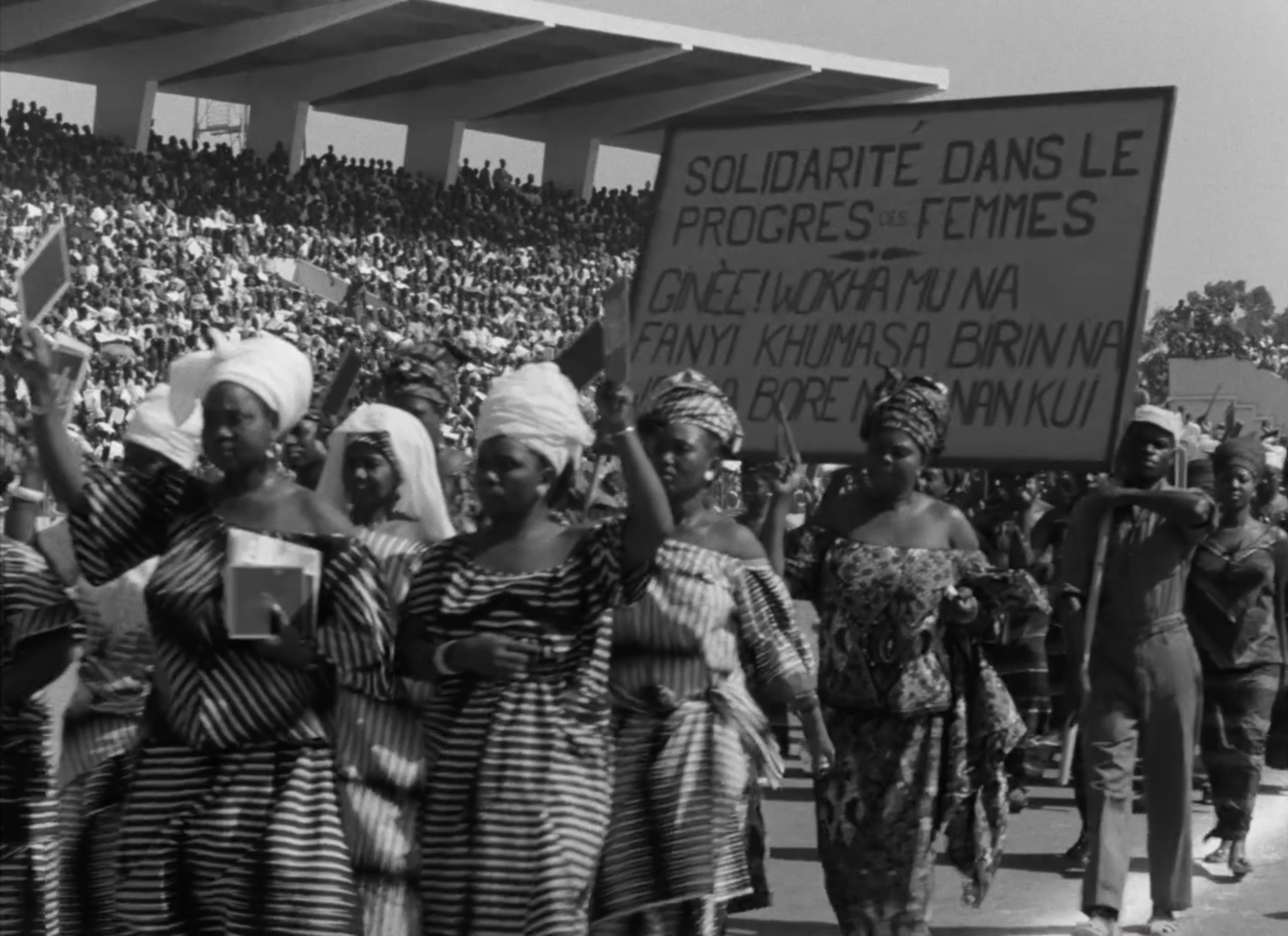
Et vint la liberté (And then Freedom Came, 1968), Sékoumar Barry’s only feature-length documentary and a foundational work of Guinean cinema, has primarily circulated in a 45-minute cut that was edited by the country’s post-revolutionary government to share with visiting dignitaries. Marking the occasion of 10 years of independence from France, Barry’s film deftly places the Guinean story within the larger context of liberation struggles continent-wide, while also rallying Guinean workers to join the project of industrialization. Barry studied film in Belgrade and relied on networks of film production outside Guinea when necessary (in this case, editing the film in Poland); his career demonstrates the filmic connections Guinea was forming with other socialist countries of the era. The film was restored to its full 90-minute runtime from materials stored at the National Film Archive – Audiovisual Institute (FINA) in Warsaw under the direction of the African Film Heritage Project (AFHP), and a raw scan was shown at FESPACO Classics in Ouagadougou in 2025 before the restoration premiered at Il Cinema Ritrovato in Bologna this past June. I spoke with Aboubakar Sanogo, FEPACI Regional Secretary for North America and FEPACI Coordinator for the AFHP, about the restoration shortly after its premiere. Note: this conversation took place before the national premiere of Et vint la liberté in Conakry, Guinea on September 28, 2026, as part of the country’s independence celebrations and the restitution of the restored print and files to the Guinean Ministry of Culture at the end of October.

Finn Jubak: Et vint la liberté is the latest film restored by the AFHP. Tell me more about the project.
Aboubakar Sanogo: The AFHP is a project that involves several partners. Within it, I represent the Pan-African Federation of Filmmakers, FEPACI, which was created in the 1970s to struggle, fight and lobby to create the optimal conditions for African cinema. At that moment, African cinema was coming into its own, but African filmmakers realized that there was very little cinematic infrastructure. FEPACI was the cinematic equivalent of taking one’s destiny into one’s own hands: investing in production, exhibition, and circulation infrastructure. As an independent filmmaker in Africa, you were making your own film, trying to raise money. And there was so little support from governments or the private sector. So FEPACI was created to try to minimize the effect of all these problems. Another goal was to connect filmmakers on the continent, because they hadn’t been connected in the colonial era. If you were a filmmaker from Senegal, you didn’t necessarily know a filmmaker from Somalia. FEPACI brought all these filmmakers together to think through the same problem of how to make films. And the idea was to put pressure on state governments to create an enabling environment for cinema. I know that was a digression, but understanding the context of FEPACI helps you get how AFHP came together.
So how did film restorations become part of FEPACI’s work?
For a long time, FEPACI was devoted to the actual filmmaking process. But the question of preservation was always there. It just had never been acted upon in a concerted way. The most important development was the opening of the Cinémathèque Africaine in Ouagadougou in 1989. Filmmakers were asked to submit copies of their films to build the collection, starting in 1988 upon request by FEPACI’s former Secretary General, Gaston Kaboré. Some of the films came from the former colonizers, and they built a sizeable collection, about 1500 films or something like that to start.
Around 2013, I was asked to be part of FEPACI, but as a film historian, I felt I should focus on the specific perspective I have, that of preservation and the film archive. So, I designed the FEPACI Archival Project, which had a few objectives, including: taking care of the institutional archives of FEPACI itself; trying to organize the archival sector in Africa; and trying to document the state of African cinematic patrimony. Unfortunately, by virtue of the ruthless and brutal colonial system and the colonial division of labor, many of the films made on the African continent did not reside on the continent. They mostly ended up in Europe. So we wanted to start tracking down these films! FEPACI had been focused on producing new films, but we had 50 to 60 years of production already behind us. And these were films that many from the contemporary generation had no idea about. Even I, a historian of cinema, had no idea about many of them, simply because they haven’t circulated in my lifetime. To have that historical access, historical memory, and historical consciousness of African cinema, in particular for young African filmmakers, was indispensable.
Of course, the question of funding remained absolutely structural. There was still not much interest from many governments in funding cinema, although that has improved. We started a partnership with The Film Foundation, which had created something called the World Cinema Project in 2007, and involved some African filmmakers, including the recently departed Souleymane Cissé. When we joined the project, they had already restored a number of African films, but on an ad hoc basis, and we suggested doing it more systematically, going country by country, region by region. And The Film Foundation woud support it financially. Many of the African filmmakers we were looking at were also part of FEPACI. We also partnered with UNESCO, to help induct the films into the Memory of the World Register. And we also worked with the Cineteca di Bologna and its lab L’immagine Ritrovata, which does fantastic restorations. So it was a bringing together of different forces that created the AFHP.

How did the AFHP choose to restore Et vint la liberté?
We set up a committee to select about 50 films to start with. In trying to decide where to start, we learned that we ourselves did not know the history of African cinema as widely as we wished. Most histories are really the histories of African films that have circulated. So there was a clear gap there. We were interested in knowing the specific filmography of every single African country. As a Pan-African organization, we inherited a tradition of freedom fighters, from Kwame Nkrumah to Frantz Fanon. So in that tradition, all African countries would be included in our project. We wanted to go as far back as possible in time, in terms of the history of African cinema. We also wanted to go as wide as possible in terms of the subject matter. And we wanted to go as broad as possible in terms of the kind of cinematic tradition. It’s a lot! But there was a group of films that we said, we can at least start with these for now. And Et vint la liberté was one of them, right from the start, because Guinea was one of the pioneering filmmaking countries in Africa. We know more about Sembène and Senegal, but the Guineans started making films at the same time, or even before him. Look at a film like Mouramani (1953) by Mamadou Touré. Moreove, in 1966, there was FESMAN in Dakar. In the film competition, there were two films that won the top award: Sembène’s Black Girl (1966) and the Guinean film Les Hommes de la danse (1965) by Costa Diagne, an extremely talented filmmaker who also trained in the Soviet Union, like Sembène. But somehow, he fell through the cracks. It was about finding these people and reinjecting them into the historical narrative, and that’s the function of some of these preservations.
Could you talk about the restoration process itself: locating the materials, what state they were in, and your collaborators?
First of all, before we do any restoration, we need the approval of the rights holders of the film. They often know where the elements are, depending on the filmmaker. Some filmmakers were meticulous in tracing every single element of their film. People like Med Hondo, for example, knew pretty much everything. But for some others, it’s extremely complicated to find the elements.
Back in 2005, Guinea had already done a survey of where their films were in partnership with UNESCO. And they didn’t have a single copy of the films they had made since, let’s say, 1958. After independence in 1958, Guinea instantly adopted the socialist route. And the government had agreements with other socialist countries, in Eastern Europe, Cuba, China. They had made a list that tracked this, and some films were post-produced in Poland, some in Bulgaria, some in East Germany, some in Moscow. So we knew that Et vint la liberté was edited in Warsaw. At the time, there were dedicated documentary studios in many of the socialist countries, the legacy of Lenin’s emphasis on documentary film.
We did some research and found that the materials had been transferred from the Polish Documentary Film Studios in Warsaw, where the film was edited, to FINA. The Cineteca di Bologna was able to reach out to them as a fellow FIAF member. They responded and said, we have everything, all the elements, and it’s all in good condition. I was so mystified, because sometimes with other European archives it’s very complicated and the records aren’t complete. But the archive was so well structured; we were very impressed. And they had the original 35mm original camera and sound negatives, so we could start the work right away. Also, Sékoumar Barry told us that this was not the only Guinean film that was edited in Poland, there were three or four other films, and we asked FINA about those too. They said that they have all the elements for those films too, which was fantastic. And on their own, the archive decided that they would digitize some of the films, and they have done two other Guinean films already with their own budget. We’re working on creating a broader partnership around African film heritage in Poland. Because Guinea was not the only country that had this type of relation with Poland. African filmmakers also trained there, and post-produced there.
So once we located the elements, we had to send them to the lab in France. One of our goals is to train more people on the African continent to do film restoration work, but for now we need to send materials to European labs to do the restorations. Anyway, we started the workflow: repair, clean, scan, et cetera. One of the most important dimensions of our process is that the filmmaker or one of the crew members is there to give the stamp of approval for the work, in particular at the color grading and sound restoration stage. In this case, Sékoumar Barry came to Paris and sat through the process to validate both the restored image and the sound.
You may have noticed in the restoration that the film is in black and white, but there’s a short section in color. In the version that was on television or on YouTube now, the color footage does not exist. One of Barry’s main desires was that he wanted to find the color footage of the Guinean flag and reinsert it in the film. Because that was how he intended it, but that isn’t the version that circulated. It is this very powerful almost two-minute sequence with the national anthem. He was so proud that we were able to add that back in. He really had tears in his eyes when we showed him that part of the restoration.
Another interesting note: since Guinea was a socialist state, the filmmakers were employees of the government. The filmmaker wasn’t even the rights holder of the film, in that system; it was the government, through its company Syli Cinema, which is now ONACIG (Office National du Cinéma Guinéen). So while doing the restoration, we were also coordinating the rights and doing the restoration through the Ministry of Culture of Guinea and the various entities that work under it, like ONACIG, and the Guinean Office of Copyrights (BGDA).
Sounds like a lot of paperwork.
Exactly, it takes a lot of time.

Tell me more about the circulation history and the discrepancy in the prints. I’ve seen the unrestored YouTube version you mentioned but it’s 45 minutes instead of 90. In what form did the film first show?
The 45-minute cut was a reduced version. According to Sékoumar Barry, this shorter version was created for Ahmed Sékou Touré, the then-president of Guinea, because he wanted a version he could show to international visitors when they came to Guinea that would be easier to sit through than a 90-minute one. The film ended up mostly circulating that way.
So were there no prints remaining of the original cut?
No, there were apparently no prints of the original still in circulation, and that’s what they had at FINA.
Got it.
Keep in mind that this film was made in 1968, and then in 1970 the country took a really radical turn. For a bit of historical context, shortly after independence Guinea, Ghana, Ethiopia, Egypt, and others helped push for the Organization of African Unity (OAU). An important structuring mission of the organization was that newly independent African countries would support national liberation movements in neighboring countries still under colonial rule. Guinea was close to Guinea-Bissau and Cape Verde, who were resisting Portuguese colonialism under the PAIGC and Amilcar Cabral. Amilcar Cabral actually took refuge in Conakry and was coordinating the resistance from there, and when the PAIGC captured some Portuguese colonial soldiers, they were held in Conakry. So in 1970, the Portuguese invaded the country, trying to free their captured soldiers and topple Guinea’s leadership. President Sékou Touré felt that the invasion could not have happened without internal collaborators, and launched a purge of those he suspected. The film community was caught up in that, and almost the entire community was thrown in jail. Sékoumar Barry was in jail for 18 months. Some people spent more than 10 years in jail and were tortured, it’s horrible. All that is to say that 1968, when this film was made, was a very specific moment in Guinea. Two years after that, things changed dramatically. And the circulation of the film gets very entangled with that history. The film was still used by the government to show to foreign visitors regularly, and I think it is still shown even on Independence Day. But I would say that cinema became a more contentious terrain, so the way it circulated outside of that was affected.
I see. Sékoumar Barry had made a few films, like L’Assainissement (1965) and Grenier à riz (1966), for Syli Cinema before this, but afterwards he didn’t make many films, did he?
Precisely. Because it was still the state that would hire you to make films. And I don’t think he was getting those commissions afterwards, even once he was out of jail. Part of the post-independence industrialization project also involved the building of film infrastructure, and the film community had been in discussions with the Germans to set up studios and production infrastructure. I think the involvement of the Germans was part of the reason that the film community was targeted by the government, because [West] Germany was part of NATO along with Portugal, and they were the enemy. So yes, he did not really make any films after this.


Given that, how does the film resonate for Barry now?
The first time I saw it in his presence was when we showed a raw scan of it at FESPACO, the biggest African film festival, in 2025. It was part of a section called FESPACO Classics that we initiated. And even though the restoration wasn’t complete, we were eager to show it to the contemporary generation. It was an incredible experience. There were Guineans who traveled, but there is also a large Guinean community in Ouagadougou, where FESPACO takes place. There was a sizeable audience. Sékoumar Barry was literally in tears when he saw the film again in full, for the first time in a very long time. And we had already inserted the section with the flag in color. Burkina Faso television was there, there were all kinds of cameras all over the place, Guinean news was covering it too. It was interesting to listen to the younger Guineans who came to see the film; they said it was validating a story that their parents had told them about what the country had been like then, since they had never lived through that period.
Because Ahmed Sékou Touré died in 1984, and Guinea then went under the capitalist banner, that meant selling off most of the factories that you see in the film. This film is all about industrialization. But most of these factories were privatized, sold either to European or other Global North entities. As I was watching it, I was struck: the move to capitalism was, in fact, a beautiful strategy to de-industrialize Guinea. It’s the same idea now: they claim the state is inefficient, is incompetent, just give these businesses to the private sector and that will be better. But in fact, it’s just a huge wealth transfer out of the country. This film gives visual evidence of what was actually being done, and the ambition of the new government for transforming the country. It was a taking of your destiny into your own hands, and it was a beautiful example for so many Africans. So I think for contemporary Guineans, it makes you look at that period with more nuance. As in, there were actual ambitions of building a country and industrializing. The film is a beautiful encyclopedia of what was being done. It also makes you look at the current moment and go, how come we went from there to here? It has that kind of memory of the future aspect to it, where the past is used to critique the present. And that is also one of the functions of this project of ours.
1968 was only 10 years after independence, with all the obstacles that the country faced. Keep in mind that the whole time, the French government was putting the country under economic sanctions.The French tried all kinds of military interventions, they tried to poison Sékou Touré many times. I mean, that side is completely missing from this film, but it should be shown in parallel. You should be cross cutting to what the French were doing to sabotage this all.
It’s striking how the film ignores the French almost completely.
Yes, and I think that’s so fantastic. I mean, at the end of the day, if African countries just focus on their work, the Global North will become irrelevant, in a sense. We just want to build our countries, you know? I think that is one of the values of the film.
When it mentions history, it mostly focuses on continuity with earlier anti-colonial freedom fighters. It’s a Marxist version of history, in which the people are the drivers. But the way you’re describing it, it goes way off only two years later in 1970. So it can seem like you’re on a path and then the path can change. But you can also come back to the path?
That’s right. The history of Guinea definitely reflects that.

Speaking of history, I loved the footage of Sékou Touré meeting with all those different leaders, like Nasser and Che.
Oh my god, that montage is fantastic. And what it shows is a country that actually had its place in the global international political system: at the UN, in international conflict, in continental conflict, in national liberation movements. Because, don’t forget that they didn’t only support Guinea-Bissau, they also supported the ANC in South Africa. One of the most renowned artists and militants from South Africa, Miriam Makeba, lived in Guinea from the late 60s to the end of apartheid. In fact, the song that ends the film, about the PDG [the Guinean Democratic Party], was later covered by Miriam Makeba. There’s a whole other story to be told about the musical aspect of the film, which is so powerful. And the art and culture part of it as well, and the way he inserted archival imagery. It was such a dynamic way of editing. I am proud we have this film as part of the AFHP, because it has such historical, cultural, and artistic significance. Some people were complaining that the film is too much like a TV documentary. And I say, if so, then it’s TV that copied him, and not the other way around.
I would like to ask you about the form of the film. In the program notes, you reference Eisenstein and Vertov. You can definitely see that, there’s montage, and I think even the idea of a city symphony is mentioned. But I think at the same time, it is very much promoting the country in a standard nonfiction form. There is a voice counting off: we’ve made this many shoes, we’ve made this many matches, and encouraging further investment. So it’s interesting that he’s threading that needle and doing both.
Exactly. He was trained on those films and was tuned to the global socialist aesthetic. And of course there were both strong ideological and cultural affinities. But I would say he’s not imitating. It’s the same with Sembène. People have said to me, if you look at Borom Sarret (1963), you can see an affinity with de Sica. It’s true, in fact. But that’s not the point. As Sembène would put it, what do these forms mean for Africa? What can you do by using a pre-existing form to engage with a completely different reality? And even in just doing that, you are transforming it and making something new.
For me, the film is showing Guineans that they are responsible for building the country they want. In Sans Soleil (1983), there is a section in the film where Chris Marker talks about the independence of Guinea-Bissau. And he says, for most African heads of state, the big question is what happens the day after. The flags have been raised, the party has happened, then what? You are alone with your people, facing the sky and the sun, and you have to invent something. And that is what this film is about: what is our task at hand, now, today? What’s listed are the elements of such a task. This is the country and the continent we are trying to build.
It is a highly inspiring film in that regard, even for contemporary Africa. I wish we had the means to show this in every single African school. We should go to the Ministry of Education and say, you have to add this film to the curriculum, because it’s a fantastic history of Africa. It’s a case study of one African country that is moving from a status of a colonized state into a project of building a modern and industrialized nation, taking account of the past and at the same time transforming it. It’s essentially Frantz Fanon applied. It’s akin to The Wretched of the Earth for cinema.

Which reminds me, I’m curious about your plans to show the film in Guinea.
Yes, we are working on a Guinean national premiere right now. And when we do that, we’ll travel to Guinea and return the film officially to the care of the people who made it. Guineans are definitely waiting for it. As I said, the 45-minute version of the film is often presented on national television. So, can you imagine that we are literally restoring the film to its original 90-minute length? This will be really exciting for Guinean and other audiences.
Note: since the interview, the Guinean national premiere of the film has occurred, and FEPACI has officially restituted the film to Guinea. The AFHP wishes to express gratitude to the Guinean government for their unflinching support for this restoration project from start to finish.
So, a copy is going to be archived on the continent as well? Where will the materials be housed?
All of it will come back to Guinea. That is part of the contract that we signed. But to do that responsibly, we need to have some conditions. And this is the issue we sometimes encounter, where a country might not have the optimal archival conditions yet. So in those cases, we sign an agreement to have the film kept temporarily at no cost in a more “professional” archive, until the conditions to keep the film safe are met in the original country. Because we also don’t want to commit cinematic crime, by which I mean pulling elements and bringing them somewhere where they cannot be properly stored. There are the issues of humidity and heat, which can totally wreck a film and would defeat the point of returning the material.
I think it is a reminder of the way that cinema itself was not really created with African climates in mind. So that power dynamic was inscribed in the technology itself. And for us going forward, it is a research and development problem that will require creative solutions for a while. For example, what about countries where electricity is limited? How do you do film preservation in that context? The task is immense. The entire idea of cinematic independence is at stake in figuring out solutions to these issues. And that was the original mission of FEPACI, as I mentioned: cinematic independence. So we have come full circle.
We are still working to solve the most structural issues of preserving African cinema, like the construction of film archives and the training of archivists. Questions like: should we build with European materials, brick and mortar, when we know that those are completely inefficient in terms of keeping cold air in a space? Probably not. So these are the questions we are hoping to answer, and not only answer but act upon.
I am seeing a theme emerge: there’s a lot of work to be done!
Yes, and another aspect is being interviewed by people like you and getting more visibility for the AFHP and our work. So thank you.ing more visibility for the AFHP and our work. So thank you.
Finn Jubak is a filmmaker, archivist, and writer based in Brooklyn, NY. He has covered contemporary found footage and experimental film practice for Screen Slate, Desistfilm, and NECSUS, among others.
If you enjoyed this article, please consider tipping the author and/or supporting Ultra Dogme on Patreon, so that we may continue publishing writing about film + music with love + care.