

by Sasha Frere-Jones
In his new biography of John Berger, From Life, writer and archivist Tom Overton speculates that “an indecent number” of people might be drawn to such a book “by the physical energy [Berger] transmitted on television or public speaking,” citing the “sense of rule-breaking sexual power” that he may have shared with Nijinsky, as critic Marina Warner once suggested. It is not hard to find people who will confirm that the camera was kind to Berger. By 1972, when the BBC broadcast the four-part series, Ways of Seeing, Berger had done radio and television in Britain, but this interrogation of visual art brought him to a much bigger audience. NPR commentator John Powers recently told The Nation’s Jon Wiener that seeing the show when it first ran was “life-changing.” Allowing that Berger “might have seemed like a rock star” because of his “long, long, curly hair” and lack of suit, Powers attributed Berger’s power to the fact that “he was simply telling you things that as soon as he said them, were transparently true.”
Is forthrightness what made Berger important to so many people? Was it the introduction of hotness into uptight familial spaces? Making material analysis a standard part of the docent’s remit? For a week across July and August of 2026, a film series devoted to Berger, called Hold Everything Dear, tried to answer these questions across screens in New York City. Curated by Film Comment editor Devika Girish, the selections were as close to perfect as programming gets. Most of the films are rarely screened, and a few, like the brief documentary on miners, Germinal, are almost impossible to see. The Ways of Seeing episodes were absent and, considering their ubiquity, the omission helped. Hold Everything Dear made a case for a Berger that we civilians could not conjure on our own, by giving us a strong sample of what Berger chose to do with his time and not just what he was commissioned to do. Even by his earliest appearance here, in 1973’s Germinal, Berger had already won the Booker Prize for his novel, G.. None of the movies shown as part of Hold Everything Dear reinforced the idea of a professional brand or even of Berger as a writer in any coherent sense.

What he was doing was helping his friends, sometimes with a clear purpose, at other times just to see what might happen. Films like Jonah Who Will Be 25 in the Year 2000 (1976), made with recurring collaborator Alain Tanner, are sincere examinations of what communal life could be like in a post-May 68 landscape. His collaborations with Timothy Neat, like Walk Me Home (1993), show Berger’s generosity, as he allowed himself to become an actor, briefly, in movies that fell well outside the spectrum of professionalism. The most thrilling aspect of the series was the glimpse we got of The Production of the World, a documentary about Berger currently being completed by director Brett Story. It was during the research process for that documentary, during a visit to Berger’s home in Quincy, that the series began to take shape.
Girish and Story were at Berger’s home in April of 2024, which Girish described as a “dark time,” in the months following October 7th. Watching the films that Berger participated in, though, produced a sense of “actual hope,” Girish said. “These films really exult in the possibility of togetherness, of solidarity, of collaboration,” she continued, accumulating a “politic of hope.” The descriptor that started to come up more often in the Seventies was “storyteller,” which Berger began using to describe himself. (The Storyteller was the first title for Overton’s biography.) Girish elaborated, describing this practice as a “call and response” with his friends, part of a “communal creating and sharing of narratives.”
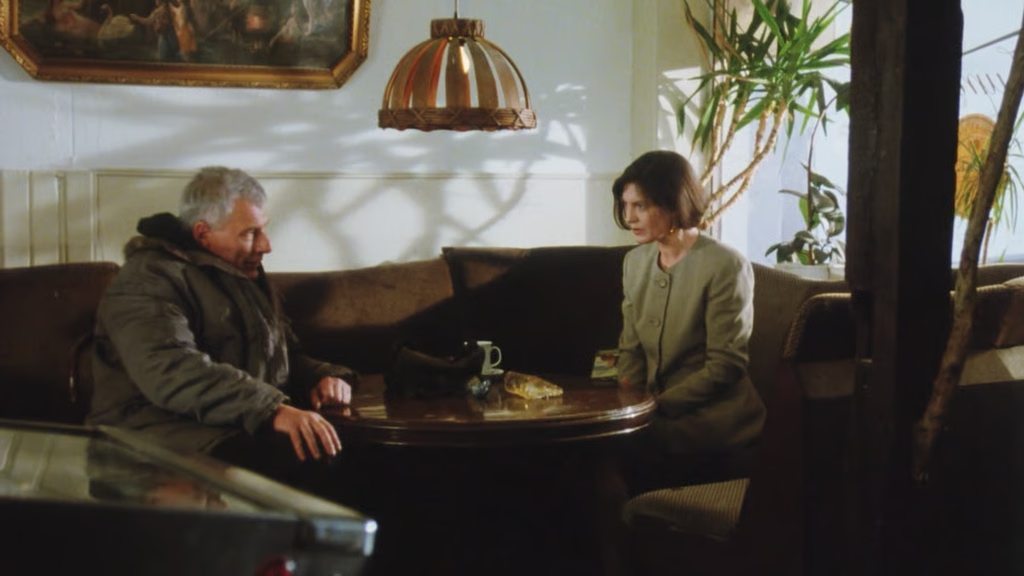
Walk Me Home was one of Berger’s several collaborations with director Timothy Neat, who appeared via iPhone video recording before the screening at the Walter Reade Theater, where actor Paul McIsaac also spoke briefly before the screening. The film takes place largely on a Scottish island called Inchkenneth, where Cloud (Angela Winkler), a German who describes her field as “the history of agriculture,” encounters a man named William (Berger) in a pub. Known to the pubsters as “Ali Baba,” allegedly a defrocked priest, the skipper of a banana boat, or both, William verifiably loves soup and slurps it from the bowl, wiping his mouth with the back of his hand in a carefree, earthy manner—no academe, our William. McIsaac plays Christian Müller, a rich creep who likes “women who refuse” and tries to lure Cloud into his helicopter. The purpose of Müller’s meetings with Cloud is obscure, beyond providing him with repeated chances to hit on her, but one can assume their connection is related to the global research program Cloud mentions, one which focuses on the ways in which agriculture is “disobedient” and refuses to “obey economic laws.” One imagines Müller wants agriculture to obey.
As for Berger’s erotic mandate, he and Winkler eventually lay, naked, in bed for a long stretch of rumination. Several younger cinephiles said, after the screening, they felt this was more rule-breaking power than they needed. This viewer appreciated the chance for older people to be hot as themselves and not as some kind of thirsty supplicants at the altar of artificial youth. As for the point of the film, though it has been described as a riff on life after 1989 and The Wall’s demise, I understood McIsaac, who attended many of the Hold Everything Dear screenings and announced to at least two different patrons that Walk Me Home was “awful.” But the film’s awkwardness, which is what I assume McIsaac was referencing, did not stop me from loving it. (The repeated insertion of a Laurel and Hardy episode about their failed plane flight, which the bar patrons were watching, was tiring.)
Walk Me Home speaks to a broad vision of life for which Berger served as a kind of unofficial avatar and whether or not the film ultimately succeeds seems secondary to outlining a worldview. The milieu is generically European, with a heavy dose of German rail travel and semi-German ID cards that flash on screen when a new character appears. Berger co-wrote the script with Nella Bielski and Neat; and their dialogue is heavier on poetry than exposition. Cloud talks of her first love, “a prisoner of war, an enemy,” which suggestively narrates the opening scene of kids and barbed wire love, after the fact. Could this “enemy” boy be William? We don’t find out. The discussions range through Christ, ocean water, screws, bedtime stories, death. This is also a life in which you (William) can sit down at a table with a stranger (Cloud), spread an array of rocks across the table and say, in full gnomic husk, “Then tell me, once and for all, what you don’t know.”

It doesn’t matter if Berger’s collaborations were pure cinematic successes. For Story, his participation was itself refreshing. “We live in such a risk-averse, professionalized world,” she said. “You are supposed to pick your fucking lane, become good at it or fake being good at it, and get all the accolades.” Another collaboration with Neat, Play Me Something (1989) places Berger in a small airport in Scotland, literally playing storyteller for a group of people waiting for a plane. (One of those waiting is played by Tilda Swinton.) Berger uses a short story of his own, from the Once In Europa collection, to tell a story played out by actors filmed in Venice. A man and woman fall briefly into each other’s arms at a Communist festival, discussing the coming classless society and having sex in a small boat. “My own experience of that film is to feel mildly embarrassed for about the first half an hour of it,” Story said, “and then that embarrassment suddenly just gives way. It’s like the film never concedes to the embarrassment of its audience or the judgment of its audience and it just digs in.”
My years of loving Berger in all his forms brings me to my own speculative theory, which is that he was ultimately more interested in people than he was in oil painting or novels or essays, none of them equal in power to human contact. In September, Overton told The Paris Review, that he “got the sense from going to [Berger’s] archive and from talking to him that writing genuinely was a struggle for him.” Berger’s second life as someone becoming someone else’s visual depends, in part, that he seems very comfortable on camera. If he was uncomfortable with the world and its myriad forms of pointless suffering, that’s very different from being uncomfortable with being alive with others. I think he had faith that people could be great.

Programmer and writer Benjamin Crais talked to me about the series, for which he programmed one key film. “I was really struck by how he speaks to the audience in a way that isn’t giving a lecture or being authoritative,” Crais said “but there’s something very intimate and I would say kind of seductive about it.” The film that departed most fully from the DIY looseness was Robert Kramer’s Walk the Walk (1996), chosen by Crais and a film that had no direct involvement from Berger. The link is that Kramer admired Berger, especially his documentary collaboration with photographer Jean Mohr. Walk the Walk is an embodiment of the ideas of labor and migration that Mohr and Berger took up in A Seventh Man (1975), a book which tracks the lives of people from Turkey and Italy and beyond working in the factories of northern Europe. In Walk the Walk, a family of three implodes early in the film. Abel (Jacques Martial), the father, ventures east from France and ends up working on a boat and then in a restaurant in Odessa. The mother, Nellie (Laure Duthilleul), stays put in Marseille to study sedimentation as a microbiologist, while her daughter, Raye (Betsabée Haas), sets out on a path that leads through Zurich to Berlin. Kramer’s movie is visually rich and confident, a largely quiet film that lets the people in it struggle with dignity. There is a confidence at work here, something you feel in Berger’s prose and in his on-screen presence but not necessarily in all of his collaborators.
Berger, as seen in the excerpt of Story’s documentary, is still the best filter for Berger. Especially having watched films of Berger in the Nineties and beyond, going back to the young art critic of the Fifties reveals a delightful consistency. “For a Marxist, as for an artist, nothing is trivial,” Berger says in a jaunty mood while being interviewed at a loud pub he frequents, unbothered by the clang of the pinball. Story runs this into an anticipatory rumble of timpani as we see one of Berger’s most famous New Statesman reviews crawl before us on the screen. This piece from January 1956 contains lines that are often repeated, even by Jackson Pollock fans. Berger writes that these “dribbled-upon, violated canvases” are, in fact, “a full expression of the suicidal despair of those who are completely trapped within their own dead subjectivity.” He talks elsewhere in the rough cut we saw of helping soldiers write letters and of the futility of democracy, as an existing thing, but his priorities are there in the art criticism from day one. It was ultimately his job to engage with painters like Pollock, but that did not obtain before his own personal commitment to the project of community, and anything that smacked of despair or self-pity was of no use to Berger. (I found vitality in Pollock and his AbEx friends, but that’s art isn’t it?) The imperfection of an art critic who simply pushes an entire movement out the window is very Berger, comfortable with his limits and the fact that, somehow, he is still helping others.
Sasha Frere-Jones is a writer and musician from New York.
If you enjoyed this article, please consider tipping the author and/or supporting Ultra Dogme on Patreon, Ko-fi, or Substack, so that we may continue publishing writing about film + music with love + care.