
by Jawni Han
The program note for the recent Anocha Suwichakornpong retrospective at Metrograph describes her as “among the most unpredictable of contemporary filmmakers.” Indeed, Suwichakornpong has undergone a remarkable artistic transformation over the years, culminating in an eclectic filmography that now includes a Wizard of Oz-inspired short, a disorienting meditation on the impossibility of making a “historical film,” and her more recent collaborations with experimental filmmaker Ben Rivers. Although each project introduces fresh visual and thematic ideas into her growing oeuvre, a few things remain constant throughout: a sense of discovery and a fascination with the cinematic apparatus. Beyond subject matter and narrative threads, what the director encounters while working on a film—whether research discoveries, personal epiphanies, or unexpected locations—shapes its form, often resulting in meta-commentary on filmmaking itself.

While Suwichakornpong’s Columbia MFA thesis short Graceland (2006)—a Jarmuschian road trip meets L. Frank Baum—may feel like an outlier in her filmography, which is largely built on nonlinearity and the flux of personal and political histories, its story and atmosphere foreshadow her subsequent trajectory as a filmmaker. The film begins with Elvis impersonator Jon (Sarawut Martthong) and an enigmatic woman (Jelralin Chanchoenglop) in a car, traveling from Bangkok to the Thai countryside. He asks her, “Where are we going?” She keeps driving without answering his question. Soon, the woman abruptly pulls over on a country road and disappears into an unkempt field. As Jon searches for her in the darkness, illuminated only by a Zippo lighter, the film enters a mythical realm, echoing Dorothy’s journey from Kansas to the Land of Oz. They eventually reunite and share a kiss by a campfire, but he wakes up alone at dawn. Back home, Jon starts crying while lying down next to a man who could be either his lover or brother. It turns out the nocturnal trip to the unknown land from the previous night was, in effect, an excursion into the mysteries of the human heart.
“Where are we going?” is the question that cuts through Suwichakornpong’s subsequent projects: a twofold query that the director poses both to her artistic process and to the audience of her films. In her feature debut Mundane History (2009), this manifests in the directionality embedded in its unusual structure. At its center are Ake (Phakpoom Surapongsanuruk), a young man who has been paralyzed by a catastrophic car accident, and Pun (Arkaney Cherkam), his live-in nurse. As Ake navigates his new reality, he maintains strained relationships with his father and the domestic staff but gradually opens up to the nurse, who shares with him a passion for literature. Initially conceived as a linear film and later “deconstructed” in post-production, it proceeds with a disjointed chronology and appears to restart itself at least half a dozen times during its 82-minute duration. The opening scene reappears fifteen minutes later, and at similar intervals there seems to be either an abrupt tonal shift—for instance, the sudden introduction of 16mm home-movie-like footage of Ake’s house—or a decisive narrative moment without contextualization, leaving only a handful of these scenes “resolved” by the end.

It might seem odd at first that Suwichakornpong opted to reassemble the film in a nonlinear fashion when the developing bond between the two men is its driving narrative force. The deconstruction was actually born out of her attempt to incorporate private epiphanies she experienced during the making of the film. In 2006, while the director was working on the screenplay, the Thai Royal Army mounted a coup d’état to overthrow the government headed by Thaksin Shinawatra, who was mired in a serious corruption scandal. It occurred to Suwichakornpong—nearly thirty at the time—that she had been born in the year of the 6 October massacre, famously documented by American photographer Neal Ulevich, who went on to win the Pulitzer Prize for his work. In 1991, when she was fifteen, the military once again initiated a coup to take over the government. It seemed as though major political upheavals occurred in Thailand every fifteen years, creating a devastating sense of historical standstill. As such, the aforementioned tonal and narrative shifts in Mundane History arrive every fifteen minutes, and each reel of the film lasts approximately fifteen minutes, as revealed during a post-screening discussion with Haden Guest at the Harvard Film Archive. The film is constantly pulled in two opposite directions: one propelled by the budding relationship between Ake and Pun, the other by a formal design that mirrors the trajectory of Thailand’s modern political history.
Suwichakornpong’s dialectical exploration of contemporary Thai life and the vectors of history take on an even more central role in her sophomore feature By the Time It Gets Dark (2016). Split into two parts, the film’s first half revolves around filmmaker Ann (Visra Vichit-Vadakan), who sets out to make a movie based on the life of Taew (Penpak Sirikul), a writer who directly experienced the 1976 massacre at Thammasat University in Bangkok. They go on a retreat at a beautiful countryside estate where Ann interviews the writer as research for her project. In a striking moment when the electricity goes out in the house, the filmmaker admiringly calls Taew “living history,” to which the writer responds, “I’m just a survivor,” underlining the chasm between their respective vantage points. The candlelight illuminating them during the blackout suggests something else as well: the resilience and courage of those who resist political oppression can serve as a kind of north star for posterity, no matter how dim, in the darkest moments.

At one point, Ann and Taew have breakfast at a café, where they strike up a conversation with an employee (Atchara Suwan). The anonymous woman says to Ann: “You should give it to her to write … It’s about her life, so it’s her story.” In a conversation with easternKicks, Suwichakornpong explains that she did not interview many people who lived through the ’76 massacre, but instead read extensively about what happened. By the Time It Gets Dark is less a film that recounts historical facts than one that explores what this history means for the filmmaker in the present moment. In 2014, during the development of the film, Thailand underwent yet another military coup, cruelly fulfilling the country’s cycle of political crisis—only this time it defied the fifteen-year interval that had determined the formal structure of Mundane History.
What does it mean to make art about a historical event from the vantage point of the present, when the past is still unfolding even as the distance from it widens? This question guides the film’s second half as it switches gears and begins following the café employee, now working as a janitor at a luxury hotel and as a waitress at an on-cruise restaurant. Interspersed throughout the vignettes of her labor are moments from the life of Peter (Arak Amornsupasiri), an actor who is first seen working at a tobacco farm and later on music video and film sets. The film patiently observes both the woman and Peter trying to make sense of their present circumstances through their work, seemingly detached from the specters of the violent history invoked in the earlier half. But the grind does not get them where they wish to be, neither materially nor spiritually. The actor dies in a freak accident, and the woman shaves her head and becomes a Buddhist nun in the end. To escape from a city subsumed by capital and the cyclical history of violence, one can either die prematurely or cut oneself off from the secular world; but for those who choose to remain in the race, the only option is to hope that things might turn out differently this time.
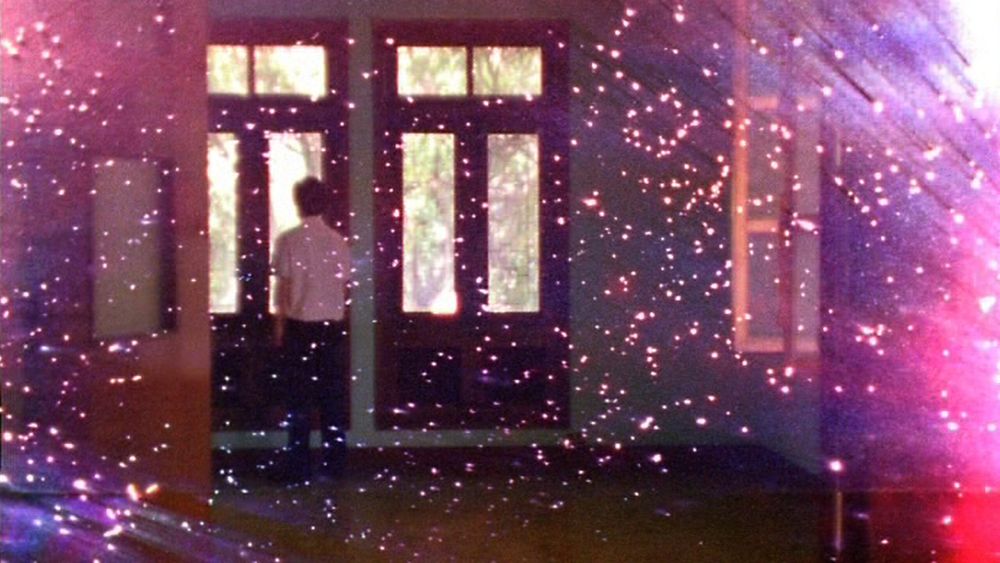
Suwichakornpong takes the contradiction between life’s forward movement and Thai society’s pull back toward its dark past to its limits in the film’s final two minutes. We first see the woman in a crowded club dancing blissfully until the image implodes into visually astonishing digital pixelation, which transitions to the serene image of a green field beneath a highly saturated magenta sky. The sky gradually turns blue, thereby restoring the textures of reality. But Suwichakornpong seems to ask: is pixelated imagery and a magenta sky really so unrealistic in a world where we are expected to buy into the idea of “progress,” even as our political system incessantly retreats to its habitual atrocities? By the time it gets dark, there may not be much light left, but still enough for a film that dares to imagine a colorful sky and refuses to accept cyclical violence as a “natural reality.”
Jawni Han (she/her) is a Korean writer, translator, and filmmaker based in Brooklyn.
If you enjoyed this article, please consider supporting Ultra Dogme on Patreon, Ko-fi, or Substack, so that we may continue publishing writing about film + music with love + care.