
by Blake Simons
Content Warning: A brief portion of this interview contains several uses of a slur that’s highly derogatory towards Rohingya people, along with the mention of a slur against Black people. This is within the context of an interviewee’s own personal experience of racism, and relayed as part of an overview of the systemic dehumanisation, disenfranchisement and genocide of the Rohingya people in Myanmar.
Cinema’s ability to foster empathy where other means have failed was evidenced in the emotionally overwhelming response to the dramatised document The Voice of Hind Rajab (2025) at last year’s Venice Film Festival, honoured with the festival’s Grand Jury Prize. Equally deserving of audience attention are the stories shared in Akio Fujimoto’s feature Lost Land (2025)—at once individual and representative of many.
The winner of the festival’s Orizzonti Jury Prize, Lost Land is a docufiction portrait of the Rohingya people, who have been forced to flee their homes due to ongoing genocide. It is a film that is poignant, pertinent, and effective in highlighting an internationally unheard crisis.
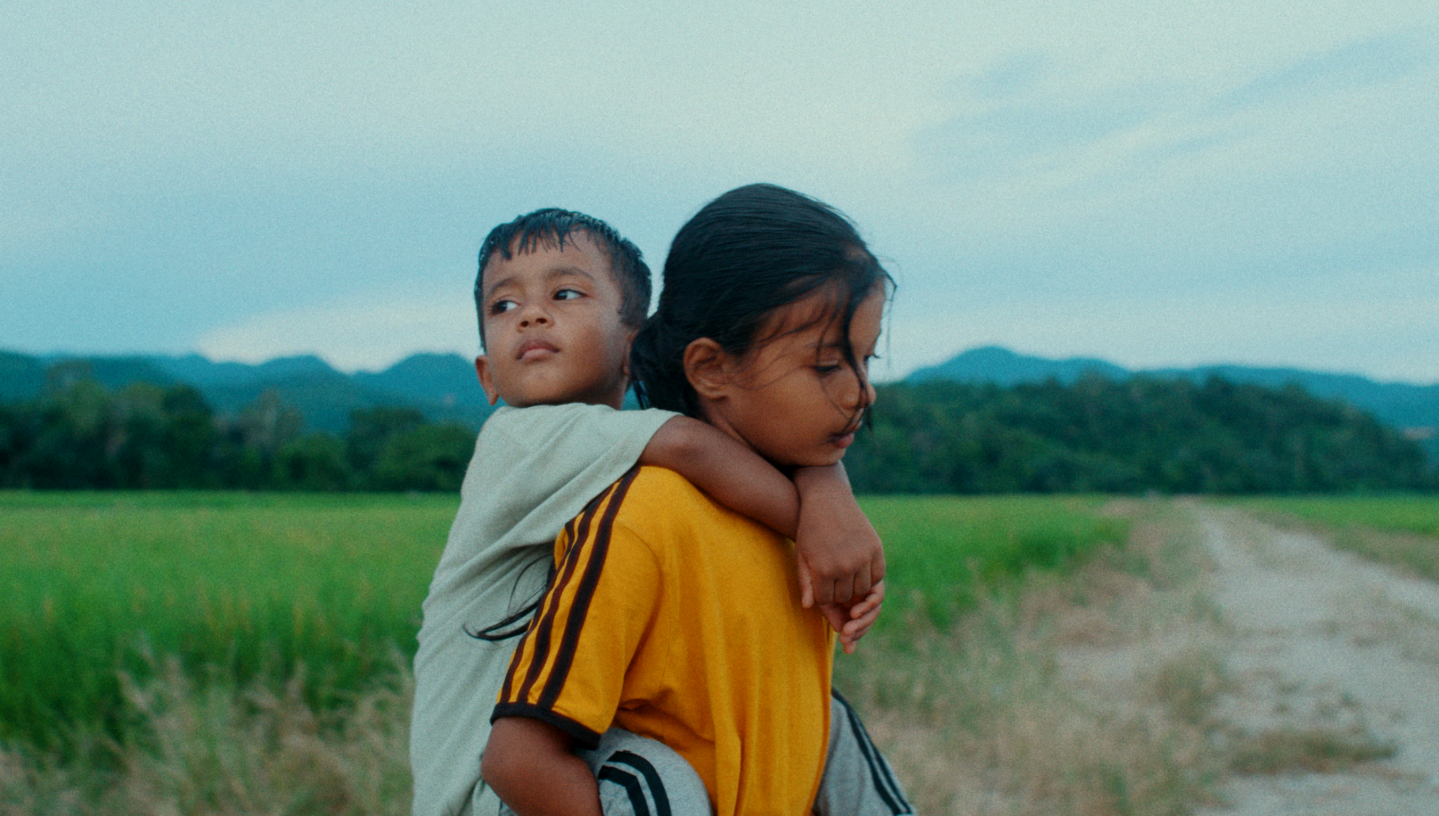
A Japanese filmmaker dedicating his career to spotlighting the plights of other cultures and peoples, Akio Fujimoto worked in close collaboration with Rohingya people on Lost Land. The film provides a snapshot of two siblings (non-professional newcomers Muhammad Shofik Rias Uddin and Shomira Rias Uddin) who journey from a refugee camp in Bangladesh to Malaysia, in search of a relative who has found work there. Their specifics are fictional, their story is not. Shot by Yoshio Kitagawa, who previously worked on Ryusuke Hamaguchi’s similarly humanist Evil Does Not Exist (2023), the static, sometimes meditative cinematography is punctuated by claustrophobic, guerilla-style handheld movements—unflinching but never sensationalist in its immersive perspective and quiet devastation.
I first came across Akio Fujimoto with his first feature, Passage of Life (2017), which is available to stream internationally on SAKKA and follows a refugee family from Myanmar as they navigate life in Japan—and their separation when part of the unit returns home. His second feature, Along the Sea (2020), follows three Vietnamese women as they take up work in Japan as illegal migrants. All three of Fujimoto’s features utilise untrained actors with real-life ties to one another, and an openness to improvisation in the pursuit of cinematic truth. The director is keen to stress that his films are collaborative efforts and truly borderless cinema.
I had the pleasure of sitting down with Lost Land’s team in Venice a few days after the film first screened for the press. Joining Fujimoto in our conversation are his regular producer Kazutaka Watanabe and co-producer and Rohingya cultural advisor Sujauddin Karimuddin.

I want to start out by noting the obvious: this is a film by a Japanese filmmaker that, much like your previous films, is non-Japanese in its subject. Lost Land is not Japanese in its location, its cast, or much of its crew. Fujimoto-san, could you tell me about expanding beyond the borders of ‘national cinema’, and why you’ve made the lives of people outside of your own culture the focus of your filmmaking?
Akio Fujimoto: It’s not like it was something that I was explicitly aiming for—I simply responded to the topics that I feel are important. It wasn’t like a backpacking thing—I’m not that type of person. My wife is Burmese, and we live in Myanmar. I have experience working there. So it stems from my private life, from how I see the world, the thoughts of my family—these facts of my life automatically led me in this direction. I’ve already crossed those borders.
Tell me about filmmaking outside of your own native language, and the challenges that you faced together in coordinating that.
Fujimoto: Naturally, it was hard at first. On my first feature, Passage of Life, communication was challenging. When there’s a language barrier, it can be hard to tell how a character is feeling and what an actor is conveying. There was a lot of improvisation, in the acting, and in the shooting of it. On my second feature, Along The Sea, I feel I overcame that sense [of a communication gap]. Even though the language barrier remained, I felt I could sense the actors’ emotions much more acutely—I got used to this kind of filmmaking. Fast forward to now, and I always have a translator with me. I don’t speak French, and I don’t speak English. I feel like I’m relying a lot on those translators, but I’m more relaxed as a result. I can feel the hardship I faced in the beginning start to fade away.
Watanabe-san, how did you first encounter Fujimoto? Did you feel a synergy or connection to his mission in terms of the filmmaking that he was pursuing?
Kazutaka Watanabe: Our first encounter was in 2013. That initial script was a project we dropped, so it wasn’t a direct route to Passage of Life. I advertised that initial project on the internet, and he was one of the applicants—that’s how we first met. Now it’s already been twelve years working together. I think, along the way, we focused on the process. We did a lot of fieldwork, travelling all around and talking about how we observe what we hear and see.
That process is great. We don’t just meet and say ‘Oh, you have the same feelings, or the same thoughts’. We need to discover—we need to sometimes get lost and walk along the sea for five or six hours, and then share our thoughts on our respective experiences. Then we feel like we have some kind of empathy, some kind of mutual thing that we can share with each other. We spent a series of trips doing that. I believe we have a similar understanding of the world.

Sujauddin, I’d like to ask how you were brought on board the project. I imagine you’ve never worked on anything quite like this before.
Sujauddin Karimuddin: When Akio came to meet me, he presented a short script. It was a story that we wanted to tell. There are many stories, and this one is very powerful, because it is not [just] history, it is an ongoing phenomenon. it is not new or contemporary, it is very old.
Since 1918, there have been Myanmar Indians who have had to flee from their homes. This was never a story that was covered by the mainstream media. A film stays with people for a long time, and that’s why I got very excited when I saw the script. I wanted to get involved with it and do my best to make the movie [its] best possible [self]. And the story is told as it is [in reality].
Could you outline the persecution and struggle that the Rohingya people are facing? It’s outlined briefly in the film, but I think it’s important to get more backdrop and context. In many respects, Fujimoto-san, you’re a ‘show, don’t tell’ kind of filmmaker.
Karimuddin: What the Rohingya population is facing is described by international scholars as a slow-burning genocide. This genocide is perpetrated by the Burmese military and junta. It’s years of propaganda that has made the entire population believe in the danger of a people. It’s what the Nazis did against the Jewish population. Since I was young, we were given names—one of them is ‘kalar’. ‘Kalar’ is, you could say, a foreigner. It’s also a degrading, demoting term—like ‘ni**er’, for example, in American. We are often compared with rats, cockroaches, and snakes, by the majority Buddhist population.
I want to [convey] the gravity of how the entire population was brainwashed over the years: when I was in school, if I did good homework, or solved a mathematical issue, the teacher would say ‘look, even kalar can do it’. Somehow, we are inferior—even intellectually we should be inferior. In 2012, the massacre happened—back then, it was almost a patriotic act to kill a Rohingya. My activism started, not to save the Rohingya people, but to bring democracy into Myanmar. What we believed was the problem was the military, not the social problem. If we could overcome and overthrow the military, we would have a democracy. In that process, I was involved with a lot of activists, including the National League of Democracy members.
The genocide was obviously perpetrated by the military, but it was supported by a lot of misinformed or misguided, brainwashed people. We must not forget that, although the biggest killing had happened in 2017, the Arakan Army is continuing the genocide. One day last year, they had killed 600 people in one village. And in just that period of time, about 150,000 people had fled by boat. Many died during that crossing.
To connect this with the film, it’s an ongoing thing. It’s a continuation of the massacre. People are fleeing in desperation to save lives. It’s not that they know where they are going will be [or lead to] a better life, but they risk dying under neo-Nazis. Risking death, risking maybe dying at sea, we have hope to survive—the hope that one day we will be able to go home.
Watanabe: I heard that every time something happens—burning, massacre, genocide—you have people who flee to Bangladesh. And then the Bangladeshi government and military force them to come back—they were going up and down, up and down, repeatedly. That’s really the background of the film.
Thank you both. It’s very upsetting to hear all of that. It’s a strange thing to ask in an interview, “why is this happening”—because there is no why, there is no justification.

Could you tell me about casting your young leads in the film?
Fujimoto: There was a community we visited, and we thought of casting while we were there. While we were conducting interviews at an elementary school, a young boy, [Muhammad Shofik Rias Uddin] passed by and stopped to draw something on the board. I felt drawn to him somehow. We went with him to his house; he lived right by the school. There, we met Shomira [Rias Uddin], his sister. And how they interacted was really lively and amazing. In Passage of Life too, we cast real siblings, and that was strong, it worked well. I thought about the story of Lost Land—it was a harsh reality. But, if I embedded their liveliness and cheerful moments into the film, it would strengthen it. So I completely rewrote and restructured the film.
We use a script, but not everything is written down. A lot comes from verbal communication. I explain the scene, what kind of dialogue we need, what movement. It’s fairly simple, and they didn’t mind. There’s a trick we used: just giving those elements in keywords. The basic instructions are clear. If they bring something more to the dialogue, that’s fine. They improvise, and many coincidences happen in front of the camera, which lends the film a certain quality.
On Passage of Life, I tried to make a natural environment by hiding the camera, using long shots, that sort of thing. I really believed in that, but it was hard. This time, I felt that creating a fake naturalism was not the right approach. We have a big camera. The children could look at the camera if they wanted. I wouldn’t say “look at the camera”, but I wouldn’t say “don’t look at it” either, because it’s there. We are here, we are shooting this, but we are not telling a lie. I thought maybe the process would be the kids coming to accept the presence of the camera and the crew—a more natural process. I thought that would be better for them.
These are highly emotionally-charged performances from your two child leads. In the situations they’re placed in in the film, are the emotions they’re drawing on from their own personal experiences, or are they something that you’re directing and guiding them to? It’s upsetting if they’re able to draw all of this from their own lives.
Fujimoto: Most of our actors have experienced this journey themselves. The elder of the two children has heard about it from her mother. But Shafi, he doesn’t understand anything. Neither of them has experienced the journey itself firsthand.
I don’t really believe in instructing the actors directly. It’s more about making an environment, treating your actors well, allowing them to relax. Doing that extracts their real, true personalities, which brings life to the film.
I’m glad we’ve got the poster here with us, because one of the things that I love most about the film is your use of colour. You use it to convey emotion, connection and nostalgia. There’s the yellowy-orange of her top. We first come to associate that colour with their home; then she’s wearing it; and then he carries that colour forward in the film’s final act.
Fujimoto: I’m very happy that you brought that up. In this film, the mango tree is very important. In this harsh reality, we have a grey tone, so the orange stands out. I wanted to provide a light—a sun—in the darkness. The colour also relates to our relationship with memories. I wanted the audience to remember that colour throughout the film.
With thanks to Kazutaka Watanabe for interpreting for Akio Fujimoto and myself.
Blake Simons is an interview-focused journalist specialising in contemporary Japanese and global queer cinemas. You can find their other writing in Sight & Sound, IndieWire, The Film Stage, ScreenAnarchy, and many other film and media outlets. They value interview work for the space that it can collaboratively create between artist and audience.
If you enjoyed this article, please consider tipping the author on PayPal and/or supporting Ultra Dogme on Patreon so that we may continue publishing writing about film + music with love + care.