
by Matene Toure
At the heart of Moroccan visual artist and filmmaker Meriem Bennani’s multimedia artistic practice is an attempt to “access the emotional intelligence” of her audience, enabling spectators to better understand the complex and profound nature of her art. By building strange sci-fi, futuristic otherworlds within her moving-image and sculptural pieces, which are mediated through digital technologies and open-source software, Bennani uses surrealism as a mode of intervention into how contemporary ways of seeing have become “incessantly hybrid” in the internet era, as Claire Bishop details in Disordered Attention. For Bennani, speculation makes the exigencies of our contemporary globalized society more discernible.

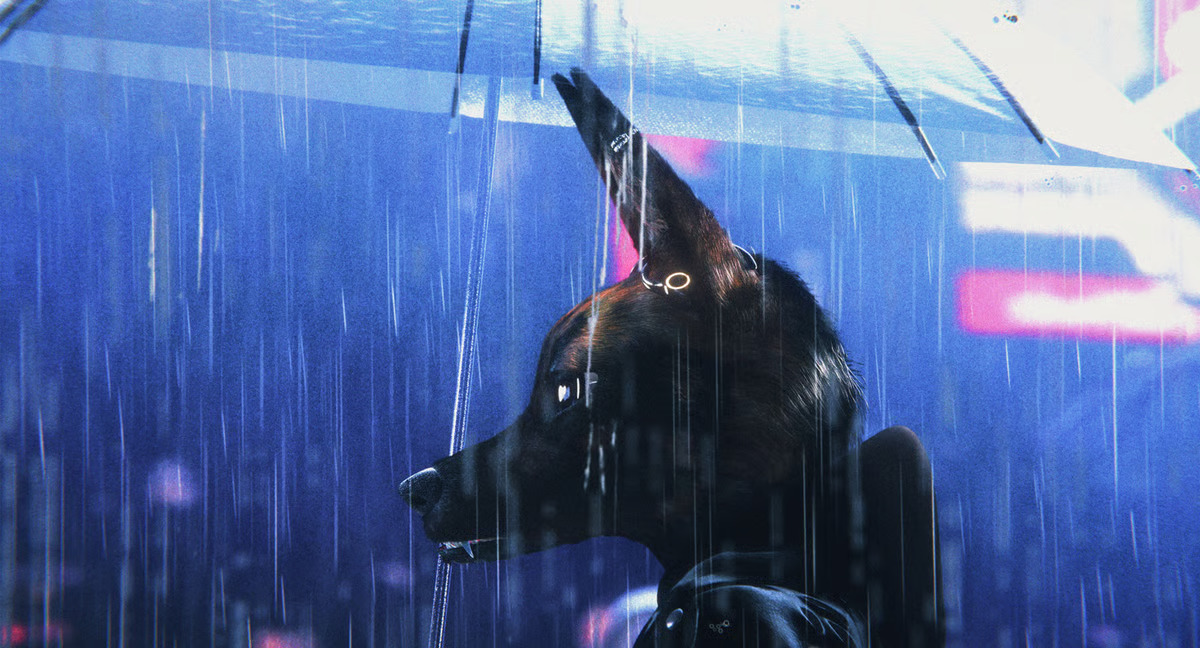
Co-directed and co-written with longtime collaborator Orian Barki, their feature debut, Bouchra, follows a 35-year-old Moroccan lesbian filmmaker living in New York. Bouchra is a Prada-wearing butch jackal struggling with writer’s block as she creates an autofictional film that delves into the turbulent aftermath of coming out to her mother. Like another project by the multi-hyphenate creatives, 2 Lizards (2020), the 3D world of Bouchra sits between Bennani’s oeuvre of anthropomorphic furry creatures and Barki’s documentary sensibilities. The digital world-building is rendered via Blender and consists of animated and live-action footage of New York City and Casablanca. The stylized urban landscapes ooze a vibrancy that pays homage to cyberpunk anime and the sultriness of Wong Kar Wai’s visual language.
In the film’s opening, Bouchra (loosely based on and voiced by Bennani) answers an emotional long-distance call from her mother, Aicha, a Casablanca-based painter (voiced by the artist Yto Barrada). They laugh, cry, and sit in awkward silences as they circle the difficult circumstances surrounding Bouchra’s coming out; Aicha’s canine-like eyes swell with tears as she finally comes to terms with having fractured their close-knit relationship for nearly a decade because her daughter is gay. However, a series of cartoonish storyboards in Bouchra’s apartment suggests that the touching moment of mother-daughter reconciliation may be fictionalized. This tension becomes more pronounced as Bouchra reminisces about her mother, with whom she shares similar habits, passions, and anxieties. In one scene, while visiting her family home, Bouchra sits on the floor near her mother’s lap as they flip through an art book by the Lebanese painter and poet Etel Adnan. A beautiful moment between the two quickly turns awkward when Bouchra holds back a crucial detail: Adnan is queer.

The blurring of the past and present grows sporadic as a sequence of WhatsApp calls circling the unsaid reveals memories of Bouchra in a state of alienation due to her mother’s negative reaction to her sexuality. Never settling on a single genre or form, the unwillingness to succumb to traditional cinematic conventions contours the film’s architecture and, in turn, the overarching narrative.This allows different facets of Bennani’s digital avatar to move fluidly, imperfectly. Like the film’s protagonist, Bennani is a queer migrant who has lived and worked in New York City for over a decade, cultivating a close-knit community that influences her work and personal identity. Just as important to her artistry are her Maghrebi family, culture, and traditions, which provide a clear political and affective throughline. Ultimately, mimicking the “split sensation” of diaspora culture, undergirding the film’s narrative as Bouchra confronts a homecoming to Morocco that is saddled with anxiety.
As soon as we’re introduced to the titular character, the screen is engulfed by the sounds of contemporary Chaâbi and Raï. As the scenography moves across continents from the shadowy, melancholy streets of New York to the bustling Casablanca metropolis, the edgy, goofy, sexually confident cig-smoking Bouchra we saw hook up with a toxic ex against her better judgment becomes subdued, self-censors, and shies away from in-depth conversations about her personal life around family. Unless tucked away in gay bars or hotel rooms, Bouchra’s sexuality is seemingly repressed in Morocco.
In a humorous text exchange with her lizard bestie, Nikki (voiced by Barki), Bouchra confesses that she has never had sex with someone who speaks her native tongue. Nikki asks, “What about that French bunny?” Bouchra insists that it’s not the same thing. This probes a diasporic conundrum that informs a larger theme of belonging and acceptance when inhabiting multiple marginal identities. Despite speaking French fluently, for Bouchra it’s not solely linguistic per se, but the shared cultural codes. She and her family also switch from French to Darija in intimate familial settings, indicating that Darija is emblematic of her heritage and ancestral lineage. While in Morocco, she meets Lamia, her lover who works for a call-in radio show, Khoui Qelbek (What’s On Your Heart?). Barki’s and Bennani’s lens fixates on their furry bodies, particularly on the ephemeral moments of yearning and pleasure, with such attention to detail that it evokes nostalgia. This fleeting and revelatory sexual experience transforms her homeland into a place of erotic desire. But it quickly dissipates when her mother catches a whiff of the affair, a reminder that her family, an extension of her homeland, and her personal identity remain irreconcilable.

Nevertheless, the film strays away from being exclusively a story about a mother’s journey to accepting her daughter’s sexuality, or trauma porn about growing up queer in Morocco, making room for an even more interesting story about how a mother-daughter relationship is shaped and altered by postcoloniality, migration, and the limitations of dominant gender and sexual expectations. Expanding on previous works, such as the Life on the CAPS trilogy (2018-2022), which interweaves the fantastical and the geopolitical to mirror the liminal status of black and brown migrants in the West. In this visual immersion, Bennani depicts a supernatural dystopia where teleportation is the new method of travel and immigrants seeking refuge from the pressures of their fascist realities are disproportionately intercepted and interned in a detention camp in the middle of the Atlantic Ocean. As a form of resistance to their expulsion to this island, they form new, hybridized societies that become intensely surveilled. In this augmented reality, families sustain connectivity through collective gathering despite the daunting air of U.S. militarism, border regimes, and racialized carceral violence.
Viewed together, Life on the CAPS and Bouchra, on differing levels of the personal and political, portray how postcolonial power structures infiltrate the family and the big and small ways they resist. They hone in on the quotidian moments of kinship and relation in which the women in Bennani’s family take center stage. Their presence in these works often gestures toward togetherness. Similarly, in Bennani’s first solo museum exhibition, FLY, a massive sculptural feat that projects the women in her family — rendered absurd with playful special effects — dancing, singing, and gossiping at a birthday party. Toward the end of the film, Bouchra’s aunties break into a traditional music ensemble in the family living room, an intimate scene that recurs throughout her art, but the film also shines in the fraught moments of estrangement. As she parses through her conversations with Aicha to truly understand what she was feeling and thinking during this time of disconnection, the mother-daughter relationship remains shielded from Western narratives of what familial acceptance should look like in relation to one’s “coming out.” While it doesn’t lead to a breakthrough moment of resolution where reconciliation feels tangible, it breathes authenticity into the storytelling that complements the unsettled nature of their long-distance relationship and the complexities of diasporic life.

Bouchra is a tender exploration of the beauty and perils of the diasporic experience and how individual identity, kinship, and relationships are reconfigured by geopolitical, geographical, and cultural barriers. By the end of the film, it remains unclear whether what we watched are imaginative scenes for the autobiographical film or lucid memories from Bouchra’s past and present; but what emerges is a delicate, humanistic portrayal of a mother-daughter bond that is constantly mediated by distance and time—thoughtfully visualizing how irreparable rifts cannot simply be talked through.
Matene Toure is a freelance tech and culture journalist, film critic, and fact-checker from the Bronx, New York City. Her film writing focuses on spotlighting new, subversive, and avant-garde film practices across the Black diaspora and the MENA region.
If you enjoyed this article, please consider supporting Ultra Dogme on Patreon, Ko-fi, or Substack, so that we may continue publishing writing about film + music with love + care.