
by Yasmina Price
Make a rule. Break it. Doubling the fabular entry point of once upon a time, Jackie Raynal’s Deux Fois (1968) is a springy cinematic exercise that plays with the levers of control and release. Luxuriating in the anatomy of visual storytelling, the film is an effervescent sequence of vignettes, sealed with the precision of a filmmaker whose training began as a technician. The title’s twist on the narrative mode of fairytales signals its incorporation of the literary genre’s original sinister qualities. Caught in a tangle of whimsy, lawless figures and inexplicable repetitions are constantly shadowed by the threat of violence.
Towards the end of Deux Fois, a typewritten text titled “Achille and the Turtle” starts with “for the third time.” A segment in which Raynal enters a shop to buy soap—uncertain of what she wants, doing a sniff test and inquiring about prices before making a decision—repeats a third time. Her non-adherence to the formula she herself set then undergoes another twist, at least linguistically. Raynal first addresses the shopkeeper in Spanish, then French, and finally both, presenting what may be less a third repetition than a compressed synthesis of the previous two. In turn, the film’s delightful chaos results from its admixture of a chilly, manicured construction with an exuberant, mischievous radiance.

Raynal’s filmmaking is textured by the particular avant-garde non-conformity which differentiated the Zanzibar group from their contemporary corollaries in France. Unlike the Nouvelle Vague directors with whom she worked as an editor—amongst others, Claude Chabrol, Jean Eustache and notably Éric Rohmer—Raynal leaned more towards the sensorial derangement and anarchic unpredictability of the Surrealists and Situationists. Deux Fois establishes its disorientating bearings from the ground up, as she displaces herself from the social, political, professional topography in Paris and France to plot the film in Barcelona.
There, Raynal deftly orchestrates an exquisite corpse of formal experimentation. Her conceptually daring film functions through an erotics of uncertainty and spontaneity to unwind any possibility of satisfied narrative expectation. Instead, it pointedly inhabits the qualities of an exercise or a sketch, absent of any preciousness to resolve. A cinematic seduction into a secret system of understanding, Deux Fois is at once conspiratorial and estranging, offering the spectator the flattering disquiet of being in on the joke—but only partially.
Everything orbits around Raynal. The filmmaker first appears as someone being watched—or at least as someone behaving as though she thinks she is being watched. Under presumed or fabricated surveillance, Raynal is framed in a medium shot, sitting on a balcony. With her head initially bowed almost as if in prayer, she is flanked by a vase filled with large feathery white stems on the right, facing a spread of food and glass bottle of coke which she eventually pours for herself. Her eyes dart nervously, looking mostly to the side and sometimes at the camera. With strange trills and guttural squawks for musical accompaniment, Raynal eats voraciously, while maintaining the fidgety unease of the paranoid object of an unverifiable gaze.

The irony is that this is Raynal’s film, she is facing her own camera, and if a gaze is being directed towards her, it is most evidently the one she orchestrated herself. The theatrical agitation of these proceedings is heightened by a formal announcement of what is to come, starting with her saying “And now, you will see a little girl on a train, then I will tell you a few little stories” and continuing on to sketch out the rest of the film, before closing with “This evening will be the end of meaning. Ladies and gentlemen, good evening.” After speaking, she remains rigidly posed and immobile, as though waiting for her photo to be taken. Another false start, the subversive ceremony has a ritualized quality, suggesting yet another system of meaning that will not deliver any stable coherence.
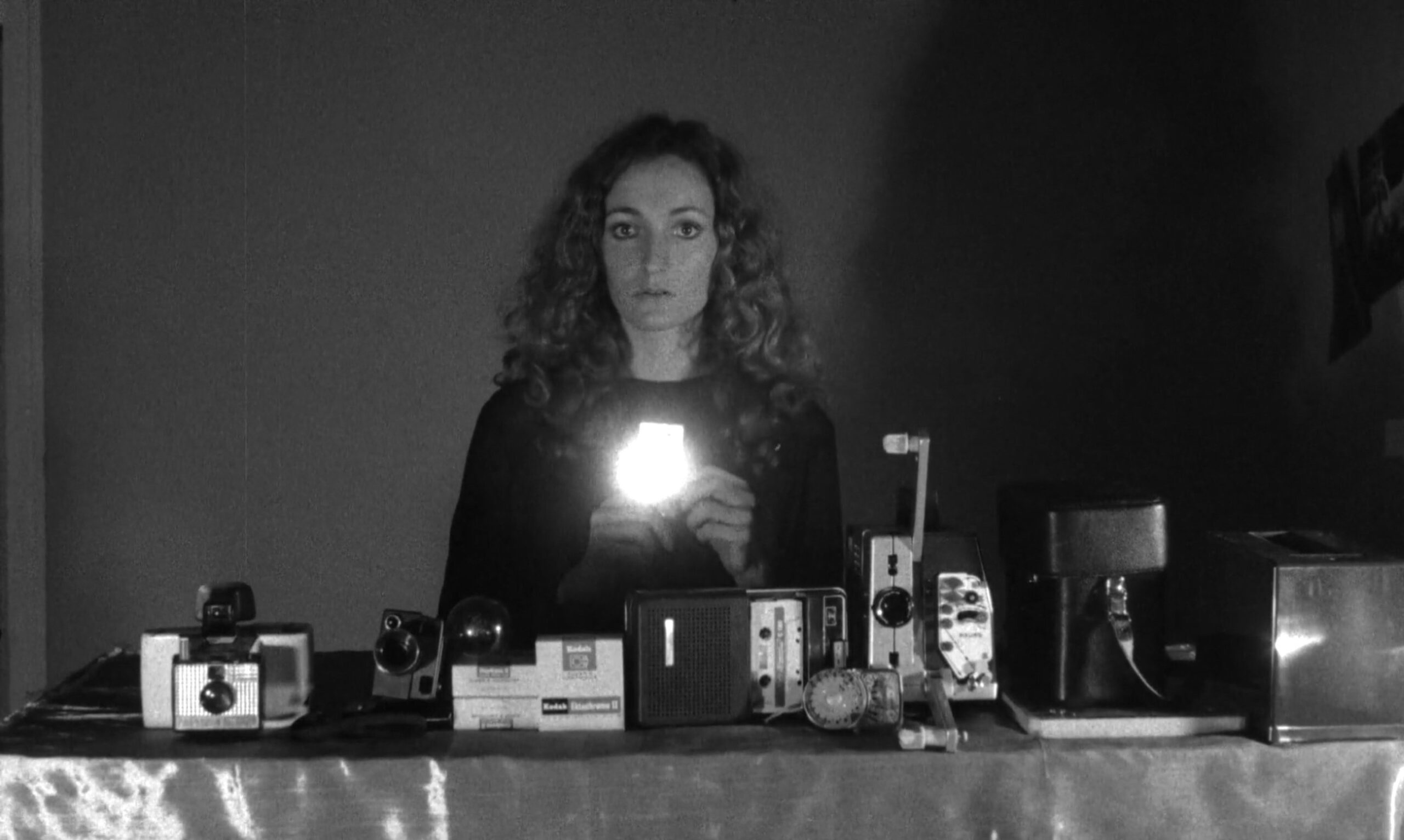
Later, Raynal stands behind a table covered with numerous cameras. She picks them up one at a time, walks off screen, puts them back down, and repeats the process. The camera ritual places the technology in her hands and foregrounds the material objects which produce images. A claim on directorial control, Deux Fois is a study in Raynal’s technical expertise. When she began her work as a film editor, the profession was the intricate and underrecognized domain of a high percentage of women compared to other filmmaking labors.

Varied events of gendered antagonism play out a feminist invective of conceptual and formal refashioning. Amongst them, the most overtly violent episode is also the one which does not repeat. Surrounded by a smudged landscape, Raynal appears in a close-up profile, a white scarf wrapped around her neck. Loud wind blows her hair around, before a pair of hands and hairy forearms gather her hair out of her face. What could have been a gesture of care quickly flips, as the hands aggressively pull her hair backwards until she disappears from view. The formal outlier in Deux Fois, a digital, pixelated choreography showing two black figures against a brightly dotted grid, communicates similar hostilities. The likenesses of a woman and a man enter into a stylized hybrid of dancing and fighting. Their acrobatic discord shows them kicking and throwing each other around, with the woman at one point wielding a knife and afterwards tossing a chair. There is no feminist triumph: the woman ends up on the ground, pushed down by the man. Between the two episodes, Raynal and the abstracted figure are physically pushed out of the screen, waging a feminist battle for authority in the visual field.
From its conception through its execution, Deux Fois circles the question of how to re-make a cinematic image by intervening in the established, patriarchal arrangements of representational space. Raynal herself incarnates the transgressive visual choreography of the film. Thwarting expectations, its mixture of chilly calculations and fiery outbursts, alternating between repose and erratic expressivity, results in a suspended, partial paralysis. Even as it performs a repetitive refutation of firm beginnings or ends, Deux Fois was the first film she directed. A take two on her ways into filmmaking, the formal dexterity of Raynal’s piecemeal portraiture is a mutinous ritual of mediated self-creation.
Deux Fois will screen as part of Jackie Raynal Presents at Anthology Film Archives September 15 – 17.
Yasmina Price is a New York–based writer and film programmer. She is devoted to visual culture from the African continent & diaspora, anticolonial cinema, and the experimental work of women filmmakers. Her work pays particular attention to the materiality of image-making and the politics of memory. She has programmed at Anthology Film Archives, Maysles Documentary Center, the Brooklyn Academy of Music, the Los Angeles County Museum of Art, the Pan African Film & Arts Festival, the National Gallery of Art and the Schomburg Center for Research in Black Culture. Her writing has appeared in edited volumes, museum catalogues and journals such as The Nation, Film Quarterly, The Baffler, MUBI’s Notebook, Hammer & Hope, World Records Journal and Criterion’s Current. She holds a Ph.D. in Black Studies and Film & Media Studies from Yale University.
If you enjoyed this article, please consider supporting Ultra Dogme on Patreon, Ko-fi, or Substack, so that we may continue publishing writing about film + music with love + care.