
by Joseph Dimacchia
Across artistic practice, the rage against death is found within the notion that form itself is everlasting, that if every maker and subject of a film has passed, they nonetheless live forever in their creation. It has been over three decades since filmmaker Gregory Markopoulos passed away, and yet the life-force behind his vast collection of works continues to resonate today. Before moving to Europe with his partner and fellow filmmaker Robert Beavers, Markopoulos was one of the most prominent figures in New American Cinema, alongside contemporaries such as Marie Menken, Jonas Mekas, Stan Brakhage, Andy Warhol, et al. Markopoulos was a champion of what could be described as cinema in its purest form: a practice disconnected from capitalism and the academic, anti-art dogma of parasitic institutions. Simultaneously, Markopoulos believed that ideal film-viewing was a product of a methodical, calculated process—from content and execution, to projection and setting. His meticulous care and disillusionment with American filmgoing led to the creation of the Temenos (ancient Greek for “sacred grove” or “a piece of land cut off for the worship of God”), an archive for the presentation of his films.

(C) Temenos Verein 2003
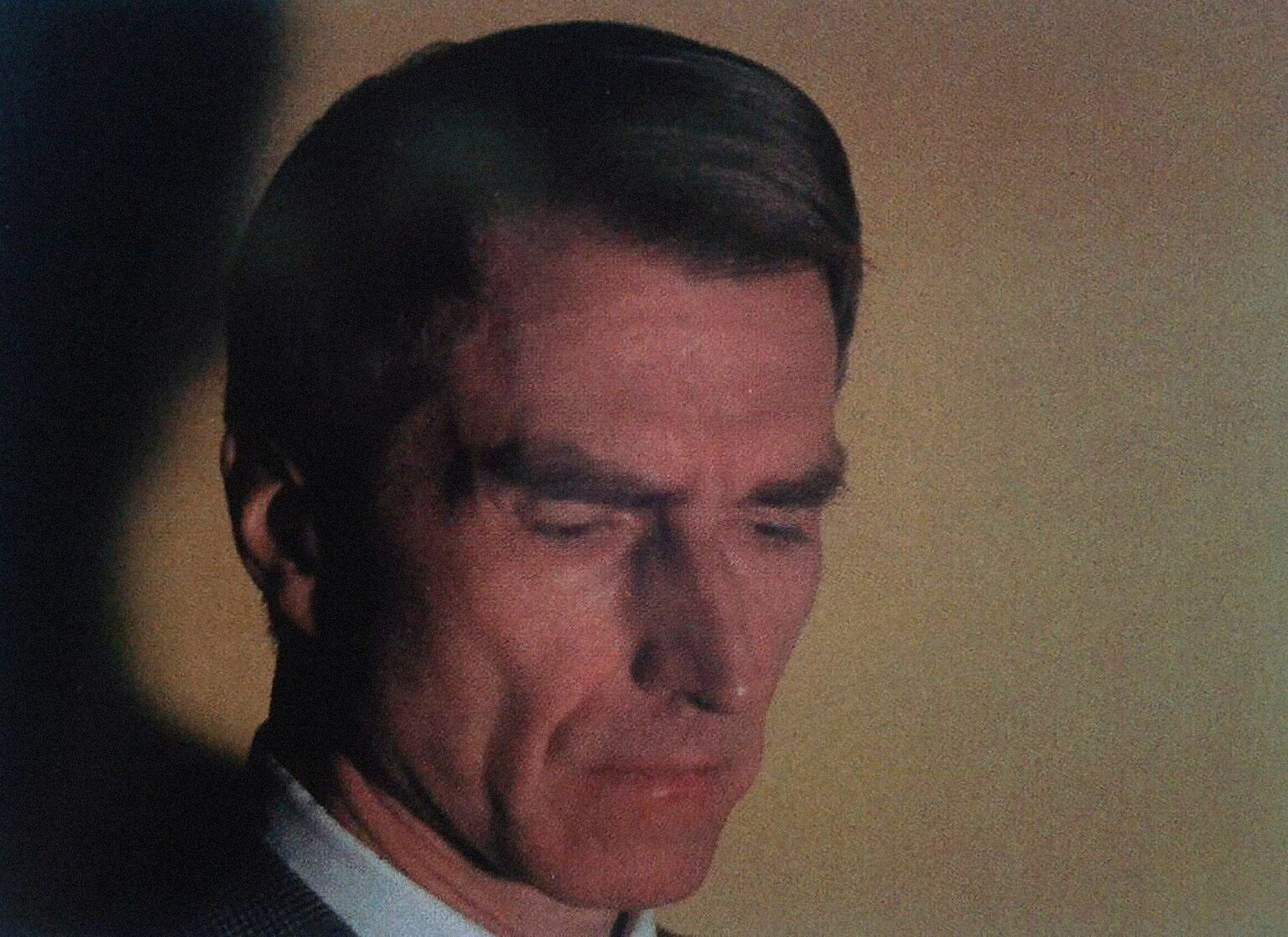
Yet in 1966, whilst still in New York, Markopoulos made what is perhaps the film most akin to Bazin’s notion of form as transcending death: his complex portrait of the Greenwich Village art scene, Galaxie. The film’s structure is ostensibly simple, composed of 33 intimate, 16mm portraits of filmmakers, writers, and artists in their homes or studios (among them Jonas Mekas, Susan Sontag, Allen Ginsberg, Shirley Clarke, and Amy Taubin), the only accompanying sound is a Hindu bell. However, Galaxie is amongst the most formally ambitious of Markopoulos’ films in its use of elaborate in-camera editing—i.e. dissolves, superimpositions, multiple frames—that all work toward an abrasively rhythmic structure. With each passing of a portrait, wherein the subject poses with a personal object of their choosing, the speed of the images becomes more and more frenetic until its conclusion.
Critics and audiences have often likened Galaxie to Warhol’s Screen Tests and have situated the former as a direct response to the latter. The similarities undoubtedly exist in the basic sense of practice, as do they in the case of Mekas’ numerous works of portraiture, but Galaxie—as with much of Markopoulos’ work—is an invention of its own brand of cinema. Galaxie, it seems, exists in some transitional space between the mechanical impulses of Warhol and the sentimentalism of Mekas, though it nonetheless holds both approaches close by in its own right. That is to say, Galaxie’s form, though theoretically akin to both Warhol and Mekas, is more in tune with what Markopoulos posited as “a new narrative film form,” in which the form itself works to create “thought images” that evoke abstract emotion.

(C) Temenos Verein
Because of this, Galaxie is more aptly dovetailed to something like Markopoulos’ 1969 film, Sorrows—which depicts the decay of the Triebschen chateau—than to the portraiture work of Warhol or Mekas. One could argue that the two films, though perhaps similar in form, are largely disparate within the scope of Markopoulos’ oeuvre. Although Galaxie is a work of human portraiture in principle, it is simultaneously a work concerned with setting in the same way Sorrows is. As with Markopoulos, there is no definitive crux to a form that prioritizes abstraction, yet both films can be viewed through a lens that focuses on the effects of time. In Sorrows, that lens is far more discernible, as its primary occupation is that of a home’s erosion. In the case of Galaxie, however, Markopoulos similarly gestures to the passage of time, yet far more obliquely. Its form, as aforementioned, is one in which the passage of time is indicated by an increasing freneticism, both in image and sound. As one portrait ends, another soon to begin, the frame becomes more elusive, refusing to hold on. Hence, Galaxie’s form—given that the film was entirely constructed in real time—is a mirror to the human concept of time, which appears to accelerate at an ever-increasing rate until it is no more.
Despite the obvious contextual framework of portraiture as a means to realism, Galaxie is nonetheless informed by Markopoulos as much as it is his subjects. In many ways, the film can be read both as a precursor to Markopoulos’ eventual departure from American cinema and as the product of his nonconformity to the overt commodification of art in the New York film scene. A mere few years before making Galaxie, Markopoulos quit his job at a Greenwich Village bookstore on the advice of fellow avant-garde filmmaker Jack Smith. He lived largely in poverty and devoted the entirety of his time and effort to filmmaking. Thus, Galaxie also positions itself as an economically ambitious work, wherein the use of in-camera editing becomes at once an artistic choice and a financial one. In other words, the film’s form takes on the energy of its subjects’ milieu: dazzling, colorful, frenetic, chaotic, yet without significant financial means. It is also a kind of foreshadowing to Markopoulos’ departure, as well as the eventual end of the artistic and social era portrayed. With each dissolve, whether from one frame to another or between subjects, one gets the impression that the people and places they inhabit are fading before their eyes. Galaxie—despite its rigor and vibrancy—is a melancholic mediation of a dying world, even if that fact is unknown to Markopoulos or his subjects. It also has perhaps the greatest affinity with Markopoulos’ theory of form, where thought images give way to abstract emotion. With each use of in-camera dissolve, each ring of a bell, each increase of speed, we can feel the milieu slipping away, and with it, its inhabitants. If Galaxie is about this fading away, this quiet death, then it is also about life and the form that endures. With each dissolve, a new image appears.
Joseph Dimacchia is a writer, critic, and poet from Cleveland, Ohio. His work has appeared in In Review Online, Offscreen, La Piccioletta Barca, Full Stop, and elsewhere.
If you enjoyed this article, please consider tipping the author and/or supporting Ultra Dogme on Patreon, Ko-fi, or Substack, so that we may continue publishing writing about film + music with love + care.