
by Alonso Aguilar
There are nations and there are cinemas. At times, they are grouped together and intertwined, by material conditions, political context and production environment. The banner of a “national cinema” is suddenly superimposed over an entire geography, as it makes things easier for the foreign onlooker. It provides a streamlined association game of gestures and motifs that are taken as innate and representative; a positivist guise not unlike the ethnographies of yore.
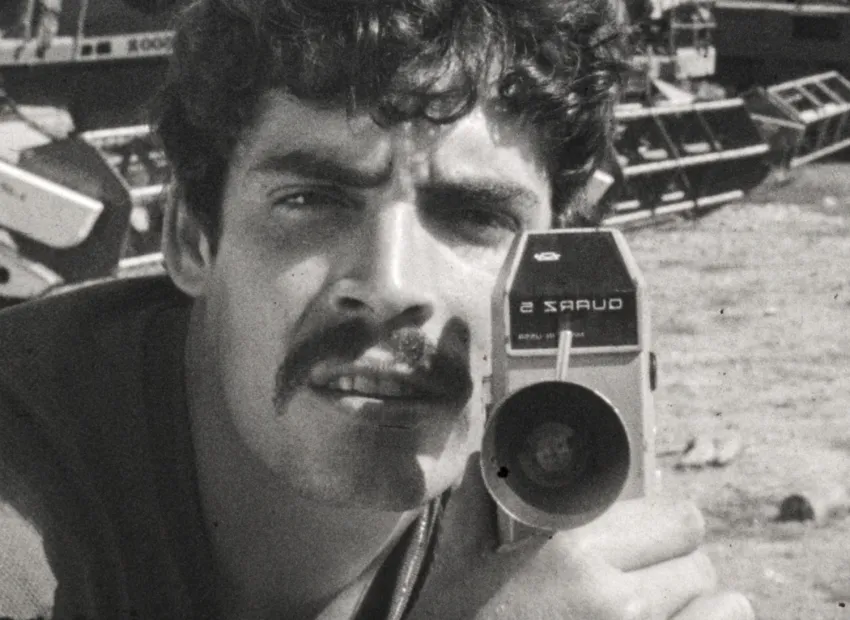
Archivistas Salvajes (The Wild Archivists) is a transnational collective composed of Lucia Malandro, Daniel Saucedo and Fabio Quintero. They are dedicated to the preservation of amateur Cuban cinemas; in plural. Their focus is the works of the cine-enthusiasts and cineclub movements that rose in the Caribbean island during the 1970s and 1980s. Unlike the usual structures of Western cinephilia, however, Archivistas Salvajes is looking for much more than hidden gems or neglected auteurs. To them, these reels and films are integral components within the wider genealogy of imagemaking in Cuba. Los Subterráneos (The Underground Ones) is their living archive for Cuban amateur cinema, a realm of production historically shoved aside when it comes to the wider cinema conversations regarding digitalisation and restoration. Archivistas Salvajes argue that the value of these works is not merely anthropological or academic, but that there are aesthetic and affective experiences unique to the cine-enthusiast forms, and that their preservation is critical, as there remains an active threat of disappearance. After all, amateur cinemas aren’t usually getting funds for restoration or institutional backing. Their existence is in direct opposition to the parameters of canon formation, framed and discussed (if at all) as lesser forms, transitional periods that filmmakers “outgrow”.

If the nation-state is already a reductive banner for heterogeneous communities and cultural practices, applying a similar framework to cinemas made within an arbitrary set of borders becomes nearly as prescriptive. Distinctiveness is ascribed to the individual auteur, but the general characteristics are understood as environmental; responses to a static country, eternally frozen within the frame, just waiting to be depicted like a painter’s model. Naturally, the sociocultural currents within the nation-state can’t be contained or compartmentalized in that manner, they are ever-flowing and ever-changing. Cinephiles tend to understand that when it comes to the epicenters of Western production historically. How often is there still talk of a French, American or British national cinema? Said analytical practice is deemed archaic and inherently limiting, reductive even in its most exploratory of uses. And yet, the standards seem to loosen up when it comes to looking down South.
If it draws the right attention, a flash in the pan is taken as aesthetic scripture, engulfing the layered histories around it into only contextual considerations. One of such cases appears when one looks into how Cuban filmmaking has been discussed, showcased and programmed through the official strands of film history. The foundation of the Cuban Institute of Cinematographic Art and Industry (ICAIC) in the early days of the Cuban Revolution in 1959, is the moment of “discovery”, if going by colonial logic. What came before is merely prehistoric, the cinematic “barbarie” that existed in the shadows, far from the enlightening torch of international interest. What came afterwards were the echoes and vestiges that can only be understood and read in a direct causality with that initial awakening. What existed at the time is buried in footnotes, and is seen as unrepresentative, a non-sequitur within the neatly told story; simply anecdotal and peripheral. Within that latter realm is where Los Archivistas Salvajes come in.
The transnational relevance and groundbreaking productions of ICAIC rapidly became a cinematic whirlwind for Northern intelligentsia. Tomas Gutierrez Alea, Santiago Álvarez, Sara Gómez, Humberto Solás, and most recently, the “discovery” of Nicolas Guillén Landrian, integrate a specific conception of a “Cuban Cinema”, no matter how distinctive each one of those filmmakers may be from one other. There’s a hierarchy that comes from an institutional logo, a branding of sorts that has been repurposed as an aesthetic signifier for the Western cinephile. It’s as if the post-revolutionary enthusiasm became embalmed within the films, ready to be approached in a vacuum, in a museological fashion to provide some sort of safely distanced, parasitical relationship for the radical chic with filmic revolutionary praxis.

How it’s been forced into a stranglehold over Western Film History’s limited conceptions of militant film isn’t necessarily ICAIC’s fault, but it signals that the expansion and countering of that narrative can only come from its margins and blindspots, of which there remain quite a few. What Archivistas Salvajes does is put them together and in dialogue with each other, granting them space for contrast and discussion, while allowing films to inhabit a space in their own terms, bypassing the othering effect assigned to them from the preconceived notions of what a national cinema is or should be.
Without industrial or arthouse hand-holding, the cine-enthusiast looks to the immediacy of their context in a close-knit dialogue that’s hard to replicate. They develop emergent methods to document the realities around them from a place of intimacy and familiarity, often with a joyful playfulness and exploration that bursts through the screen. The cine-enthusiast approaches the camera from a place of impulse, without necessarily having clear sights on the form things will take, or how they’ll relate. Their films are additive through lived experiences, and their filming process is in many cases even more relevant than the final result itself. Pragmatism and cynicism have no place in amateur cinema; it’s ontological.
Amateur: Gallicism borrowed from the French, meaning “lover of”. Its root comes from the Latin Amator, literal translation of “lover”.
By definition, the amateur filmmaker is a lover of cinema as a creative outlet. Their gaze is affectionate precisely because it’s dealing with an extension of their own realities, their films being testaments to what other cameras don’t deem worthy. The works archived and showcased by Archivistas Salvajes in many cases focus on the hyper-local milieus of Cuban small towns, from traditional festivities, folk rituals, and loving tributes to the eccentricity and singularity of local characters and spaces.
Their screening program, “Records of the Everyday: Festivities, Rituals, and Popular Memory” is precisely an ode to collective histories and mythmaking. A trumpeter and candy seller called Sorelio “Pucho” Hernández records images of where his folk group Tambores de Bejucal takes him. These never aspired to be “finished films”, with his reels not so unlike the scattered impulse of family home recordings and old snapshots. In his case, the reels show the vitality of Bejucal’s carnivals and festivities, and most importantly, see in the recurring faces and voices a palpable archive for his neighbours and community. Miguel Secades in Cine Club Cubanacán from Central Cuba documents the traditional celebrations of Cruz de Mayo and the Parrandas in Remedios and Camajuaní. Felipe Rouco is a young photographer who depicts the intricacies behind the iconic pilgrimage to the Sanctuary of San Lázaro, one of the Caribbean’s most renowned expressions of religious syncretism between Catholicism and West African belief systems. These materials are shown in their own fragmentary nature, accompanied by live readings, musical interpretations and testimonials. They aren’t forced into a “traditional film format” which they never asked for, as they warrant rethinking our own ways of engaging with the act of watching and experiencing.

Another one of their screening programs, “Cuban Experimental Cinema: Games of Language, Diaries, and Urban Drifts”, might appear on the surface like a more familiar auteurist presentation of two key figures of Cuba’s independent and amateur scenes like Manuel Marzel and Juan Carlos Alom. In reality, their deeply expressive and formally curious works present a bridge to the wider histories of Sigma Cine Club and the non-institutional production circuits in the Caribbean. Collage works, observational documentary, lyrical gestures, and mischievous use of pop music all present some of the possible avenues for the Cuban cine-enthusiast during the 1980s and 1990s. If a shared concern was to be established, it’d be an ongoing inquiry into cinematic language from a place of wonderment and active back-and-forth.
A parallel between ICAIC’s revered golden period of production and the amateur works preserved and presented in Los Subterraneos might exist in how eclectic, adventurous and heterogenous the films forms and subjects are, but that speaks precisely to the core impossibility of defining a national cinema. Are Santiago Alvaréz’s vigorous anti-imperialista agitprop “more Cuban” than Juan Carlos Alom’s poetic musings? Are Guillén Landrián’s impressionistic snapshots of life in Oriente “more Cuban” than Pucho Hernández’s celebratory reels from Bejucal? Perhaps allowing them to coexist, contradict themselves and allow for a multiplicity of Cuban cinemas is truer to what’s already in the works themselves.
Alonso Aguilar is a Costa Rican writer, critic and programmer. His writings have featured in Mubi Notebook, Bandcamp Daily, Hyperallergic, photogénie and Cinema Tropical, among other outlets.
If you enjoyed this article, please consider tipping the author and/or supporting Ultra Dogme on Patreon, Ko-fi, or Substack, so that we may continue publishing writing about film + music with love + care.