
by Olivia Hunter Willke
A year between the deaths of iconic popstar Michael Jackson and iconic film star Elizabeth Taylor, filmmaker Michael Robinson seemingly traversed through several stages of the afterlife to return with his digital masterwork, These Hammers Don’t Hurt Us (2010). Hammers dances around a trek toward the hereafter, using larger than life figures as conduits for the mythic tale of the Egyptian goddess, Isis and her son, Horus. Reappropriating images from Taylor’s starring role in Joseph L. Mankiewicz’s Cleopatra (1963) and Jackson’s 1992 Egyptian-themed music video “Remember the Time” directed by John Singleton, Robinson weaves a dazzlingly prophetic narrative of Isis escorting Horus beyond both the underworld and overworld. The adjacent imagery of Mankiewicz’s film and Singleton’s music video interspliced and interacting evokes a tender connection, one that the two biggest tabloid stars of the 21st century seemed to share both in and out of the spotlight. The two celebrities function here as vessels for the usual caveats of fame, obsession, media madness, and surveillance. It recreates a relationship, while also conjuring an evocative reading of time, technological evolution, cultural shifts, pastiche, and myth itself. Sixteen years on, These Hammers Don’t Hurt Us remains a mystical cultural and artistic artifact.

Michael Robinson’s work often appropriates dated popular imagery and transforms it into shatteringly ominous modern realignments. Light Is Waiting (2007) uses the season 3 premiere of Full House, in which the family takes a trip to Hawaii, and “devours itself from the inside out.” In Robinson’s hands, it contorts into a strobing, mirrored clash of privileged annihilation with an excess sense of doom. Hold Me Now (2008) applies the titular Thompson Twins song (sans singing) in a karaoke-like scroll of lyrics at the bottom of an emotional and physically exaggerated scene from Little House on the Prairie. Between flashes of black frames, the slow-motion scene plays out as the two figures grab and paw and push at each other, a histrionic dance to the hollowed out, stripped down pop melody. A commentary on melodrama and performance anchored by playful homage to dual figures and structural stutter, cousin to Hollis Frampton’s Critical Mass (1971) and Ken Jacob’s filmography.
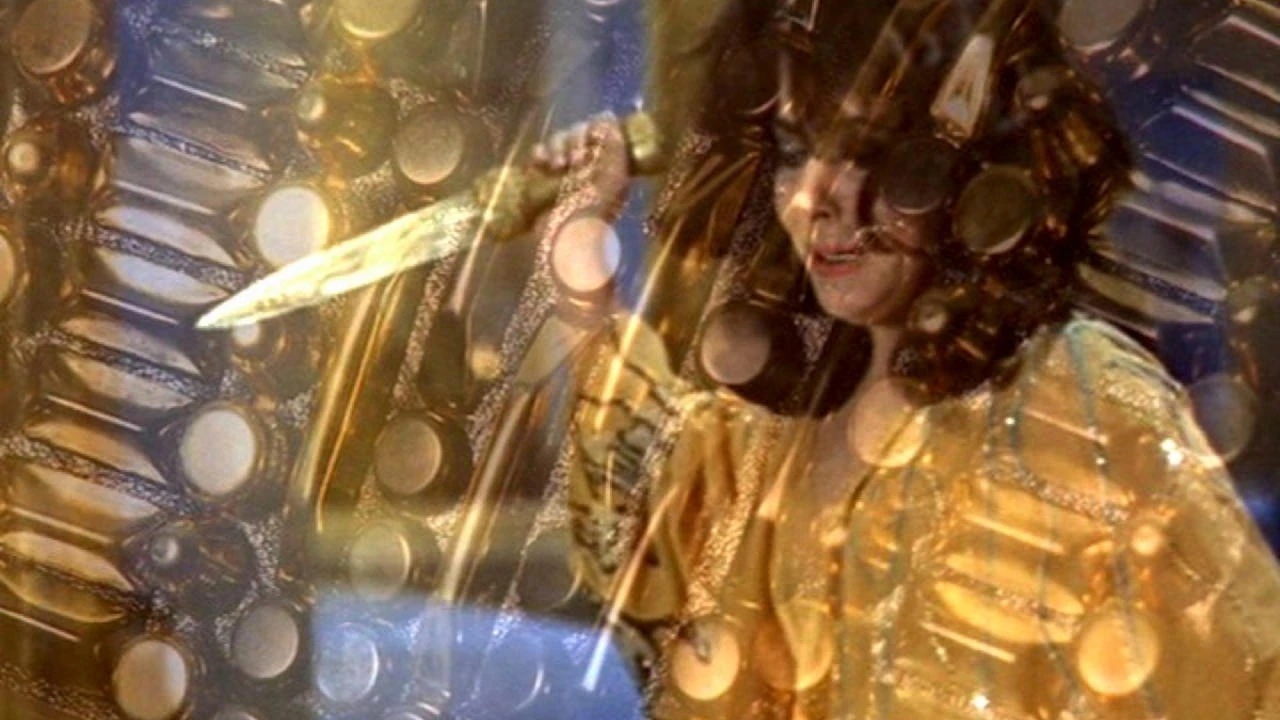
These Hammers Don’t Hurt Us opens on the image of a rotating bejeweled jacket, as if from a museum displaying articles of antiquity. Sparkling gems adorn the cream colored, sculpted fabric, as the monologue Cleopatra whispers to seduce Caesar is used as voiceover. “I will bear many sons. Isis has told me. My breasts are full of love and life. My hips are rounded and well apart. Such women, they say, have sons.” Oscillating lines of colored static create a vortex that leads to a rainbow-ridged pyramid and tunnels. Taylor as Cleopatra emerges from the throbbing channels, her eyes piercing through two peepholes in an ornate mosaic eye. She witnesses her son, Jackson’s Horus, rhythmically dancing surrounded by a coterie of background dancers that one imagines are slaves. The film descends back into the sparkling tombs and pulsating black catacombs. Isis seeks a seer and is prompted to peer into a lit flame to catch a glimpse of the future. Within the crackling fire, she sees Horus, ambushed by guards armed with scimitars. He narrowly escapes capture by twirling into dust. She cries out in a maternal howl. Swaddled by refracted light, we are transported back to the articles of sculptural jackets. Different configurations of gems and jewels in close-ups mimic the glittering maze the viewers have been traveling by thus far. A golden, silver, and black-studded jacket fades against an image of Cleopatra holding a knife as it catches the light, before doubling over onto the bed in mourning. An allusion to Michael and Liz’s comfort and reprieve found in their real life relationship, here Taylor (as Cleopatra as Isis) is portrayed alone in maternal distress. She is ostensibly burdened with divinity and aware that her son, Jackson’s Horus, suffers the same affliction. A calcified mummy, its body covered in a shroud, appears as she opines, “Without you, this is not a world I want to live in, much less conquer. Because, for me, there would be no love anywhere.” In these lines, it is as if Taylor has preliminarily mourned her long-time friend, confidant, and pseudo-son. At the time of Jackson’s passing, Taylor wrote on her Twitter account, “My heart…my mind…are broken. I loved Michael with all my soul and I can’t imagine life without him.” A montage of wraps and shrouds bubble and seep as Isis continues, “Do you want me to die with you? I will. Do you want me to live with you? Whatever you choose.” Two twinkling orbs and jets of light (stars in the form of Isis and Horus) shoot out from the point of a 3D rendering of a pyramid beside a river and begin to soar over a vacant landscape, up and out of this divine and hostile land.

At the time of release, Cleopatra became the most expensive film ever made. In conjunction, “Remember the Time” was one of the most expensive music videos ever made. Tapping into the excess and glamour generally associated with pop culture’s depictions of ancient Egypt, the utilization of these two portrayals create a camp representation of celebrity indulgence and media’s ahistorical romanticism. The alignment of these figures within this fictional, scintillating ancient Egypt offers the means to characterize not only a bond, but an entire shifting world. Wrestling with a sense of oldness and newness, digital and analog, a clash of time and requiem for those that have perhaps been left behind during the transition. The monument of fame by way of pyramids and massive structural elegies shrunken down and bottled within a personal and mythological digital capsule; Hammers feels both utterly, eternally expansive and patently intimate. In the dizzyingly epileptic final minutes, ice skaters adorned in Egyptian garb, twirl in synchronized dance, spinning as the screen flashes. A dazzling committee meant to greet Horus in the beyond or bid him adieu from this mortal coil, they celebrate his journey and ascension to higher plane. More than a decade since its conception and release, These Hammers Don’t Hurt Us remains a sophisticated meta-media translation of pop culture artifacts as oblique renderings of history, as well as a wholly unique, radiant, platonically romantic spin on mythology.
Olivia Hunter Willke is a film writer, analog filmmaker, and programmer based in Chicago by way of Texas. Her work blends political urgency, formal analysis, and emotional revelation.
If you enjoyed this article, please consider tipping the author and/or supporting Ultra Dogme on Patreon or Ko-fi, so that we may continue publishing writing about film + music with love + care.