
by Justine Smith
Portuguese filmmaker João César Monteiro has been playfully referred to as a “satanic presence.” He, who has played a king, a fool, a criminal and a pervert, was shaped by writers like Céline, De Sade and Rabelais and like many directors of his generation, found inspiration in Robert Bresson, Jean Eustache and Jean Renoir. He was born on February 2nd, 1939 into an anti-fascist and anti-clerical home in the heart of a theocratic fascist dictatorship under Salazar, who ruled over Portugal from 1932 until 1968. Salazar died in 1970 and his regime would outlast him by a few short years.
Monteiro is indebted to Portugal, and the epics of Luís Vaz de Camões, the heteronyms of Fernando Pessoa and the horrific promise of the sea. His work was deeply enmeshed in the paradoxical might and decay of Empire and the enigmatic beauty of Lisbon’s urine-stained streets. He’s a filmmaker totally shaped by his birth and yet one who resisted it completely. “My greatest misfortune was having been born in Portugal,” his character says in one of his last films, As Bodas de Deus (1999). But, if he were not born in Portugal, he would never have been.
When Portugal’s dictatorship fell on April 25th, 1974, Monteiro was 35 years old. As people took to the streets, a florist with a warehouse overflowing with red carnations began passing them out. The Carnation Revolution began as a non-violent coup followed by workers’ strikes and uprisings. It was deemed by Irish writer, Phil Mailer, the “impossible revolution”.
Impossible within the confines of Portugal. Impossible because no island of libertarian communism can exist in a sea of capitalist production and of capitalist consciousness. Impossible because the upsurge was rooted — as in concrete — in the underdevelopment of Portuguese society as a whole. Impossible, given the social composition of modern Portugal, the weight of the northern, smallholding peasantry, the influence of the Church, the erosive and demobilizing effects of chronic poverty and unemployment. Impossible, finally, it is claimed, because state capitalism, not socialism, was ‘objectively’ on the historical agenda, and because of the state-capitalist mentality of the ‘socialist’ revolutionaries.

João César Monteiro would pick up a camera in the aftermath of April 25th, shooting footage for the documentary The Guns and the People (1975), as part of a collective of filmmakers representing the Sindicato dos Trabalhadores da Produção de Cinema e Televisão [Union of Cinema and TV Production Workers]. The documentary showed jubilation and ecstasy in full colour, as people imagined what a new Portugal might look like.
Monteiro was already making films by 1974. His short film about Portuguese poet, Sophia de Mello Breyner Andresen (1969), already featured many of his trademarks, while his medium-length short, deeply indebted to Jean Eustache, He Goes Long Barefoot That Waits For Dead Men’s Shoes (1970) was repressed by the regime, only to be shown on TV for the first time in 1979.
The whiplash between anger and pleasure flows through his filmography; the ecstasy of liberation, the violence of oppression and the whimsy of rebellion. Despite his insistence that cinema was inadequate as a medium for poetry, his work nonetheless viewed art as sacred. He aligned with Sophia de Mello Breyner Andresen’s comments in his film that “poetry is a moral act.”
His documentary, What Shall I Do With This Sword? (1975), reveals a filmmaker implicated in the struggles of post-revolutionary life. Portugal had liberated itself from the dictatorship, and now was left to reimagine what a new Portugal might look like. The film intermixes footage of people on the streets and backrooms, discussing the possibility of a free country, along with the threat of American naval forces lining the horizon with their warships. Monteiro would intercut his footage with Murnau’s Nosferatu, an allusion that would recur throughout his filmography.
Despite the ardour of its speakers in What Shall I Do With This Sword?, it already feels as though the revolution was lost. Portugal, a small country, could not compare with the might of the American fleet. The people, who starved under Salazar, starve once again in the face of America’s insatiable hunger. Portugal, an ancient country, loses itself once again. The hope for re-invention was waning, as American influence would overtake Salazar as oppressor.

Years later, in 1981, Monteiro would release Silvestre, the story of a young woman who disguises herself as a knight. Embracing artifice, the film was shot largely against projected backdrops. Rather than embracing contemporary language and form, in this film Monteiro prefers to use antiquated Portuguese and flattened image compositions that resemble paintings and tapestries. The film’s beauty, glowing red skies and the cherubic beauty of Maria de Medeiros, finds itself dismantled by the vulgarity of dialogue like “Apart from cunt there’s no smell like smoked sausage,” and the strange eroticism of glowing severed hands.
It makes sense that Monteiro’s early work should embrace folklore; he’d do the same in another early film, Veredas (1978). Fascism destroys culture. Monteiro was faced with a challenge post-dictatorship: how do you reclaim images that were not just erased or forgotten, but used in service of oppression? How to be Portuguese after dictatorship and revolution? Brechtian artifice infused with the erotic imagination, uncommercial and unpalatable, becomes a way of not only resisting the frictionless art of fascism, but also the encroaching shadow of capitalism. Though fascists and capitalists have their own tendencies towards the perverse, they deny it, embracing instead a garish image of honour and respectability. Monteiro’s transgressions become, as critic Felipe Bragança wrote for the Brazilian film journal Revista Contracampo “a gesture of resistance” and “a kind of pulsating organ.” His surrealism and vulgarity emerges in response to the repressive impulses of authoritarianism, our dreams remain our own.

The head of the Portuguese Cinemateca, João Pedro Bénard da Costa, who would appear in several of Monteiro’s films, including Recollections of the Yellow House (1989), wrote about the context of the Revolution in Monteiro’s work for the catalog “João César Monteiro”, published by Cinemateca Portuguesa-Museu do Cinema, Lisbon, April 2005:
Through fascism we were torn from the umbilical cord of our own history, pulverized: what will our destiny be? Thrown into a thousand pieces, we make films that vainly invoke the gai savoir of elves to try to resemble them. Atrocious, the beach opened by this exploitation—a ridiculous geography of a fabulous and conjectured region. Can we still read the fragments of our dispersed body? Reconnect them to a civic desire? Our destiny is an unfathomable palimpsest, a misunderstanding. Who are we, so identical to ourselves and to nothing? What does our vague and obscure nature resemble?
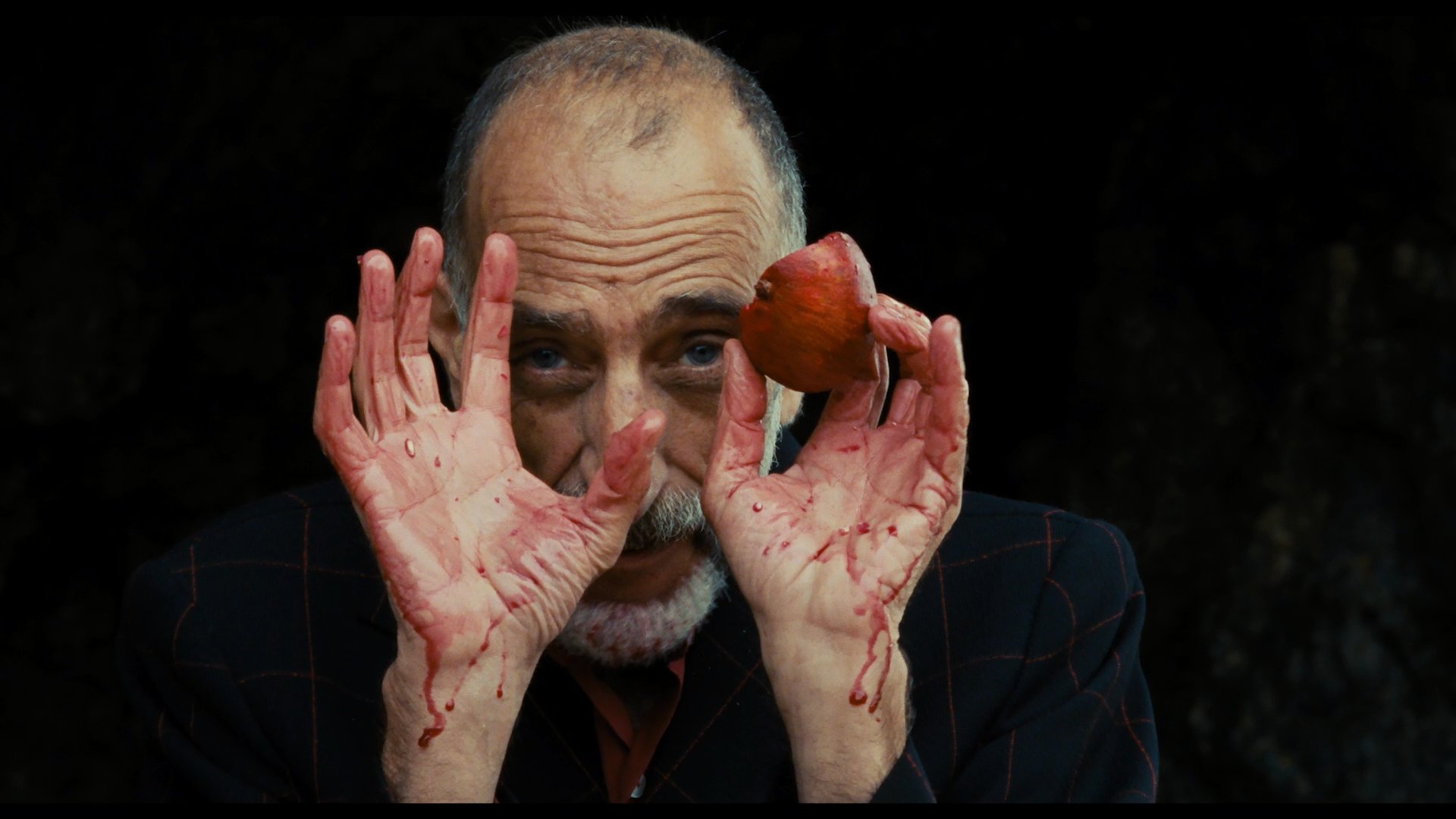
Recollections of the Yellow House would be João César Monteiro’s biggest success, winning the top prize in Venice. He stars, for the first time, as his heteronym, João de Deus, a middle-aged man who lives in a cheap boarding house in an old part of Lisbon. He’s an impoverished writer plagued by fleas. Trickster and imposter, João de Deus’ appetites will drive him through the city and a series of vignettes; from slurping bathwater to disguising himself in a fascist general’s uniform. Childlike and mischievous in his disposition, he’s equal parts Chaplin and Puck.
After shooting his film, À Flor do Mar (1986), along the coast of Algarve, Recollections of the Yellow House marks a return to Lisbon. The city is grey; the skyline barely visible amidst the buildings that seem to swell inward. There’s a dampness that lends the film a faint chill. The ardour and passion of the 1970s revolutionary footage shot by Monteiro seems stamped out completely; if living conditions have improved since April 25th, the horizon still seems crowded by invisible warships—strangling any possibility for renewal.

Recollections’s final act would feature the remnants of the 1988 warehouse fire in Lisbon, which consumed 18 buildings in the historic Chiado district, leaving 2 people dead, over 50 injured and 300 people homeless. The disaster would be compared to the devastating 1755 Earthquake which would leave the country in rubble, but is perhaps more representative of the ultimate failure of the revolution. The fire was a scandal that exposed the systematic failures of a society to protect its people and legacy.
After being expelled from his boarding house, João de Deus finds himself in the Hospital Miguel Bombarda, a psychiatric hospital in Lisbon. The building is strange, featuring a circular courtyard that’s part colosseum, part panopticon (perhaps though, it most resembles an ouroboros, with no beginning or end). Those familiar with Portuguese cinema might also recognize it as the location of António Reis’s pivotal 1974 documentary, Jaime, a movie that Monteiro admired. It’s impossible not to also see parallels between that film’s subject, Jaime Fernandes, a psychiatric patient who began drawing expressionistic artworks in his final days, and the overall undertaking of Monteiro’s body of work, which privileged not just the subversive power of outcasts but also the sanctity and liberating power of art.
João de Deus would return years later in God’s Comedy (1995). More uptight and outwardly respectable, João now owns an ice cream shop. The seams of his reputation hang by a thread, as he engages in increasingly perverse acts with his employees and other neighborhood girls. We see the continued intermixing of high culture, Beethoven and Schubert, with base instincts and Portuguese pimba music (a style of popular Portuguese music with lively beats and often featuring sexual innuendos). The film feels as though it’s at least partially inspired by this passage from Rabelais’s Gargantua and Pantagruel, where cream and the heavens seem to collide;
There will be sojourners come from the earth, who, longing after the taste of the sweet cream, of their own skimming off, from the best milk of all the dairy of the Galaxy, will set themselves at table down with us, drink of our nectar and ambrosia, and take to their own beds at night for wives and concubines our fairest goddesses, the only means whereby they can be deified.

Amidst its many European influences, the film remains extremely Portuguese. The passage from Rabelais rhymes with the lyrics of pimba musician Quim Barreiros, whose music plays at the ice cream factory, “Suck it Teresa/Suck it Teresa/What a delicious ice cream.” The film also features an homage to O Patios dos Cantigas, a 1940s Portuguese comedy. In that film, people of the neighborhood tease the local butcher. Here, not only does Monteiro repeat the joke, but further desecrates the dictatorship era popular comedy, by having João de Deus defile the butcher’s daughter. He makes her bathe in milk, then sit on a cornucopia of eggs (a reference to Bataille’s Story of the Eye), as she recites a poem from Luis de Camões, The Magic Venom. He will make his special “Paradise” ice cream with the milk and eggs flavoured with her body and fluids.
The film expands as a treatise on cinema itself. We see as Monteiro refuses commercialism, by creating a film that is unappealing to the masses; too long, too perverse, too still. The ice cream at the centre of the film becomes a metaphor, as they attempt to sell the company to the French (at the presentation of the wondrous cream, the French Minister named Antoine Doinel cannot be present, he’s too busy “visiting the most modern morgue in Europe.” The role, initially offered and refused by Jean-Pierre Léaud, is played instead by Jean Doucet). After João is disgraced and loses his shop, it is converted into a flashy “American Style” milkshake joint.
Monteiro refuses the easy nationalistic reading of his preference for non-commercial art in the face of American imperialism by utilizing subversive eroticism and perversion. Rather than indulge in the fascistic “Portugal First” mentality (in the present day, the country is covered in posters from the far-right Chega party in anticipation of the upcoming election), he imagines a world of art and poetry that refuses not just commercialism but also political appropriation. João may be a pedophile and a criminal, but he’s also a fiction; one that represents the liberated imagination.
In the French publication, Décadrages, we find a passage transcribed from an interview with Monteiro in 1997 with critic A. Mota Ribeiro, which showcases his continued pre-occupation with revolution. He says, “The society, which I try to exclude myself from, disgusts me… I am for a radical transformation of society by violent means. If it could be done without violence, all the better, but we have to move forward with the knowledge that violence might be necessary. There will be another revolution, but with a new model that will replace the one where other revolutions have failed. The capitalist system is nothing but agony, it’s a system in autophagy.”

In Monteiro’s final film of the João de Deus trilogy, As Bodas de Deus (1999), João de Deus is “gifted” a large sum of money by God. After saving a young girl from suicide by drowning, he becomes her patron and later a baron. He falls in love with a Princess (who he wins in a card game), and expectedly, loses it all, finding himself worse off than when he began.
Perhaps Monteiro’s most beautiful film, his preference for natural light has never been more sculptural, as characters stand in front of doorways and windows, framed by an outside world that always seems just within reach. The frames within frames—evoking distance—emphasize the meta-textuality of his work, but also their painterly influences. Despite his rebellious nature, Monteiro reaches for poetry in the image, taking pleasure in “the beauty of the moving wind in the trees”.
Aside from the mixture of high and low art, we have more precise invocations of the revolution; a character quotes Stalin, “the only good fascist is a dead fascist.” In the final act, soldiers uncover hidden tanks from the 25th of April, a meaningless act that ushers in no meaningful change within the movie. While at the Opera, the Soprano unveils her breasts to the crowd, saying “I bare my bosom to the bullets of the tyrants!” The Princess turns to João, “But aren’t we a free country?” He has no answer. Shortly thereafter, in another invocation of Bataille, he pulls an egg from under her dress.
As the film moves towards its ending, we return to familiar ground. João finds himself, once again, in the Hospital Miguel Bombarda. In a perversion of Bresson’s Pickpocket, he’s confronted with the young girl he once saved. He asks her for one of her pubic hairs after exposing her breasts to him. “The flesh is weak but the soul hovers freely over the sea.”
The film was not well received in Portugal. An anonymous writer sums up public sentiment well, “his film caused a lot of pain; it’s a waste of time and money in a poor country of poor people.” It’s hard to say if this statement contributed in part to the “blackening” of Snow White, his 2000 adaptation of a play by Robert Wasler, a retelling of the classic tale. The film featured a predominantly blank screen. Voices of the actors performing are heard on the soundtrack, and occasionally the camera turns on and upward, the blinding blue sky, a sharp contrast with what critic Luis Miguel Oliveira deemed the “sensual” darkness, “that caresses the viewer, that enraptures them.”

The possible reasons behind the blank screen vary: was it an argument with his producer, was a jacket forgotten in front of the lens or was he mad that his funding was cut in half by the government? The film was a scandal, with audiences echoing the anonymous reader who condemned As Bodas de Deus. It seemed decadent, if not criminal, to spend taxpayers’ money on a film that was mostly a black screen. The prickly filmmaker addressed the people on the public channel. What do you have to say to the Portuguese people? “The Portuguese audience can go fuck themselves.” His anger, performative and still playful, demonstrates the tension he embodied within Portuguese society. His filmmaking feels marked by love for Portugal and a despair that it could not be saved.
Despite writing that Portugal’s 1974 Revolution was “impossible,” Phil Mailer also saw hope in the impossible that was perhaps shared by Monteiro,
But men and women have always dreamed ‘impossible’ dreams. They have repeatedly sought to ‘storm heaven’ in the search for what they felt to be right. Again and again they have struggled for objectives difficult to attain, but which they sensed to embody their needs and desires. It is this capacity which makes of human beings the potential subjects of history, instead of its perpetual objects.
Long before he became João de Deus, before he became known as a rebel pervert and a satanic presence, Monteiro gave an interview on public TV. The interviewer asks him, how can he continue to make films with public money? Can he subside without the help of the Portuguese State? Cigarette in hand and with a laugh, he answers, “How is Portugal going to subside without me?”
Before the release of his final film, Vai e Vem, João César Monteiro, died of cancer on February 3rd, 2003 at the age of 64.
Justine Smith is a writer and festival programmer based in Montreal, QC. She is the screen editor at Cult MTL and has contributed writing to the BFI, Vinegar Syndrome and Little White Lies. Since 2020, she has programmed the Underground Section at the Fantasia International Film Festival.
If you enjoyed this article, please consider tipping the author on PayPal and/or supporting Ultra Dogme on Patreon so that we may continue publishing writing about film + music with love + care.
It just feels wrong to know foreigners are aware of what pimba is lmao
Jokes aside, I had no idea of César Monteiro was such an interesting figure. Here in Portugal nobody ever talks about national cinema, let alone Monteiro for how inaccessible many of our auteurs are (and probably by how uncompromising and anticapitalist some of their movies are). I really need to check him out.
Pimba music is a crime, but one that occasionally you have to indulge in, like shoplifting or light vandalism.
I hope you enjoy discovering his work 🙂