
by Vedant Srinivas
Cezanne did not think he had to choose between feeling and thought, as if he were deciding between chaos and order. He did not want to separate the stable things which we see and the shifting way in which they appear. He wanted to depict matter as it takes on form, the birth of order through spontaneous organization.
Cezanne’s Doubt, Maurice Merleau-Ponty
Whether or not the adage that words can rarely approximate the vivacity of the image holds true for cinema, it certainly seems true of Zhou Tao. Originally trained as a painter, Tao later turned to mixed media and video, and has, over the past decade or so, made some of the most remarkable moving image works of our time. There is something inherently slippery about his films—the ease with which they render the everyday strange. Hovering somewhere between representation and abstraction, Tao’s continually shifting works seem to demand a singular vocabulary: one oriented towards gesture, texture, intensity, and modes of attention.
Central to Zhou’s practice is what he calls the ‘zone with folds’: an organic coalescence of humans, machines, and environment, brought about through manipulations of focus, depth, scale, composition, and camera movement, elementary cinematic devices that in Zhou’s hands implode all classical notions of time, space, and visual realism. Whether in the industrial park of North of the Mountain (2019), the wastelands and hilltops of The Worldly Cave (2017), or the vast expanses of the Gobi Desert in The Periphery of the Base (2024)—a work that transfigures an unidentified megastructure into something approaching a fever dream—Zhou’s films present a topography in perpetual transformation, opening onto forms of perception rarely available to human experience.

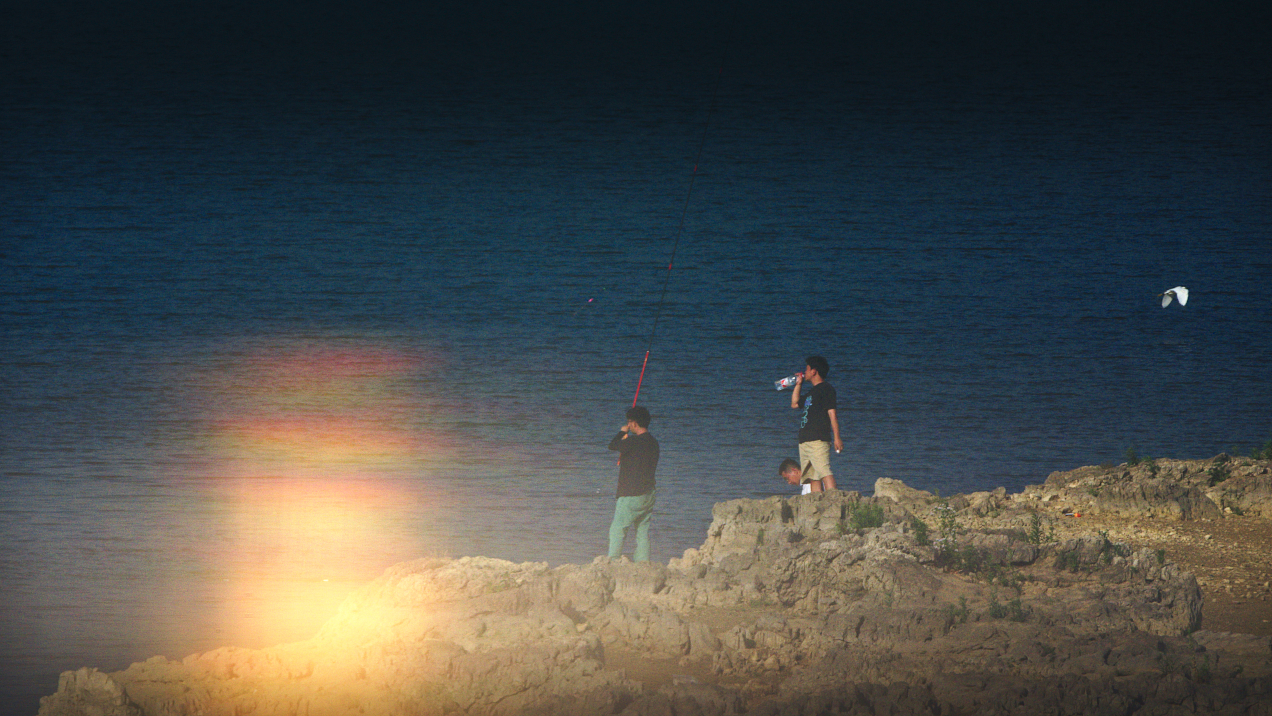
The Rib of the Greater Bay Area (2026), Zhou’s latest work, takes as its point of departure a series of tourist spots across the Guangdong–Hong Kong–Macau Greater Bay Area. Capturing locations that had gone viral on the Chinese app Xiaohongshu, the film moves along the Pearl River towards the famous Victoria Harbour, seamlessly bridging the rural and the urban. There is the eventful—a wedding photoshoot, a dazzling rainbow—but also the nondescript —people fishing, boats gliding, boys swimming, a stork stalking its prey—all chanced upon by the camera. At times the camera abandons humans altogether and, much like a Chinese shanshui painting, attends instead to water in its myriad manifestations: swirling waves and ripples in hues of blue, green, ink-black, and gold, with sunlight scattering across its surface.
There is something profoundly kinaesthetic about Rib: the camera is constantly panning, zooming, reframing, and refocusing, lingering on minute movements almost like improvised brushstrokes. Shot with a 600mm telephoto lens, Zhou’s images flatten and modulate the landscape into shifting masses of colour and texture. At the same time, objects in the foreground repeatedly drift in and out of view, filtering and obstructing the image, smearing translucent bokeh across the frame. For the technically versed, the transitions are easy enough to detect, but it is ultimately more rewarding to surrender to the film’s own visual logic, to let oneself be carried along by its peculiar magic.
In one of the film’s most remarkable passages, the camera patiently observes a group of boys playing in the water. Near the top edge of the frame, the faint reflection of a passing boat drifts into view. Then, with a sudden jolt, the camera swerves upward. The image passes through blocks of indeterminate colour stripped of depth—much like a Rothko painting—before arriving at what appears to be the sky. It grows progressively hazier, dissolving into shards of orange and blue, and finally gives way to an all-encompassing white. The camera continues its ascent until the image collapses into blurry darkness: representation pushed to the very edge of the medium, confronting the limits of digital realism.
It is difficult to overstate the effect of these mutating sequences. One is left with a sense of awe at what is unfolding, at a reality constantly shifting under our feet while maintaining its synesthetic essence. The camera is less interested in revealing than in obstructing, and yet it is through this very obstruction that another mode of perception emerges: one grounded not in fixed categories but in brute sensation.

Rib’s images occasionally recall the luminous landscapes of Peter Hutton and James Benning, but the artist whose spirit most palpably animates Zhou’s durational textures is the experimental filmmaker and video artist Leighton Pierce. In works such as Fifty Feet of String and Glass, Pierce transforms ordinary domestic moments into something utterly strange and transfixing, an impressionistic world where boundaries dissolve and spill over into one another. In both Zhou’s and Pierce’s work, there is an intuitive calibration between filmmaker, camera, and landscape, as though bodily rhythm had become coterminous with the device—the kino-eye—and with the undulating world before it. The resemblance extends even to their descriptions of artistic practice: Pierce speaks of ‘composing an experience for the audience’, while Zhou describes himself as a ‘collector of feelings’.
It is perhaps no coincidence that both Pierce and Zhou are repeatedly drawn to water, a fascination they share with the Lumière brothers, whose earliest films presented at the first ever public film screening in 1895—L’arroseur arrosé, La pêche aux poissons rouges, and Baignade en mer—already revealed a fascination with its shifting surfaces. What water shares with film, and even more so with video, is temporality and movement as its ontological principle: a medium in perpetual transformation, capable of continually expanding and reorienting vision.
In Zhou’s case, filming water—and everything around it—facilitates a radically open mode of perception, one that rejects the stability of figuration in favour of something more fluid and sensory: a liquid aesthetic. It is perhaps for this reason that the film’s shifting compositions never feel merely descriptive; they seem instead to inherit the liquidity of their subject.
There is also something quietly political about Zhou’s constantly shifting gaze, one that resists the fixity of things and places. Over the past few decades, the Greater Bay Area has become one of the defining landscapes of twenty-first-century Chinese modernity, repeatedly photographed, circulated, and consumed through the language of infrastructure and technological progress. Zhou’s camera continually slips away from these regimes of visibility. Instead, it redirects attention toward what they leave behind: the incidental, the peripheral, and the incorporeal—to those moments in which the world presents itself before settling into a standardised image.
Zhou’s soundscape reinforces this perceptual shift. While the film initially remains grounded in diegetic sound—boats passing, distant conversations, bursts of music, the crash of water—it gradually assumes a more enigmatic register. Voices and waves become intertwined with spectral hums and vibrations, the ambient frequencies of a smart city merging with the natural soundscape. Like the image, sound no longer anchors the viewer within a stable geography but continually unsettles orientation, making the familiar environment appear strangely porous.

In the end, like most great moving image works, The Rib of the Greater Bay Area is less concerned with making an argument than with cultivating a particular quality of attention. The world Zhou evokes is undeniably mediated by technology and capital, yet it remains filled with pockets of wonder and opacity that elude their organising logic. Rather than asking us to recognise the world, Zhou repeatedly asks us to encounter it anew.
Writing on Kiarostami’s cinema, the French philosopher Jean-Luc Nancy offers what might equally be described as a metaphysics of the moving image: ‘But this does not mean a cinema treating of metaphysical themes; it means cinematic metaphysics, cinema as the place of meditation, as its body and its realm, as the taking-place of a relation to the sense of the world.’1
Something of this order seems to be at stake in Zhou’s practice. At a time when perception is increasingly organised by algorithmic images, and our capacity to surrender to an aesthetic impression is steadily eroding, Zhou’s work proposes another possibility: the moving image as the site where the inside meets the outside, and where the viewer meets the resplendence of the world.
NOTES
1. The Evidence of Film, Jean-Luc Nancy
Vedant Srinivas is a curator, writer, and film programmer from India. His writing has appeared in MUBI Notebook, Senses of Cinema, Cineaste, Documentary Magazine, Variety, Desistfilm, and Photogénie, among other publications.
If you enjoyed this article, please consider tipping the author and/or supporting Ultra Dogme on Patreon, Ko-fi, or Substack, so that we may continue publishing writing about film + music with love + care.