
by Autumn Johnson
Monica Sorelle’s 2023 film Mountains is set in the “Magic City” known as Miami, Florida. Often represented on the big screen in action-packed and euphoric adventures filled with drugs, guns, and sex, audiences may associate Miami with films such as Scarface (1983), Bad Boys (1995), Miami Vice (2006). Instead of high-octane hijinks, Sorelle’s debut feature focuses on the illusion of social mobility in the Magic City, through the journey of a Haitian-immigrant family living in the neighborhood of Little Haiti. The result is not only a refreshing representation of Miami culture but also a timely depiction of the issues of capitalism for the aspiring yet struggling percentage of the United States’ population who often find themselves working against, rather than for, themselves.
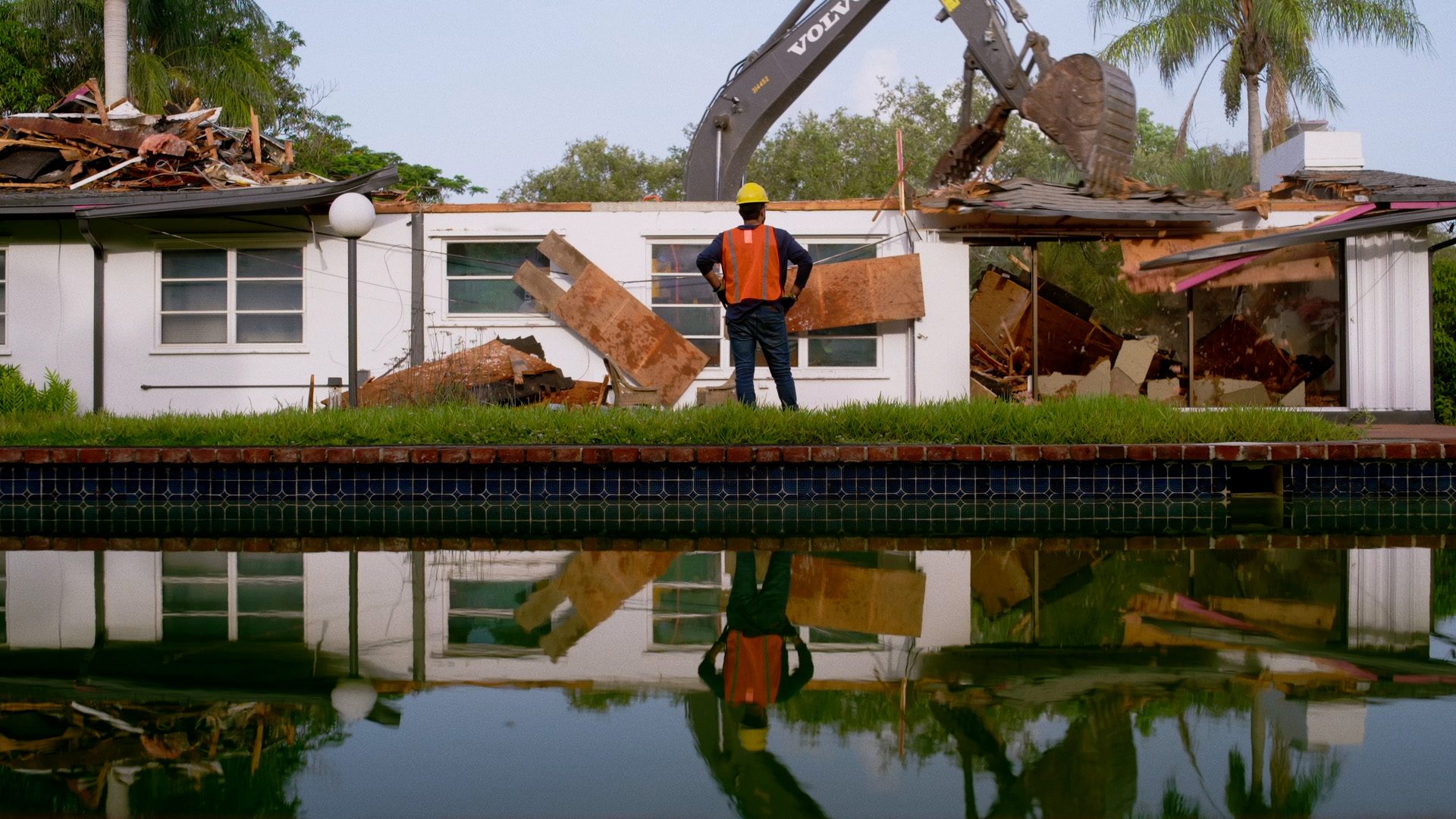
The juxtaposition of occupation and aspiration is explored through the story’s focal point, Xavier (Atibon Nazaire), a demolition crew member, alongside his wife Esperance (Sheila Anozier), an independent seamstress and dressmaker, and their 20-something-year-old son, Junior (Chris Renois), a valet driver and aspiring stand-up comedian. Each character, with their specific relationships and interactions, add a unique perspective to the pursuit of social mobility. Sorelle stacks undeniable layers of truth and observation about the individual and the communal experience of the current American socio-economic climate through the carefully crafted characterisation and intimate scenes of dialogue. Every scene seems to include a line that emulates a preacher’s best sermon, paralleling the Haitian proverb featured at the film’s start: “Behind Mountains, are Mountains.” Exposing the often muttered truths about living in a capitalist society, the viewer is left to reflect on our feat-filled, mountain-climbing culture where resilience and struggle are championed and seen as the cause for celebration and the only conceivable means of “success”. However, Sorelle’s debut feature critiques the common narrative by considering what is sacrificed in pursuit of climbing the mountain.

“When you put your mind to something, you don’t look up until it’s done. But my love, you have to see what’s happening outside.” —Esperance
Xavier’s mountain is his pursuit of a better life. He works overtime, saves money, and dreams of a bigger home for himself and his family. However, where many films visually overcompensate to show the urgency and need for more space, Sorelle does the opposite. Xavier and his family seem to be ‘just right.’ There is no excessive need or greed. They have a place to sleep, food to eat, cars to drive, and in the case of Esperance and Junior, space and time to engage in their hobbies. With this depiction, it is established that perhaps what Xavier wants is not necessarily what he needs.
Xavier claims the family needs more space while Esperance points out that they have enough space. He claims his son Junior needs to do more with his life, while Junior points out that he loves what he does. Xavier is the only one in his family in a constant state of dissatisfaction and despite even his own friend’s weariness about his job, he is convinced it can never harm him. When the demolition company inches closer and closer to Little Haiti, Xavier selfishly twists the reality of the situation to be a good thing, proclaiming, “This week isn’t so bad because I’ve been so close to home.” His reluctance to see outside of himself is further emphasized when he states how far he’s willing to go in pursuit of reaching his own goals. He proclaims he would demolish a friend’s house if he were told to. To Xavier, these churches, homes, and local businesses are simply addresses, of course, until the location is all too familiar.

“You don’t own anything in this country.” —Esperance
In America, we live on stolen land, which is unfortunately destined to be stolen again so long as such structural inequalities remain. Yet, for Xavier and many others, the idea of ownership represents a tangible sign of success.
Early foreshadowing occurs at the appearance of Esperance’s brother Jimmy (Macc Plaise), who joins the family for dinner one evening. He is a car salesman who drives a Mercedes and is constantly making new additions and improvements to his home. He self-proclaims, “I’m not the type of person that’s ever satisfied,” and it becomes evident (in a matter of 3 minutes) that for him, like many, ownership is not only a goal, but a bragging right. In a climactic moment of tension, Jimmy crows to Junior, “You don’t have to park the cars when you own them.” Junior, less attached to the ideas of wealth, claps back, “or you could let me hold yours,” placing an emphasis on shared resources and wealth.
Throughout the film, Sorelle seems to visually beg us to question why we must own everything. The houses in Little Haiti are all bought up by the same realty company, while in other scenes we see evidence of homelessness, mobile business fronts operating out of vans, and constant displacement. Between these scenes, we explore the inside of homes, including the first residence which Xavier is set to put a vacancy notice upon. The home doesn’t appear to be in a state of disrepair, but rather displays minor damage and remnants from the past tenant—emphasizing that not too long ago, this was someone’s home. The same scene is recreated when Xavier is forced to put the same notice on the door of the house he had dreamed of calling home only weeks before.

“In this life, you always have to sacrifice something for something else.” —Xavier
In a transparent and heartfelt moment between father and son, we finally see Xavier begin to find clarity as he sheds the heavy burden of his ‘dreams’ and admits that what he thought was behind the “mountains” has not been as beautiful as he imagined.
If we must sacrifice in this life, why not sacrifice for each other? If we have the choice of community, why should we reject it? There are multiple instances of kind acts that in some way represent this selfless act of giving: the food truck owner is willing to share his hot sauce with Xavier, Junior’s cousin is willing to attend, record, and give feedback on his comedy sets, and Esperance is willing to volunteer her time to ensure school children make it across the street safely. Even Xavier shows that he is capable of putting himself out there for others when he argues that Danial deserves to work a full amount of hours on the demolition site. In one of the film’s most beautiful scenes, the family attends a communion party where everyone in the community prepares a dish. As simple and common of an act as this may be, it purposefully showcases the importance of community beyond a friendly face. By the end of Mountains, Xavier takes a moment to fully realize this mountain he has been chasing is no longer something he wants to be a part of. While the demolition continues, Xavier loomingly watches from the street. It is not clear what will happen to Xavier after this moment, but when the community of Little Haiti visually sweeps him into their song and dance as they march down the street, it feels like all will be okay. As the credits roll, the birds chirp, the wind chimes clink, and the voices of the neighborhood sing in Haitian-Creole. It is simple compared to the roaring demolition of homes featured at the start, but it is the first time we collectively feel content with simply viewing the mountain from afar.
Autumn Johnson is a cultural worker who is passionate about supporting and sustaining local art and film communities. She has guest curated the film series, “Through the Lens of Black Women” at the Museum of Fine Arts, Houston and is currently pursuing a Masters of Arts in Museum Studies at New York University.
If you enjoyed this article, please consider supporting Ultra Dogme on Patreon or Ko-fi, so that we may continue publishing writing about film + music with love + care.